Showing posts with label book reviews. Show all posts

Thursday, December 26, 2019

2019 Media Year in Review

In 2018, I read 30 books and decided to make it a priority to read at least 50 books in 2019 - and I'm proud to say I surpassed that goal, reading 60 books! - though admittedly some of those were re-reads of old favorites. Here were some of my new favorites, read for the first time in 2019:

Non-fiction:

  • 21 Lessons for the 21st Century by Yuval Noah Harari
  • Act Natural: A Cultural History of the Misadventures of Parenting by Jennifer Traig
  • Everything Happens For a Reason - And Other Lies I’ve Loved by Kate Bowler
  • Becoming by Michelle Obama
  • Daring Greatly: How the Courage to Be Vulnerable Transforms the Way We Live, Love, Parent, and Lead by Brene Brown
  • Expecting Better: Why the Conventional Pregnancy Wisdom is Wrong - And What You Really Need to Know by Emily Oster
  • Everything Below the Waist: Why Health Care Needs a Feminist Revolution by Jennifer Block
  • Good Talk: A Memoir in Conversations by Mira Jacobs


    Fiction:
    • The Kiss Quotient by Helen Hoang
    • Juliet Takes a Breath by Gabby Rivera
    • Circe by Madeline Miller
    • The Seven Husbands of Evelyn Hugo by Taylor Jenkins Reid
    • When Elephants Fly by Nancy Richardson Fischer
    • Normal People by Sally Rooney
    • Red, White, and Royal Blue by Casey McQuiston
    • The Girls at 17 Swann Street by Yara Zghei
    • Hot Dog Girl by Jennifer Dugan
    • Magic for Liars by Sarah Gailey


    I also saw 10 theater productions (in Detroit, Flint, and local community theaters), 35 new movies (in theaters, borrowed from the library, or on Netflix), and 15 TV series (on various streaming services) over the course of 2019, also totaling 60. Here were some of my favorites in those categories:

    Theater productions:

    • A Midsummer Night’s Dream @ the Capitol in Flint (2/15)
    • The Play that Goes Wrong @ the Fisher Theater (2/17)
    • Hamilton @ the Fisher Theater (3/17)
    • Waitress @ the Fisher Theater (5/12)
    • Anastasia @ the Fisher Theater (6/16)

    Movies:

    • Mary Poppins Returns
    • Crazy Rich Asians
    • Captain Marvel
    • Spiderman into the Spider-verse
    • Avengers: End Game
    • Wine Country
    • Toy Story 4
    • Booksmart
    • Always Be My Maybe
    • Rocketman
    • Yesterday
    • Harriet
    • Frozen 2

    TV shows:

    • Derry Girls
    • Russian Doll
    • Pen15
    • Schitt’s Creek
    • The Great British Bake-Off
    • The Good Place
    • Bojack Horseman

    (Not enough recommendations for you? If you want to read my 2018 favorites, you can visit this post.)

    Wednesday, December 26, 2018

    2018 Reading & Theater Year in Review

    I didn't read as many books in 2018 as I have in some more prolific years, but I did read 30 books over the course of the last twelve months, including several that I immensely enjoyed and learned from. My favorite reads in 2018 included non-fiction, fantasy, graphic novels, YA, and bestselling literature:

    • Strange the Dreamer and Muse of Nightmares by Laini Taylor
    • An Absolutely Remarkable Thing by Hank Green
    • Like a Mother: A Feminist Journey Through the Science and Culture of Pregnancy by Angela Garbes
    • Educated by Tara Westover
    • Lincoln in the Bardo by George Saunders
    • Nimona by Noelle Stevenson
    • The Facts of Life by Paula Knight
    • The Unit by Ninni Holmqvist
    • Doing Harm: The Truth About How Bad Medicine and Lazy Science Leave Women Dismissed, Misdiagnosed, and Sick by Maya Dusenbery
    • Starglass by Phoebe North
    • If I Was Your Girl by Meredith Russo

    As usual, my to-read list on Goodreads (which is currently at over 1000 books) is far too long for the amount of time I have to actually read (especially given that more new books are coming out all the time) - but I'm going to try to prioritize reading more in 2019 again and see if I can read at least 50 books next year.

    This year I was also fortunate enough to have the opportunity to go to twelve theater productions! Four of them (if an Upright Citizens Brigade improv show counts) were seen during my trip to New York City with my husband in late March/early April, including two off-Broadway shows (Puffs, a Harry Potter parody; and the musical Avenue Q) and Lobby Hero on Broadway. Another four were put on by our local community theater, Avon Players in Rochester Hills: Boeing Boeing, Dial M for Murder, and the musicals Brides of Madison County and the Hunchback of Notre Dame.  Three more were part of "Broadway in Detroit": Something Rotten at the Fisher Theater, and Wicked and Aladdin at the Detroit Opera House. And the final show we saw in 2018 was the musical Cabaret at the Whiting in Flint, MI.

    We always try to make an effort to see as many theater productions as our schedules (and bank accounts) will allow - because my husband and I both love to see live shows and to support local theaters - but this year was definitely our record so far. (In fact, we actually had tickets to see thirteen shows, but ultimately decided not to see our local community theater's production of Steel Magnolias in September, as it was only a week after my D&C for my miscarriage, and we didn't feel particularly up for what we knew would be a very emotional drama.) 2019 is shaping up to be another exciting (and potentially record-breaking) year for theater for us - we already have tickets purchased for nine shows, all in the first half of 2019, including the rest of our "Broadway in Detroit" season tickets and Avon Players season tickets. I've also been toying around with the idea of taking a long weekend to Stratford, Ontario to see a few plays (since it's already been 13 years since I've last been!!). Whether or not we take a Stratford trip or decide to see any plays in July-Dec 2019 will likely depend on how quickly we're able to get pregnant again, and when my due date ends up being - but it's certainly possible that we'll break our record of twelve shows throughout the course of 2019!

    Saturday, September 23, 2017

    Creativity and Mental Health

    On a related topic to my current "Ability Bouquet" drawing (which includes differences in physical, emotional, and mental ability) is the correlation between creative people (painters, sculptors, musicians, performers, composers, fiction writers, poets) and mental health issues. As Lord Byron remarked about himself and his fellow poets, "We of the craft are all crazy. Some affected by gaiety, others by melancholy, but all are more or less touched."

    This is a correlation that I've always found rather interesting - both on a personal note (as someone working in creative professions and with mental health issues running in her family) and on a broader scale - and is therefore a topic I've thought a lot about over the years. I even wrote a paper on this topic for an Art History class in college, listing famous 19th & 20th century artists who suffered (or probably suffered) from mental illnesses including depression, bipolar disorder, schizophrenia, personality disorders, and substance abuse problems.

    There are a lot of similar lists out there, linking famous (dead) people to probable mental disorders. For example, Kay Redfield Jamison's book, Touched with Fire: Manic-Depressive Illness and the Artistic Temperament - a fantastic book, by the way, and well worth the read if this is a subject you're interested in - includes in Appendix B a list of writers, artists and composers with probable cyclothymia (a form of mild bipolar), major depression, or manic-depressive illness. The famous names include writers F. Scott Fitzgerald, Ernest Hemingway, William Blake, Edgar Allen Poe, Victor Hugo, Emily Dickinson, John Keats, Edna St. Vincent Millay, Sylvia Plath, Walt Whitman, Joseph Conrad, Ralph Waldo Emerson, William Faulkner, Mary Shelley, and Virginia Woolf; musicians Peter Tchaikovsky, Robert Schumann, and Irving Berlin; and artists Paul Gauguin, Vincent Van Gogh, Michelangelo, Edvard Munch, Georgia O'Keeffe, Jackson Pollock and Mark Rothko.

    I find understanding people's psychology really fascinating, and it can be a fun (though not necessarily truthful) exercise to speculate on the inner turmoil of historical figures. I also find it interesting (and problematic) how eager our society is to latch onto this creativity-mental health correlation, to the point where we have this prevailing archetype of the crazy, boozy, moody, unstable artist. By putting so much weight on this correlation, we end up stereotyping, exaggerating, and misunderstanding it, to the detriment of living artists and contemporary sufferers of mental health issues. I want to clear up some of these misconceptions in this blog post.

    First of all, it is important to remember that correlation does not imply causation. Having a mental illness does not make someone an artist - nor does being an artist necessarily give someone a mental illness.

    It is possible that certain mental illnesses (especially mood disorders or substance abuse problems that include addiction to mood/mind altering substances) might inspire creative ideas or ideas with emotional resonance. But having thoughts or feelings and being able to turn those thoughts and feelings into a moving piece of art, music, theater, or writing is not the same thing. Thinking or feeling something does not always (nor often) translate into being able to work as a functioning artist.

    For that matter, not everyone struggling with mental disorders wants to be an artist, and saying that there is or should be "a creative upside" to a manic episode, to seeing hallucinations, to overcoming pain, or to using mind-altering substances is a dangerous suggestion. It alienates or shames those who don't get anything "productive" out of these things, making them believe that they aren't processing or dealing with their emotional or mental health problems in an acceptable, affirming way.

    It is also possible that trying to work as a professional artist - with the erratic hours, variable paycheck, and exposure to potentially dangerous art supplies (lead paints, fumes, aerosol sprays, sharp carving tools, exacto knives, etc) - might trigger or exacerbate an episode of a mental disorder in some people. But this type of work environment does not affect everyone in the same way, and usually when it comes to mental illnesses, nature and nurture work concurrently. Someone's environment alone won't cause mental illness - they also often have to have a genetic predisposition that makes mental health issues more likely to cause them problems.

    What's more likely, then, is that instead of it being one OR the other, it's one AND the other. They each feed off each other in people who are both artistic and deal with mental health issues: their chosen profession will sometimes impact their mental health and their mental health with sometimes impact their professional life.

    In addition, other outside factors might cause, inspire, or impact both. Maybe thinking creatively is a personality trait that both makes someone more likely to consider a career in the arts and to suffer from mental health issue; maybe genetic strengths in senses like vision, hearing, or touch (or in the parts of the brain that regulate those functions) make someone more likely to develop talents in visual, auditory, or tactile fields which are also creative, as well as making them predisposed to certain mental illnesses.

    It has also been suggested that it is not actually true that more writers and artists suffer mental illness compared to the general population - just that they are perhaps more sensitive to their own mood states, and therefore more able or willing to articulate and report on them.

    Science is still searching for the answers to these questions - and may never find them. Rarely is there just one cause; usually it is a whole plethora of possibilities, all working together - and yet also all working differently in each person.

    The second important point I want to make is this: just because some artists suffer from very serious mental illnesses doesn't mean that all artists do - or should. It doesn't mean that a healthy, functional, well-adjusted artist is "less of an artist" for not struggling with inner demons. It also doesn't mean that mental illness makes someone a better artist.

    In fact, the opposite is often true. Though periods of depression or mania might seem to give someone deep access to human emotions or spark artistic inspiration, an artist suffering from those mood disorders is often unable to actually function as an artist (that is, produce creatively) during those periods. It is only after they have somewhat recovered that they will have the motivation, focus, and ability to produce quality work or follow through on their projects to completion.

    And yet we have this prevailing stereotype of the emotional artist, which romanticizes damaging and dysfunctional behaviors as something vital and required for anyone wishing to create serious art. As Jamison writes, "The assumption that within artistic circles madness, melancholy and suicide are somehow normal is prevalent, making it difficult at times to ferret out truth from expectation."

    When people believe that their mental disorders are an integral part of who they are - the part that makes them special, gives them creative inspiration, or improves their work - they sometimes purposefully suffer them, even when other options are available. They might refuse treatment, deny medications, or choose to self-medicate instead (with harmful substances like alcohol or drugs), all in the spirit of retaining the core of their personality, being "true" to who they are, or tapping into a mythical artistic well of deep emotions/real creative inspiration.

    Like any job, there will be times when it's easier or harder, when ideas come faster or slower, and when it seems like you've been waiting years for inspiration or recognition. But artists, writers, musicians, and performers are also sometimes expected to put themselves in dangerous positions or situations that others wouldn't, just for the sake of the story; suffer mental illnesses that others would not put up with, in an effort to carry the emotional weight of the world and see/understand universal truths about the human condition; or even purposefully self-harm with destructive behaviors in a misguided attempt to "become a true artist" - all expectations that are grossly unjust for anyone to endure. When it's such a prevelent idea in society, it's hard to shake - but the truth is, artists do not have to suffer for their art, and I resent the implication that they do.

    Mental disorders are serious things. I personally know several people (most of whom are NOT artist-types) who suffer from depression, anxiety, OCD, bipolar disorder, and others; I see how it impacts their lives. It's not something to joke about, minimize, ignore, stigmatize, or fetishize. Suffering isn't romantic. It doesn't automatically make people stronger or more creative, and it doesn't open imaginative doors to them that would otherwise remain closed. People can find inspiration in a lot of places - their suffering included - but no one has to suffer to find inspiration. There are always other ways.

    Sunday, January 1, 2017

    Books Read in 2016

    I did not read nearly as many books in 2016 as I did in 2015. But I did read some! Here are my favorite reads from the last year:
    • A Little Life by Hanya Yanagihara
    This was difficult to read because the subject matter was truly heartbreaking. The main character, Jude, has emerged into adulthood (somehow), despite a litany of horrible childhood abuses of every type you can imagine (and trigger warning! - many of which are described in detail). Even though the traumas of his past are actively over, the physical, emotional, sexual, spiritual pain remains, impacting his ability to forge strong, healthy relationships with anyone - including himself. 
    • The Sun Is Also a Star by Nicola Yoon (5 stars)
    This was a really cute YA novel. Jamaican-American immigrant Natasha meets-cute with Korean-American Daniel on the worst day of her life (the day her family is about to be deported). Adorableness and heartfelt conversations ensue.
    • Sex Object by Jessica Valenti (4 stars)
    Remember that blog post I wrote about grieving losses? That's what this book feels like. It doesn't necessarily have a coherent thesis or any concrete advice (and the introduction brings up this fact, so Jessica Valenti is well aware of it), but it was an interesting look into someone's life - especially the unwelcome, seedier parts of it, the mistakes, failures, and sources of shame and embarrassment (whether rightfully earned or not) that we often try to sweep under the rug. It's a memoir of growing up female in New York City, and its rife with examples of everyday sexism. Not always an easy thing to read, but I felt like it was an important read. Sometimes all we can do is offer to be a witness, you know? History needs witnesses.
    • The Flight of the Silvers by Daniel Price (4 stars)
    There were a few problematic things about this book - mainly that the characters were sort of one-dimensional/stereotypes, especially the women. But the plot was intriguing and solid enough to mostly make up for the mediocre handling of the characters.
    • Moloka'i by Alan Brennert (3 stars)
    This was an interesting historical novel about a leper colony in Hawaii at the turn of the (last) century. It covers a lot of important topics and was decent storytelling - but I did at times feel like it could be more. I think it was just the way it was written that I found lacking a little. It felt like literary subject matter but wasn't written in a literary sort of way - not necessarily a bad thing, but it didn't quite seem like a perfect fit for me.
    • How to Be Secular: A Call to Arms for Religious Freedom by Jacques Berlinerblau (4 stars)
    This was a great introduction to the role religion plays in politics (to the detriment of both). It outlined history I wasn't aware of and was eager to learn. My husband read this book first, and loved it so much he decided to buy it. Then I finally got around to reading it this year; I read it while on vacation, lounging on the beach, underlining nearly every paragraph in pencil.
    • Miss Peregrine's Home For Peculiar Children by Ransom Riggs (4 stars)
    The first book in the series (I read all three this year) was the best. My main complaint with the sequels was the way the female characters were treated - any empowering that happened in book one was minimized or completely taken away from them in books two and three. But that wasn't the only issue - I also found the plot less appealing in general. The first book however, was highly enjoyable. I loved the extended metaphor between the shadows and the WWII Nazis; the idea that children and other innocents could be targeted for a number of reasons (Jewish heritage, "peculiarities") and that such persecution could not and should not be tolerated.
    • Uprooted by Naomi Novik (5 stars)
    This book was recommended to me by a friend. (More than recommended actually - she bought me my own copy and shipped it to my house as a gift. I had to read it after that!) It twists the fairy tale genre by challenging stereotypical gender roles, and offers a nuanced, well-written, relatable female lead who I loved.
    • When Breath Becomes Air by Paul Kalanithi (4 stars)
    This was a heartfelt memoir written by a neurosurgeon dying of lung cancer. If he had lived to see it finished, it would have been a better book - but his time was limited, and he got an impressive book written in the little time he did have.
    • The Muralist by B.A. Shapiro (5 stars)
    I'm a sucker for books about artists - especially historical artists written by authors who did detailed research into the time period. But this is more than just a strong book about an artist (and the Abstract Expressionist movement in New York City) - it's also an important book for the current political climate. It's all too easy to draw parallels between American attitudes toward Jewish refugees in the pre-World War II era and American attitudes toward refugees today.
    • All of David Mitchell's books 
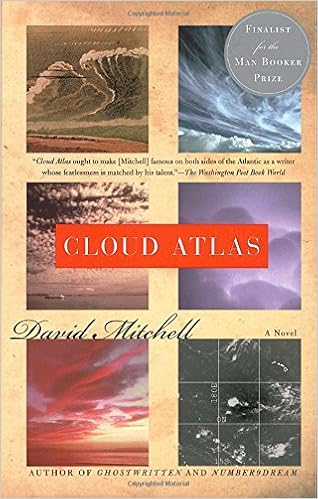
    I also read all of David Mitchell's books this year (or re-read in the case of Cloud Atlas, The Bone Clocks, and Number9Dream, which I had read previously). I already talked at length about my opinions on these books in this blog post - so I won't bore you again. :)

    --

    Here's to another year filled with good books! Bring on 2017. :)

    Friday, July 22, 2016

    The Books of David Mitchell

    Last month, I posted a series of my favorite quotes from David Mitchell's novel Cloud Atlas, connecting his words to my recent set of six acrylic paintings. In that post, I mentioned that I was in the process of reading through all his novels in chronological order by publication date, and that I would write another post when I was finished, compiling some of my favorite ideas and quotes from his oeuvre. Today is that post.

    After months of reading and rereading (many of his books I had read before, but not all of them), I finally finished Slade House a few weeks ago. And now I'm finally getting around to reflecting on his "David Mitchell universe" as a whole.

    My favorite Mitchell book is, obviously, Cloud Atlas. Not only do I find his characters in that book particularly compelling/relatable; I also prefer the explanation given in that book for how souls can connect throughout time. This connection is mystical/spiritual in nature, not overt, and rather inexplicable. It creeps up in moments of deja vu, or in the process of living a creative life. Some characters feel connected to each other intuitively, or even seem to remember things that didn't happen to them - things that might have happened in a past life, but not in the one they are living. Some recognize these moments of deja vu and interpret them as reincarnation - not "proof" of its existence, per se, but enough to warrant contemplation of the possibility. Still other characters do not explicitly feel like they are a reincarnation; they have no specific memories. And yet, they too are connected to other characters, even though they may never realize it. They read their diaries, listen to their compositions, read their manuscripts, watch their movies, or learn of them in history books, revering what they do not understand and worshipping them as gods.

    I don't know if "souls" are truly reincarnated or not, and in any case there is hardly a way to prove definitively either way. But humans are able to feel inexplicable kinship with one another, and we do pass down bits of ourselves (our feelings, our experiences, our ideas) in creative works we produce and the legacy we leave behind. (Of course I want to believe that is true. I am an artist and a writer; I make things in the hopes that the things I make will connect with people, both now and in the future. I want to leave a "mark" on the world that will outlive my mortal body.)

    And it is precisely this idea of intuitive connection and passing down creative works to future generations that Cloud Atlas embodies so well - which is why I love it so much. It feels real. It is something that I could buy happening to our world.

    In contrast, Mitchell's other books that deal with the idea of a soul take a more "science fiction" approach (The Thousand Autumns of Jacob de Zoet, Bone Clocks, and Slade House). Without giving too much away, these books create a world in which (some) people are perfectly aware of their souls and the souls living in other people, and steps are made to try to ensure immortality by using this soul-knowledge to their advantage. There is a behind the scenes "war" in which people nurture themselves at the expense of others, and others do their damnedest to stop them.

    It's an exciting story, to be sure - and certainly seems to be the way Mitchell is going for future books, given that his last three books all deal, at least partly, with this idea. But it is decidedly different than the more believable, more relatable, more mystical, and - I think - more fascinating way that souls and people interact in Cloud Atlas.

    That said, there is something to be gotten out of each of his books - even the ones that don't seem to touch on the idea of a soul/reincarnation. Here are some of my favorite quotes from each of his books:

    [WARNING: MILD SPOILERS AHEAD.]

    ---

    Ghostwritten (1999)

    "We abdicate certain freedoms, and in return we get civilization."

    "All these people, flyovers, cars, walkways, subways, offices, tower blocks, power cables, pipes, apartments, it all adds up to a lot of weight. You have to do something to stop yourself caving in, or you just become a piece of flotsam or an ant in a tunnel...You have to make your place inside your head."

    "It's better to fight and lose than not fight and suffer, because even if you fight and lose your spirit emerges intact."

    "The her that lived in her looked out through her eyes, through my eyes, and at the me that lives in me."

    "For a moment I had an odd sensation of being in a story that someone was writing."

    "I wonder if computers ever dream of humans."

    "She didn't come in the dramatic way they do in movies. Nothing was hurled across the room, no ghosts in the machine, no silly messages typed on my computer or spelled out with fridge magnet letters. Nothing like Poltergeist or The Exorcist. More like a medical condition, that, while terminal, grows in such small increments that it is impossible to diagnose until too late."

    "I'm sorry, but I don't have any spare time to give you."

    "I'm this person, I'm this person, I'm that person, I'm that person too."

    "Now that I'm dying again I recognize the signs."

    "The Holy Mountain didn't care about the stupid world of men."

    "'The world's gone mad,' I said. 'Again.' 'And it will right itself,' said my Tree. 'Again.'"

    "Kindness always make me weep. I don't know why."

    "I added 'writers' to my list of people not to trust. They make everything up."

    "With the intuition of an old dying woman, I know she isn't telling the whole truth. With the certainty of an old dying woman, I know it's not the truth that much matters."

    "It is so much easier to destroy than it is to re-create."

    "I have only one fear: to be inhabiting a human at the moment of death."

    "There's no future in stories...Stories are things of the past, things for museums."

    "I am my mind - do I have a mind I don't know about within my mind, like humans?...How do I know that there aren't noncorpa living within me, controlling my actions? Like a virus within a bacteria? Surely I would know. But that's exactly what humans think."

    "Everything is about wanting."

    "It's a very special talent that men have, to possess seeing eyes yet be so blind."

    "But what if the rats happened to like being in the maze?"

    "Does chance or fate control our lives? Well, the answer is as relative as time. If you're in your life, chance. Viewed from the outside, like a book you're reading, it's fate all the way."

    "The act of memory is an act of ghostwriting."

    "We're all ghostwriters, my boy. And it's not just our memories. Our actions, too. We all think we're in control of our own lives, but really they're pre-ghostwritten by forces around us."

    "Anyone can predict effects from a given cause."

    "Memories are their own descendants masquerading as the ancestors of the present."

    "Even time is not immune to time."

    "In five hundred years we are going to be either extinct, or...something better."

    "The human world is made of stories, not people. The people the stories use to tell themselves are not to be blamed."

    "Disbelieving the reality under your feet gives you a license to print your own."

    "History is made of arbitrary choices."

    "Information is control."

    "Will my soul find a path out of these tunnels?"

    ---

    Number9Dream (2003)

    "A book you finish reading is not the same book it was before you read it."

    "Dreams are shores where the ocean of spirit meets the land of matter. Dreams are beaches where the yet-to-be, the once-were, the will-never-be may walk awhile with the still are."

    "Maybe the meaning of life lies in looking for it."

    "Your turn has come to sift through the dreck of humanity for rare specks of originality."

    "Human beings despise what is beautiful and good, and seek to destroy the things they need the most."

    "The body is the outermost layer of the mind."

    "I forget that other people in the world have broken parts, too."

    "During those nine pouched-up months, what do babies imagine? Gills, swamps, battlefields? To people in wombs, what is imagined and what is real must be one and the same."

    "People prefer loneliness to harmony."

    ---

    Cloud Atlas (2004)

    (For quotes from Cloud Atlas see my previous post.)

    ---

    Black Swan Green (2006)

    "Adults can't be expected to understand."

    "Games and sports're really about humiliating your enemies."

    "It's not that I'll die that bothers me. It's that I'll be the last one."

    "Dead things show you what you'll be too one day."

    "Mentioning my stammer makes it realler."

    "Try to will it out of existence, it'll just will itself back stronger."

    "Identify a demand, handle its supply, make your customers grateful, kill off the opposition."

    "Human beings needs to watch out for reasonless niceness too. It's never reasonless and its reason's not usually nice."

    "The earth's a door, if you press your ear against it."

    "War's an auction where whoever can pay the most in damage and still be standing wins."

    "How can the world just go on, as if none of this is happening?"

    "War may be an auction for countries. For soldiers it's a lottery."

    "Wars do not simply appear from nowhere. Wars come, over a long period of time, and believe me, there is always plenty of blame to be shared out between all those who failed to prevents its bloody arrival."

    "I want to bloody kick this moronic bloody world in the bloody teeth over and over till it bloody understands that not hurting people is ten bloody thousand times more bloody important than being right."

    "Prettiness often papers over nastiness."

    "Often I think boys don't become men. Boys just get papier-mached inside a man's mask. Sometimes you can tell the boy is still in there."

    "Isn't no god better than one who does that to people?"

    "The world unmakes stuff faster than people can make it."

    "If you show someone something you've written, you give them a sharpened stake, lie down in your coffin, and say, 'When you're ready.'"

    "Beauty is not excellence. Beauty is distraction, beauty is cosmetics, beauty is ultimately fatigue."

    "Your potter has made the vase, yes, but has not made the beauty. Only an object where beauty resides. Until the vase is dropped and breaks. Who is the ultimate fate of every vase."

    "If you are not truthful to the world about who and what you are, your art will stink of falseness."

    "Truth is everywhere, like seeds of trees; even deceits contain elements of truth. But the eye is clouded by the quotidian, by prejudice, by worryings, scandal, predation, passion, ennui, and, worst, television."

    "Music's a wood you walk through."

    "Speaking one language only is prison."

    "Magnets don't need to understand magnetism."

    "Will I be some kid's dad one day? Are any future people lurking deep inside mine?"

    "People're a nestful of needs."

    "Adolescence dies in its fourth year. You live to be eighty."

    "Shunning one hopeless battle is not an act of cowardice."

    "Questions aren't questions. Questions're bullets."

    "The boy could preach till he's purple. They'd not believe him. They'd not want to believe him."

    "Courage is being scared shitless but doing it anyway."

    "Is a secret a secret if it isn't true?...A secret needs a human agency to know it, or at least write it down. A holder. A keeper."

    "You think you are in charge of the secret, but isn't it the secret who's actually using you? S'pose lunatics mold their doctors more than doctors mold their lunatics?"

    "Dancing's like walking down a busy high street or millions of other things. You're absolutely fine as long as you don't think about it."

    "Dancers think they're in charge but they're obeying ancient orders."

    "But once a lemon meringue's cut, no amount of tears can make it whole."

    "If consequences of consequences of consequences of what you do're your fault too, you'd never leave your house."

    ---

    The Thousand Autumns of Jacob de Zoet (2010)

    "A sailor's heart's the sea's plaything, eh?"

    "The world is composed of people who are convinced of it."

    "Immortality comes at a steep price."

    "Respect, he thinks, cannot be commanded from on high."

    "Your own descendants yet unborn beg you to make the correct choice at this hour."

    "Every seat of power in the empire is divided, and thereby neutered."

    "Jacob finds himself as little able to evade the man's gaze as a book can, of its own volition, evade the scrutiny of a reader."

    "Mortification...requires at least a little pride."

    "What if people make bad choice and president is bad man?"

    "The fairer sex can show as much resilience as the uglier one."

    "When shaving, a man rereads his truest memoir."

    "What sort of gift is it that the giver doesn't offer until he wants something from the intended recipient?"

    "Power has an unpleasant taste."

    "We must guard ourselves against our protectors."

    "To doubt the soul would strike me as peculiar."

    "But mine is the true faith...Whilst yours is idolatry."

    "This is longest bridge you ever cross, because this bridge go between two worlds."

    "To not say 'no' is to half say 'yes.'"

    "High office, as you shall one day discover, distances one from one's men."

    "It's a man's conduct that God is interested in, not the circumstances of his birth."

    "What man ain't the honestest cove in his own eyes?...'Tain't good intentions what paves the road to hell: it's self-justifyin's."

    "A tidy metaphor does not make a wrong thing right."

    "The ladybird believes she is on a momentous journey, but she is going nowhere."

    "I wish spoken words could be captured and kept in a locket."

    "Creation unfolds around us, despite us, and through us, at the speed of days and nights, and we like to call it 'love.'"

    "To list and name people is to subjugate them."

    "Slavery may be an injustice to some...but no one can deny that all empires are founded upon the institution."

    "The soul is a verb. Not a noun."

    "A carelessly tossed stone can sometimes results in a rock fall."

    "Details beget facts, and facts, judiciously sent forth, become assassins."

    "Expensive habit is honesty. Loyalty ain't a simple matter."

    "The scarcity of facts leaves holes where rumors breed."

    "The present is a battleground...where rival what-ifs compete to become the future 'what is.'"

    "For what is it that directs the minds of the powerful? The answer is 'belief.'... Power is informed by belief that this path, and not another, must be followed."

    "Self-pity is a noose dangling from a rafter."

    "The belly craves food, the tongue craves water, the heart craves love, and the mind craves stories."

    "Whatever a man is busy with, that is what, or whom, he values."

    "Isolation, ingenuity, power...fear. These achieve most ends."

    "It is not superstition but reason that concludes the realm of knowledge is finite and that the brain and the soul are discrete entities."

    "Your soul knows what your mind is too knowledgeable to understand."

    "The mind has a mind of its own. It shows us pictures. Pictures of the past, and the might-one-day-be."

    "My true name I tell nobody, so nobody can steal my name."

    "Why must all things go around in stupid circles?"

    "If only human beings were not masks behind masks behind masks. If only this world was a clean board of lines and intersections. If only time was a sequence of considered moves and not a chaos of slippages and blunders."

    "Admission of weakness is a weakness."

    "We have just enough religion to make us hate, but not enough to make us love."

    "The easiest way to control others is to give them the illusion of free will."

    "The truth of a myth...is not its words but its patterns."

    "One must be wary of understanding one's enemy, lest one becomes him."

    "Nobody ever died for a flag, only what the flag symbolizes."

    "This world contains just one masterpiece, and that is itself."

    "The purest believers are the truest monsters."

    "A great teacher attains immortality in his students."

    ---

    The Bone Clocks (2014)

    "Promise me you'll memorize the path through it, so if you ever needed to, you could navigate it in the darkness. Please."

    "The brain could be an illogical place."

    "People are icebergs, with just a bit you can see and loads you can't."

    "Pity is a form of abuse."

    "What if...what if heave is real, but only in moments? Like a glass of water on a hot day when you're dying of thirst, or when someone's nice to you for no reason, or...S'pose heaven's not like a painting that's just hanging their forever, but more like...like the best song anyone ever wrote, but a song you only catch in snitches, while you're alive, from passing cars, or...upstairs windows when you're lost..."

    "Psychologists say there's a second umbilical cord, an invisible one, an emotional one, which ties you to your parents for the whole time you're a kid. Then, one day, you have a row with your mum if you're a girl, or your dad if you're a boy, and that argument cuts your second cord. Then, and only then, are you ready to go off into the big wide world and be an adult on your own terms."

    "Perhaps daymares are like cancer, which goes away and comes back when you think you're all clear."

    "Capitalism eats itself. When it can't feed the millions it spits out, no amount of lies or brutality will save it."

    "Being born's a hell of a lottery."

    "Hobbies are for pleasure, but rituals keep you going."

    "When you know your memory's been monkeyed around with once, how can you ever be sure of any memory again?"

    "You make a list, see. It's called 'All the Things I'll Never, Ever Do to Get By.' The list stays exactly the same, but its name changes to 'All the Things I've Had to Do to Get By.'"

    "I think about pinball, and how being a kid's like being shot up the firing lane and there's no veering left or right; you're just sort of propelled. But once you clear the top, like when you're sixteen, seventeen, or eighteen, suddenly there's a thousand different paths you can take, some amazing, others not. Tiny little differences in angles and speed'll totally alter what happens to you later..."

    "Victims aren't cowards. Outsiders, like, they never have a clue how brave you have to be just to carry on."

    "Power is the ability to make someone do what they otherwise wouldn't, or deter them from doing what they otherwise would."

    "Power is lost or won, never created or destroyed. Power is a visitor to, not a possession of, those it empowers. The mad tend to crave it, many of the sane crave it, but the wise worry about its long-term side effects. Power is crack cocaine for your ego and battery acid for your soul."

    "Mortality is inscribed in your cellular structure, and you say you're not ill?"

    "When civilization shuts up shop, a gun'll be worth any number of university degrees."

    "You'd think old age was a criminal offense, not a destination we're all heading to."

    "Whatever I do with my life, however much power, wealth, experience, knowledge, or beauty I'll accrue, I, too, will end up like this vulnerable old man."

    "Coupling is frenzy; decoupling is farce."

    "Persuasion is not about force; it's about showing a person a door, and making him or her desperate to open it."

    "Perhaps this will just be one of life's dangly plot lines that one never revisits."

    "Human beings are walking bundles of cravings. Cravings for food, water, shelter, warmth; sex and companionship; status, a tribe to belong to; kicks, control, purpose; and so on, all the way down to chocolate-brown bathroom suites. Love is one way to satisfy some of those cravings. But love's not just the drug; it's also the dealer. Love wants love in return."

    "We're all of different things at different times."

    "Lust wants, does the obvious, and pads back into the forest. Love is greedier. Love wants round-the-clock care; protection; rings, vows, joint accounts; scented candles on birthdays; life insurance. Babies. Love's a dictator."

    "People are superb at not thinking about awkward truths."

    "You only value something if you know it'll end."

    "You need a leap of faith to leave your old life behind. True metamorphosis doesn't come with flowcharts."

    "If an atrocity isn't written about, it stops existing when the last witnesses die."

    "When a parent dies, a filing cabinet full of all the fascinating stuff also ceases to exist. I never imagined how hungry I'd be one day to look inside it."

    "Wrong turns teach us the right way."

    "God is willing to trust us with the small print."

    "It's not just that you get old and your kids leave; it's that the world zooms away and leaves you hankering for whatever decade you felt most comfy in."

    "However much you love them, your own children are only ever on loan."

    "We all of us have less time than we think."

    "Nonfiction that smells like fiction is neither."

    "Bury the hatchet. Hatchets don't work on ghosts. They cannot hear you. You only end up hatcheting yourself."

    "Men marry women hoping they'll never change. Women marry men hoping they will. Both parties are disappointed."

    "The secret of happiness is to ignore your reflection in mirrors once you're over forty."

    "Modesty is Vanity's craftier stepbrother."

    "When I remember my mother, am I remembering her, or just memories of her?"

    "For most digital-age writers, writing is rewriting. We grope, cut, block, paste, and twitch, panning for gold onscreen by deleting bucketloads of crap."

    "Even if a poet sets out to invent a new poetics, he or she can only react against what's already there."

    "Writers don't write in a void."

    "A writer flirts with schizophrenia, nurtures synesthesia, and embraces obsessive-compulsive disorder. Your art feeds on you, your soul, and yes, to a degree, your sanity."

    "Are we mutants? Have we evolved this way? O are we designed? Designed by whom? Why did the designer go to such elaborate lengths, only to vacate the stage and leave us wondering why we exist? For entertainment? For perversity? For a joke? To judge us?"

    "Some truths are inadmissible in the court of the sane."

    "Attaining immortality is easier than controlling its terms and conditions."

    "One cannot cross the same river twice."

    "Each resurrection is a lottery of longitudes, latitudes, and demography."

    "Yes, I am only a pawn, but a game of chess may hinge upon the conduct of a single pawn."

    "If you love and are loved, whatever you do affects others."

    "The Script loves foreshadow."

    "The future looks a lot like the past."

    "All great cities do and must revert to jungle, tundra, or tidal flats, if you wait long enough, and I should know."

    "I'd rather trust my memory than my eyes."

    "We live on, as long as there are people to live on in."

    "If you could reason with religious people, there wouldn't be any religious people."

    "There is no God but the one we dream up."

    "If you can't trust your mind anymore, you're mentally homeless."

    "Change is sort of hardwired into the world."

    "If life didn't change, it wouldn't be life."

    "The 'natural order of things' is entirely man-made."

    "Civilization's like the economy, or Tinkerbell: If people stop believing it's real, it dies."

    ---

    Slade House (2015)

    "My question falls down a deep well with no bottom, and I forget what I've forgotten."

    "Mrs. Todds my English teacher gives an automatic F if anyone ever writes 'I woke up and it was all a dream' at the end of a story. She says it violates the deal between reader and writer, that it's a cop-out, it's the Boy Who Cried Wolf. But every single morning we really do wake up and it really was all a dream."

    "Dream-people always say they're real, so pardon me for not believing you."

    "It can't hold forever and it won't."

    "People are masks, with masks under those masks, and masks under those, and down you go."

    "Grief is an amputation, but hope is incurable hemophilia: you bleed and bleed and bleed."

    "Once you've been a psychiatric patient, no one ever gives you the benefit of the doubt again. Easier to fix a bad credit rating than a bad credibility rating."

    "Truth has this habit of changing after the fact, don't you find?"

    "Death's life's only guarantee, yes?"

    "In war, ends justify means. War is ends justifying means."

    "Memory's a slippery eel at the best of times."

    "One percent is still...too many."


    Friday, June 17, 2016

    Cloud Atlas Sextet - Abstract Acrylic Series

    As I teased yesterday, I decided to give my recent series of six acrylic paintings names inspired by David Mitchell's novel "Cloud Atlas," one of my favorite books.

    It's hard to describe what the book is about, because it's about so many things. It's not even a single genre; it is six interconnected stories, told in ring composition, that span time, space, and genre.


    --

    [Warning: Mild Spoilers ahead.]

    There is Adam Ewing, the San Franciscan notary who travels to the Pacific Islands in the 1870s on job assignment from his father-in-law, whose eye-witness accounts of racism, missionary work, ship travel, and unexpected friendships are told through his diary pages...

    Which are discovered decades later by Robert Frobisher, a young, bisexual, probably-bipolar, musical genius/college drop-out in 1920s England/Belgium, whose experience working as an amanuensis for an aging composer is told through letters written to his friend Sixsmith...

    Which are read decades later by Luisa Rey, a journalist desperate to uncover the truth about the dangerous corruption of power companies in 1970s California, whose story is told as a manuscript for a detective novel...

    Which was submitted for publication decades later to one Timothy Cavendish, an elderly publisher who is coerced into imprisonment in an old folks' home in contemporary England and who later spins his tale of woe into his own manuscript-turned-Hollywood-Blockbuster...

    Which is watched decades later by Sonmi, a clone-waitress shoved into a revolution by Unionists eager to expose the flaws of the current government in the futuristic city of Neo-Seoul, whose account is recorded by an Archivist...

    Which is used as a sacred text for the dawn of a new religion in a post-apocalyptic Cannibal-infested dystopian Pacific Island future inhabited by one adolescent Zachry and a visiting woman from another tribe.

    --

    Though each section is its own story, they are also clearly tied together, with some characters (Sixsmith in particular) popping up in more than one chapter (Frobisher's and Luisa Rey's chapters, in the case of Sixsmith).

    It's a brilliant (though sometimes confusing) piece of literature, and I highly recommend taking the time to read it. And, if you enjoy it - David Mitchell has several other books he's written that also tie into each other, and into Cloud Atlas. The same characters and themes keep recurring; by now he has created a veritable "David Mitchell Universe." (I'm actually in the process of reading through all of his novels in chronological order (by publishing date); when I'm finished, I intend to write a blog post about this comprehensive universe and some of my favorite ideas/quotes from his oeuvre.)

    If you don't have time to read the book, however, Cloud Atlas is also a pretty great movie (starring Tom Hanks, Halle Berry, Jim Sturgess, Hugh Grant, and others). I actually saw the movie first; which I think helped my understanding of the book, even though there are some clear differences between the two.

    --

    In any case, because I enjoy Cloud Atlas so much and reread it for the third time recently, it's themes and characters were on my mind as I worked on these six paintings. The imagery of the paintings, of course, has little to do directly with the subject of Cloud Atlas; my paintings are based on photographs taken of flowers, which I manipulated/flattened in Photoshop, added patterns to, and traced and painted on acrylic paper. But there are six of them, just as there are six stories in Cloud Atlas, and in trying to figure out what to title my paintings, I started wondering which paintings might relate best to which Cloud Atlas chapters.

    Here are the six finished acrylic paintings:


    (These paintings are available for purchase through my Etsy store, here.)


    --

    Let's go one by one through these paintings and their titles.

    First, "The Eyes of Friends," inspired by the chapters featuring Adam Ewing. (This painting is available for purchase here.)


    I rather thought some of the impatiens looked like they "eyes" in the blue spots of their centers, and so was drawn to Adam Ewing for the naming of this painting. Impatiens represent "motherly love" - and though there are no mothers among Ewing's all-male shipmates, he does find out which friends he can trust to take care of him when he falls violently ill.

    Some great quotes from the two Adam Ewing chapters:

    “I seen too much o' the world, I ain't good slave.

    “Pain is strong, aye - but friends' eyes more strong.

    “That's what all beliefs turn to one day. Rats' nests & rubble.

    “Wolves don't sit in their caves, concocting crapulous theories of race to justify devouring a flock of sheep! ...True 'intellectual courage' is to dispense with these fig leafs & admit all people are predatory.

    “No state of tyranny reigns forever.

    “Torturous advances won over generations can be lost by a single stroke of a myopic president's pen or a vainglorious general's sword.

    “...only as you gasp your dying breath shall you understand, your life amounts to no more than one drop in a limitless ocean! Yet what is any ocean, but a multitude of drops?”

    --

    Next is "A Spent Firework," inspired by the chapters featuring Robert Frobisher. (This painting is available for purchase here.)


    This one was a no-brainer. This sunflower painting is the only one in this series of six that features only one flower (instead of several); that symbolism coupled with its general shape and flamboyant vibrancy led me to Frobisher's story for title inspiration. It literally looks like a firework.

    Some great quotes from the two Robert Frobisher chapters:

    “A half-read book is a half-finished love affair.” 

    “Fear can clear the mind as well as cloud it.” 

    “How vulgar, this hankering after immortality, how vain, how false. Composers are merely scribblers of cave paintings. One writes music because winter is eternal and because, if one didn't, the wolves and blizzards would be at one's throat all the sooner.” 

    “Cowardice is nothing to do with it - suicide takes considerable courage. Japanese have the right idea. No, what's selfish is to demand another to endure an intolerable existence, just to spare families, friends, and enemies a bit of soul-searching.” 

    “...now I'm a spent firework; but at least I've been a firework.” 

    “Another war is always coming...They are never properly extinguished. What sparks wars? The will to power, the backbone of human nature. The threat of violence, the fear of violence, or actual violence is the instrument of this dreadful will.” 

    “...reworking my 'sextet for overlapping soloists': piano, clarinet, 'cello, flute, oboe, and violin, each in its own language of key, scale, and color.” 

    “Composers draw inspiration from their environments.” 

    “Boundaries between noise and sound are conventions, I se enow. All boundaries are conventions, national ones too. One may transcend any convention, if only one can first conceive of doing so."

    “Writing is such a damn lonely sickness.” 

    “The healthy can't understand the emptied, the broken.” 

    “Rome'll decline and fall again.

    “We do not stay dead long.” 

    --

    Next is "An Infinite Matryoshka Doll," inspired by the chapters featuring Luisa Rey. (This painting is available for purchase here.)


    The phlox plant, which keeps its blossoms tightly compacted and close to its stem, indeed reminded me of a Russian matryoshka doll with its repeating instances of the same (but slightly different) flower. In addition, this being based on a photograph taken in Florence, got me thinking about cycles of art history. The Florentine "Renaissance," though named for a "rebirth," harkened back to the Classical styles of the past.

    Some great quotes from the two Luisa Rey chapters:

    “Anything is true if enough people believe it is.” 

    “The media... is where democracies conduct their civil wars.” 

    “It's a wise soul who can distinguish traps from opportunities.” 

    “One model of time: an infinite matryoshka doll of painted moments, each 'shell' (the present) encased inside a nest of 'shells' (previous presents)...” 

    “Power, time, gravity, love. The forces that really kick ass are all invisible.” 

    “What if trying to avoid the future is what triggers it all?” 

    “It's a small world. It keeps recrossing itself.” 

    “Truth doesn't care who discovers it.” 

    --

    Next is "Toppling Dominoes," inspired by the chapters featuring Timothy Cavendish. (This painting is available for purchase here.)


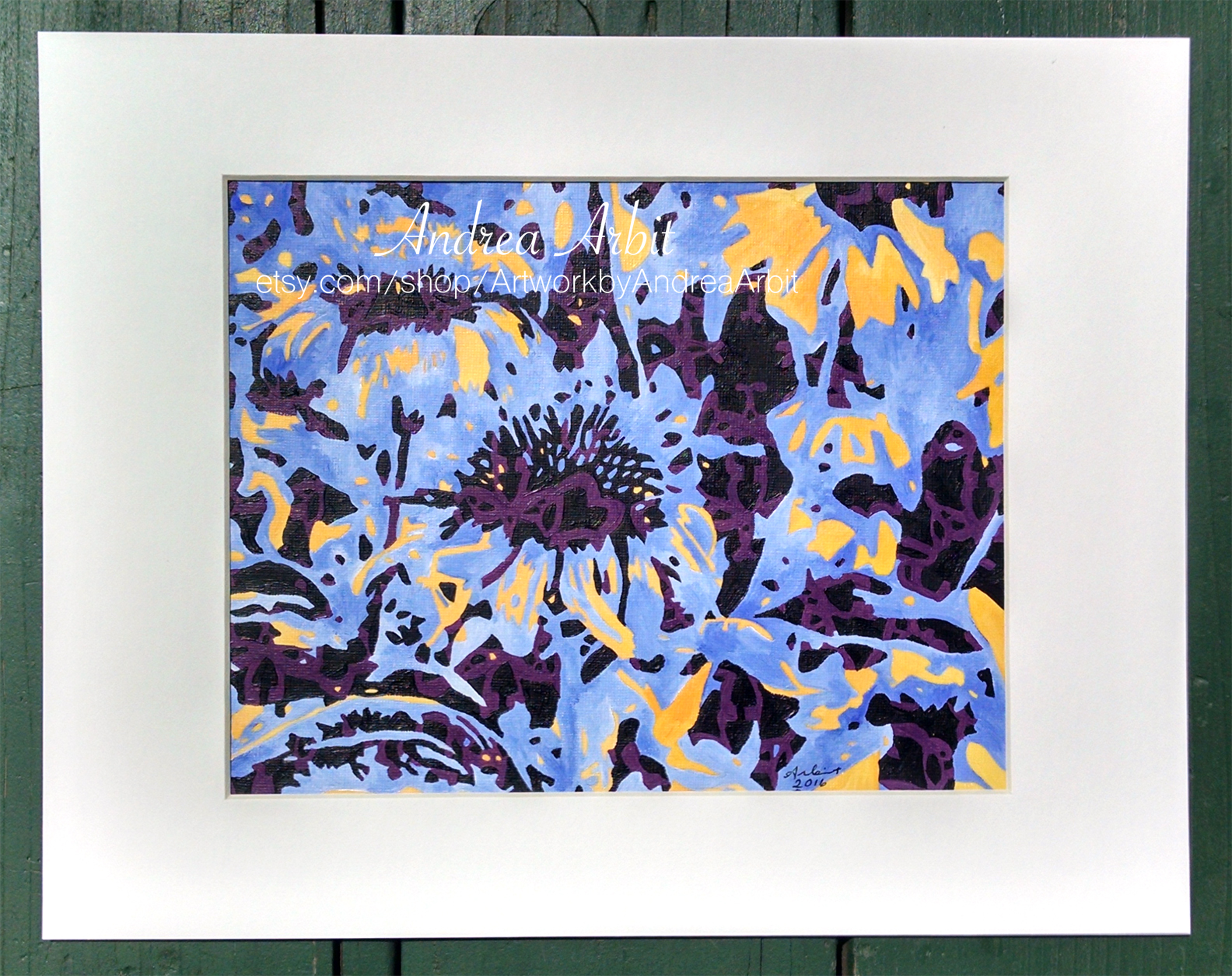
    This painting is the one with the fewest moments of yellow. The majority of the piece is in the blue midtone range, and the little shots of yellow and splotches of the dark background pop forward, looking almost like cascading or tumbling items caught in a blue river. The little black points that congregate at the center of each coneflower similarly remind me of the pips on dominoes. Furthermore, coneflowers symbolize strength and healing - and through the course of his chapters, Cavendish finds himself incarcerated with nurses attempting to tend to his sickness of old age, desperate to find the strength/cunning within him to escape.

    Some great quotes from the two Timothy Cavendish chapters:

    “We cross, crisscross, and recross our old tracks like figure skaters.” 

    “Conduct your life in such a way that, when your train breaks down in the eve of your years, you have a warm, dry car driven by a loved one - or a hired one, it matters not - to take you home.” 

    “You will not apply for membership, but the tribe of the elderly will claim you.” 

    “I recall a yesterday and see a tomorrow. Time, no arrow, no boomerang, but a concertina.” 

    “Books don't offer real escape, but they can stop a mind scratching itself raw.” 

    “Once any tyranny becomes accepted as ordinary...its victory is assured.” 

    “...plan was a high-risk sequence of toppling dominoes.” 

    “What wouldn't I give now for a never-changing map of the ever-constant ineffable? To possess, as it were, an atlas of clouds.” 

    --

    Next is "Truths & Mistruths," inspired by the chapters featuring Sonmi. (This painting is available for purchase here.)


    This is one of the more abstract paintings in this series (tied, I think, with "Toppling Dominoes," above). It is so chaotic that if one did not know it was based on a photograph of snapdragons growing on their stalks, one might think it was something else altogether - something not even floral. Sonmi's chapters are similarly chaotic - there is much talk of "truth" and what really is or isn't real. Her answers to the Archivist's questions alternatively resemble a box of puzzle pieces and a completed Jigsaw puzzle.

    Some great quotes from the two Sonmi chapters:

    “Our lives are not our own. We are bound to others, past and present, and by each crime and every kindness, we birth our future.”

    “Truth is singular. Its 'versions' are mistruths.” 

    “You must create Catechisms of your own.” 

    “Most of science's holy grails are discovered by accident, in unexpected places.” 

    “One's environment is a key to one's identity.” 

    “Travel far enough, you meet yourself.” 

    “Fantasy. Lunacy. All revolutions are, until they happen, then they are historical inevitabilities.” 

    “No crisis is insuperable if people cooperate.” 

    “...ignorance of the Other engenders fear; fear engenders hatred; hatred engenders violence; violence engenders further violence until the only 'rights,' the only law, are whatever is willed by the most powerful.” 

    “No matter how many of us you kill, you will never kill your successor.” 

    --

    Finally, "This Busted World," inspired by the chapter featuring Zachry. (This painting is available for purchase here.)


    Though Zachry lives in a post-apocalyptic dystopian world, there is still hope for the future - a rebirth, a reawakening, a "rising from the ashes." In the language of flower symbolism, Black-Eyed Susans represent encouragement. I love the way the yellow petals rise out from the black and blue background in this painting; as well as the symbolism of their being taken from a photograph of landscaping along the Riverwalk in Detroit, Michigan - a city who has seen hard times lately, but whose city motto is 'We Hope For Better Things; It Shall Rise From the Ashes.'

    Some great quotes from the one (long) Zachry chapter:

    “Times are you're weak 'gainst the world! Times are you can't do nothin'! That ain't your fault, it's this busted world's fault is all!” 

    “...the gone-lifes outnumber the now-lifes like leafs outnumber trees.” 

    “The learnin' mind is the livin' mind... an' any sort o' Smart is truesome Smart, old Smart or new, high Smart or low.” 

    “So many feelin's I'd got I din't have room 'nuff for 'em. Oh, bein' young ain't easy 'cos ev'rythin' you're puzzlin'n'anxin' you're puzzlin'n'anxin' it for the first time.” 

    “We Old Uns was sick with Smart an' the Fall was our cure.” 

    “There ain't no journey what don't change you some.” 

    “In our busted world the right thing ain't always possible.” 

    “Souls cross the skies o' time...like clouds crossin' skies o' the world.”