Showing posts with label female genital mutilation. Show all posts

Friday, May 12, 2017

Gender is a Spectrum

There are two terms that we use more or less interchangeably - sex & gender - but which actually mean slightly different things (depending on who you ask). 

As I see it, sex usually refers to someone's biological sex (as characterized by the genitalia and other secondary sex characteristics you were (or weren't) born with, or by the chromosomes you were or weren't born with), whereas gender is the outward expression of one's sex - how you think of yourself/label yourself or how you are thought of/labeled by outsiders who interpret your behaviors (how you dress, how you wear your hair, your mannerisms, your ways of speaking, how you process or express emotion, how you interact with others, etc.) through the lens of contemporary gender stereotypes.

Often (but not always), one's sex and one's gender are the same - such as when a biological female considers herself to be a woman, and embraces/identifies with many (but rarely all) stereotypical behaviors of contemporary womanhood. These people are cisgender, also known as "gender-straight" or "gender-normative," meaning they conform to the gender/sex based expectations of society. 

Other times, a person's self-concept of gender does not match the sex they were assigned at birth. These individuals might identify as transgender. They may reject the stereotypes of the sex they were assigned at birth in favor of ones that better match their self-concept, may dislike the parts of their biology that do not represent the gender they feel they truly belong to, and may request that those they interact with change the gender pronoun they use to refer to them. They may take hormone treatments or go through surgeries to transform the parts of their biology they dislike, so that their physical appearance better matches their true gender. Some individuals who are transgender know from a young age that there is a disconnect between their minds and bodies; others do not realize it until much later in life. It is best not to assume any of these things, because every transgendered individual (just like every person in general) is unique and experiences life differently. 

>> Side note #1: Rejecting some gender roles does not automatically change someone's gender - "effeminate" men and "tomboyish" women exist, and they are not less of a man or less of a woman than manly men or feminine women (unless they want to be). 

>> Side note #2: A person's gender identity is not the same as their sexual orientation. Though being attracted to women is a stereotypical gender characteristic for many men, it is only one of many. Someone could be a gay man (and therefore reject one of the stereotypes of their male gender role), or even an effeminate gay man (and therefore reject many of the stereotypes of their male gender role), but still identify as male. Similarly, a woman could be attracted to women, or even be attracted to women and reject other female gender stereotypes, but still identify as female.

Behaviors or proclivities are gender-specific only because we have made them so. Women are not inherently "more nurturing" or "more domestic" than men. All genders/sexes are capable of providing quality childcare, and in completing household chores; like any other tasks, these are tasks that one gets better at with training or practice. Behaviors that we see associated with women, and behaviors we see associated with men, are things that women and men do because of how they are brought up, what they are taught, how they are treated, and social norms they are exposed to and encouraged to emulate (whether consciously or subconsciously).

Gender characteristics are fluid, changing throughout time and differing among cultures. For example, in America, it used to be acceptable for all children, regardless of gender, to wear dresses, and the color pink used to be associated with boys and blue with girls. In another example, some cultures associate displays of emotion as exuding manliness, while others associate emotional sensitivity with femininity. It doesn't take too much research to realize how arbitrary those characteristics are assigned to one gender or another - and not too much further thinking, once one has reached that realization, to conclude that it is ridiculous to insist that women or men "should" act a certain way. There is more than one way to be a man; there is more than one way to be a woman.

Gender is therefore more of a spectrum than a simple binary between male and female. You can have supposedly masculine traits even if you're a woman; you can have supposedly feminine traits even if you're a man. In recent years, this has developed into some people choosing to identify as neither a man nor a woman, or choosing to identify as both man and woman. They are the same person they always were; they are merely looking for a more appropriate label to use for themselves - a label that recognizes the arbitrariness of gender characteristics/the lack of a gender binary, and a label that encompasses how they truly feel about themselves and what group(s) they belong to, or want to belong to, or want not to belong to.

Some terms you may hear include:
  • agender: a person who is internally ungendered or who does not have a felt sense of gender identity
  • bigender: a person whose gender identity is a combination of a man and a woman
  • pangender: a person whose gender identity is comprised of all or many gender expressions
  • gender diverse or gender non-conforming: a person who either by nature or by choice does not conform to gender-based society expectations
  • gender fluid: a person whose gender identity or presentation shifts 
  • genderqueer or gender non-binary: a person whose gender identity is neither man nor woman, is between or beyond genders, or is some combination of genders; often used as a reaction to/commentary on the social construction of gender, gender stereotypes, and the gender binary system
Sex characteristics seem more rigid at first glance (males have penises; females have vaginas), but are actually just as fluid as cultural gender conventions. There are different ways to define one's biological sex, and all of them are less clear-cut than the strict male-female binary we suppose. 

You could define sex by observable, external characteristics (penises and scrota and facial hair, vulvae and hip width and breast size), or by internal sex organs (ovaries, uteri, prostrates) - but to use such a narrow definition would be to exclude or shame those who have had hysterectomies or mastectomies or other surgeries, those whose secondary sex characteristics are inconsistent with their primary sex characteristics (i.e. a "bearded lady" or someone with "man boobs"), and those who were born with conflicting or absent characteristics (i.e. an intersex child born with male and female organs, or a child born without any reproductive organs at all).

A male does not stop being male just because he's had surgery on his prostrate. A large-chested female is not "more female" than a small-chested female. Nor does a starving female who starts to grow extra body hair (to keep her skeletal frame warm) or lose the ability to menstruate (due to a lack of key nutrients in her diet) stop being female because of these physical changes to her body.

Every body is different; these differences can occur naturally, from genetics or environmental factors (such as diet), or they can occur medically, due to life-saving surgeries, medications, or elective procedures. They could even occur through abuse, such as someone who has had their genitals mutilated or altered. Girls who have had their vulvae stitched shut are still girls, just as the man whose wife famously cut off his penis is still a man.

How then can we insist there is a standard body that every male should have, or a standard that every female should have? Every female body looks different from every other female body, every male body looks different from every male body, and there are still other bodies that do not fit cleanly into a male or female category at all.

You could also try to use hormones to divide humans into males and females, looking at levels of testosterone, progesterone, or estrogen. But some males or females have naturally occurring levels of hormones that are typically found in someone of another sex, and others see altered hormone levels due to medical treatments, surgeries, or medication side effects. 

Females with Type 2 diabetes, for instance, have pancreases that must produce extra of the insulin hormone - and sometimes increased production of other hormones, as well, including testosterone, which can affect ovulation and fertility. PCOS (polycystic ovary syndrome) is another common illness which can affect hormone levels and impact reproductivity. 

Should such individuals no longer be considered female, just because of hormone imbalances or fertility difficulties? Of course not! If being female only meant that one was capable of ovulation, then girls could not be considered female before menarche either, nor older women after menopause. As much as it sometimes seems like we're heading in that troubling direction, we are emphatically not living in Margaret Atwood's The Handmaid's Tale; females are worth more than their ability (or willingness) to bear young.

Finally, you could also classify people by chromosomes - XX for female, and XY for male. But there are other chromosome combinations that naturally occur in humans, including Turner syndrome (X0, or only one sex chromosome), Triple-X syndrome (XXX, or even XXXX or XXXXX, where multiple X chromosomes are inherited), Klinefelter syndrome (XXY or XXXY, where extra X chromosomes are inherited with a male Y chromosome), and XYY (aka Jacobs) syndrome. 

Some of these individuals see their fertility compromised because of their condition; others see no obvious symptoms that they have a chromosomal abnormality and go through their entire lives never knowing. 

People who are born with any of the non-typical XX or XY chromosome combinations listed above, and/or people whose reproductive or sexual anatomy at birth does not seem to fit the typical definitions of female or male are known as intersex. These individuals are proof that gender is a social construct; there are not "only" two sexes, and therefore not only two genders, either. Sex/gender is a spectrum, rather than a simple either/or. Whether you look at physical characteristics, hormone levels, or chromosomes, there is more variation than the dichotomous "female" and "male" categories we are taught.

And so, if sex and gender are divided rather arbitrarily into different categories, than it makes no logical sense to treat people differently or give people different privileges or limitations based on their sex or gender. This is what feminism is - an insistence that woman and men should have equal rights and equal opportunities. Women and men should earn equal pay for equal work, should be treated with the same dignity and respect, and should feel valued and safe in whatever realm of society they choose to inhabit. 

"Woman" and "man"; "female" and "male" - these are just words, just labels that we came up with in an attempt to understand our world. Their definitions can change, just like any word evolving over time. Furthermore, new words can be added to the lexicon if needed (and I would argue - they are needed). There should not be any controversy in this - it is just people trying to explain their experience, use words carefully and conscientiously, and have some say in how people are or aren't labeled. There is no harm to it, and in fact often a great deal of good. Discovering who you are and who you want to be, and being allowed to define yourself as you see fit, are important aspects of being human and being free.

Wednesday, January 6, 2016

L'Art Erotique - Broadcasting Schedule

As I've mentioned before, last May I was flown to Denver to interview with Eureka Productions, a company based in Montreal, Canada, for their upcoming TV series "Erotic Art," which will show on ARTV. They talked to me about my thesis paintings, which feature flowers that were restrained, pierced, and mutilated as metaphors for female sexual oppression, assault, and female genitalia and sexuality in general. (Search the "thesis" tag on this blog to read more about my thesis specifically, or read the thesis online for free at: http://commons.emich.edu/honors/238/)

Well, now is the time for the TV show to air! I'm not sure which episode my specific interview will be a part of, but here is the list of episodes that will be airing, for those who may live in the Montreal area and are interested in checking it out. The first episode airs tonight (January 6th).

If I find out where my interview is online, I will post that here as well, but for now watching live on ARTV is the only option. Here is a description of the episodes, as sent to me by Eureka Productions in an email: (French first, with English to follow.)

-

Encore un grand merci pour votre participation et votre implication dans notre projet de série documentaire intitulé l'Art érotique.

Grâce à votre généreuse collaboration, nous avons réussi à rassembler des artistes inspirants issus de disciplines variées, autour d’un même sujet : l’érotisme et la sensualité dans l’art.  L’équipe d’Eurêka! Productions est heureuse de vous présenter le résultat de ses rencontres à travers le monde, dès le mois de janvier 2016.

Voici les horaires de la télédiffusion sur la chaine canadienne ICI ARTV :
 1/ Ode à la beauté, mercredi 6 janvier 2016 à 21h - Les modulations du corps dans l'art : réinvention des perceptions de l'érotisme
 2/ Éros et Thanatos, mercredi 13 janvier 2016 à 21h - L'érotisme entre vie et mort, le corps dans une frontière trouble.
 3/ Jeux Jouissifs, mercredi 20 janvier 2016 à 21h - L'érotisme quand il n'est pas pris au sérieux, place au plaisir.
 4/ Éros au futur, mercredi 27 janvier 2016 à 21h - Entre machines et robots, voyage de l'érotisme et des corps à travers le temps 
 5/ Désirs secrets, mercredi 3 février 2016 à 21h - Pèlerinage dans les confins du désir et de l'interdit, l'érotisme caché sous la symbolique.

Suite à la diffusion télé de l’épisode dans lequel vous apparaissez, Eurêka Productions vous fera parvenir un DVD de celui-ci. Au plaisir de vous revoir à travers vos nouvelles œuvres !

-

Thank you once again for being part of the documentary series and its web project "l'Art érotique" ("The Erotic Art"). Your collaboration made it possible for us to be proud of the good quality work we did.

Now, the time has come to present you the good result of Eurêka! Productions’s work.  By going on ICI ARTV, Canadian Channel, on January 2016, you'll be able to watch the collaboration of our work in the five episode of the series.

Here is the TV broadcasting schedule on ICI ARTV :
 1/  Ode to Beauty, Wednesday January 6th 2016 at 9 p.m. - The body's curve, eroticism and sexuality as creative sparks.
 2/ Eros and Thanatos, Wednesday January 13th 2016 at 9 p.m - The dangerous line between death and living: erotic tension between two bodies.
 3/ Game and Pleasure, Wednesday January 20th 2016 at 9 p.m - This episode will explore the playful side of erotic art.
 4/ Eros and the Future, Wednesday January 27th 2016 at 9 p.m - Eroticism through machines and robots.
 5/ Secret Desires, Wednesday February 3rd 2016 at 9 p.m - A journey through the hidden erotic uses of everyday objects.

Following the television broadcast of the episode in which you appear, Eurêka! Productions will send you a DVD of it. Hope to see you through your new works!

Friday, September 11, 2015

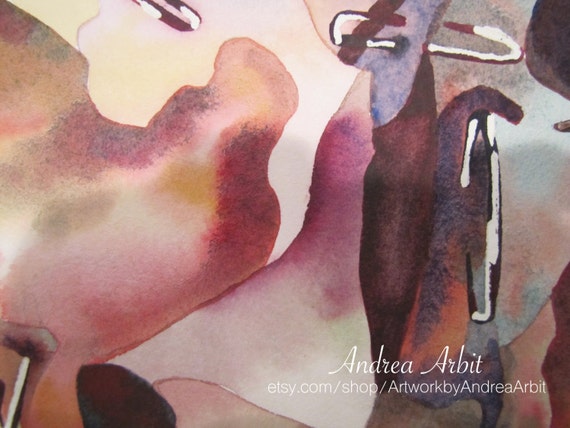
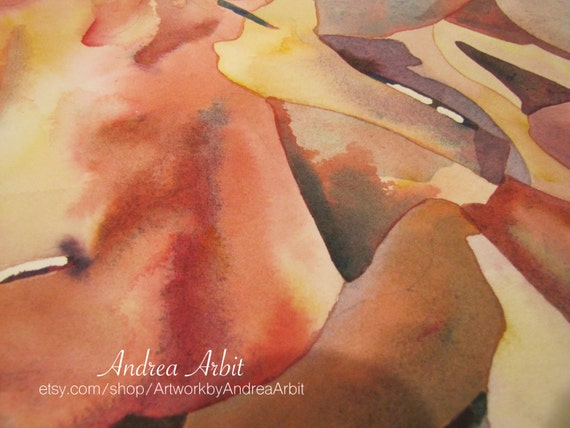
Hanging by a Petal & Stapled Apart & Bound & Debris


There are four more watercolor paintings I would like to talk about that I created for my thesis. They are in much the same vein as the last two I talked about (the ones from yesterday's post) - each of them uses flowers as a symbol for female genitalia or female sexuality so that I could raise awareness and start discussions about female sexual assault, rape, and female genital mutilation (FGM), among other things.

-

(Purchase Hanging by a Petal through my Etsy shop!)

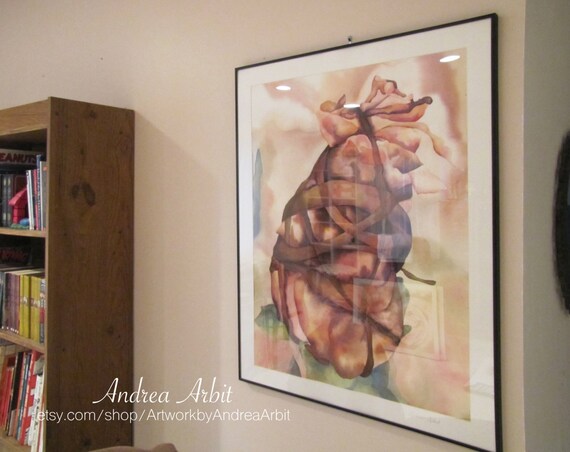
"Hanging by a Petal" by Andrea Arbit - Watercolor painting on paper, 30"x22"

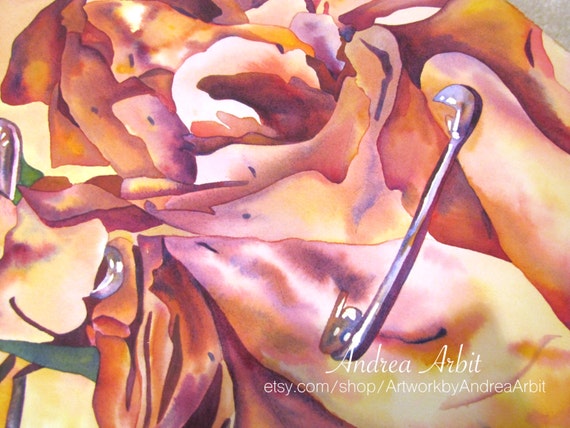
For Hanging by a Petal, I again used safety pins to mutilate a set of roses. The two roses are currently held together with pins, and their petals show perforations and scars from earlier assault attempts. As I wrote in my thesis, "the petal in the foreground - stabbed with safety pins so many times that it cannot stay attached to the rest of the flower - is starting to unravel, the piles of petals giving evidence to the unfortunate future of the rose."


-

(Purchase Stapled Apart through my Etsy shop!)

"Stapled Apart" by Andrea Arbit - Watercolor painting on paper, 22"x30"

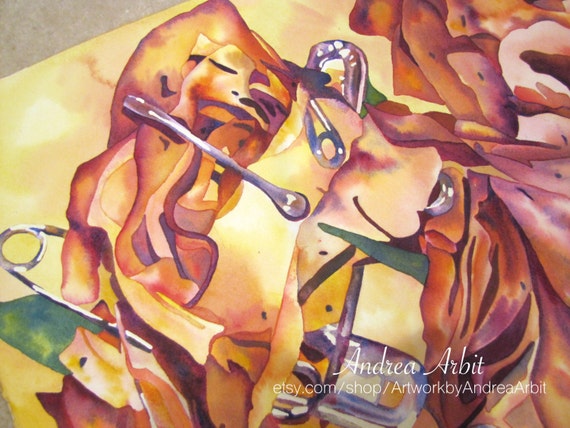
Stapled Apart shows rose petals that were assaulted with numerous staples. The palette in this one is not the pinks, yellows, and violets that I used in most of the rest of the series. Instead, I experimented with darker colors, browns, and sickly yellow-greens. In my thesis I wrote: "While creating my other pieces, I feared that pleasant colors would cause confusion about what the paintings were about. I worried that Pinned for Safety, Hanging by a Petal, and Stabbed might be too “pretty” – that viewers would think I was advocating or even celebrating violence with them. The darker, more neutral colors look more sinister. However, I quickly returned to the more saturated pinks, yellows, and violets for my remaining watercolors because I am more drawn to saturated colors and want to attract viewers. I wanted the color palette – if nothing else – to seem celebratory and hopeful."


-

(Purchase Bound through my Etsy shop!)

"Bound" by Andrea Arbit - Watercolor painting on paper, 30"x22"

Bound depicts a rose bound in rubber bands, literally restricting it from fulfilling its purpose to act as a reproductive agent for the plant, as well as its purpose to be aesthetically pleasing. These limitations could reference physically violent genital restriction (e.g. FGM), or emotionally or psychologically restrictive social norms placed on expressions of female sexuality, as I talked about in the post with the "hesitant" flowers that had chosen to cover themselves with caution tape.

As I said in my thesis: "Even when no sexual abuse has occurred, women are often taught that their genitalia are unclean or shameful, and should be covered up and avoided at all times... Vaginismus is only one of several sexual disorders women may acquire due to societal restrictions on sexuality. A woman with vaginismus is so afraid of vaginal penetration that an involuntary spasm of the muscles surrounding the vagina blocks any attempt at entry; the spasms can even be triggered by just thinking about something (a penis, a tampon, medical instruments needed to conduct pap smears) entering the vagina. Though physical causes may also contribute, the majority of vaginismus cases are caused by any of numerous psychological issues: anxiety about being vulnerable, losing control, or getting pregnant; fear or anticipation of intercourse pain; performance pressures; negativity toward and guilt about sex; past emotional or sexual abuse; overly rigid parenting; unbalanced religious teaching; and inadequate sex education."

It is interesting, I think, to note that there is no way for this rose to have completely bound itself in those rubber bands without outside assistance. Unlike Silk Caution and Poisoned Rose, which I talked about previously, the rose is being restricted by objects outside of itself.


-

(Purchase Debris through my Etsy shop!)

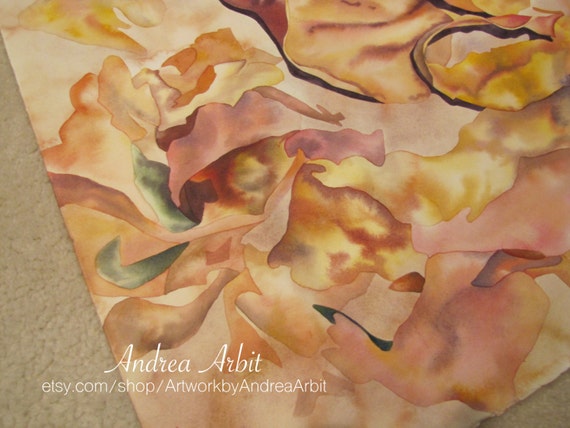
"Debris" by Andrea Arbit - Watercolor painting on paper, 22"x30"

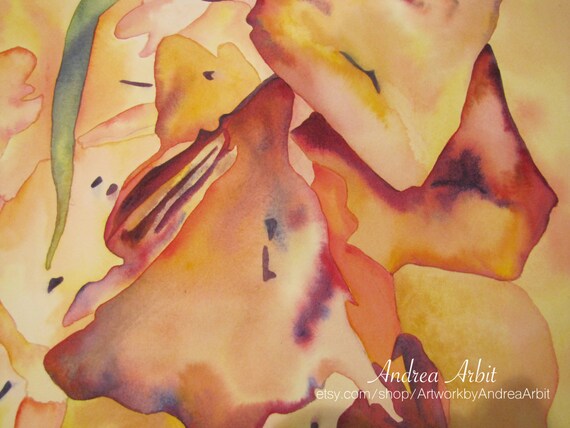
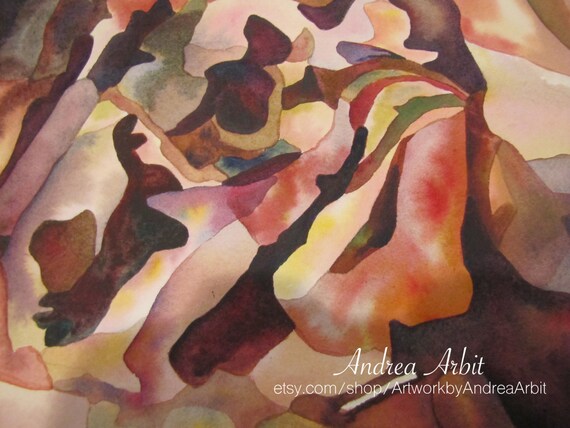
Finally, we come to the last painting in this thesis series. In Debris, I do not include any evidence of what destroyed the flower; the focus is instead on the aftermath - the debris of destruction, or perhaps simply the wilting of old age. "My palette is hopeful and suggests that life will eventually renew itself – there will be other roses. I hope that with each passing year, more women and girls will find empowerment in their bodies and sexuality."


Five years after writing those words, I'm still working on my own empowerment. I do think I'll get there - as long as I keep trying to get there. I haven't made nearly as much progress in unlocking my self-confidence as I'd hoped I would have by now - but only because I've become complacent. When something is shrouded in shame and embarrassment, it's easier to avoid it than it is to work on it. Consistency is key.

Don't forget to check out my Etsy shop for these paintings and others in this thesis series!

Thursday, September 10, 2015

Pinned for Safety & Stabbed

In case you're new to this week's series of blog entries, I've been talking about my honors thesis, which consisted of several watercolor paintings and a companion written artist statement.

In the first several paintings, I was using flowers (roses in particular) as a symbol for female sexuality and female genitalia. Once I had created the "hesitant" flowers (the ones with caution tape) and the "healing" flowers (the ones with bandages), I started to realize how I could use the symbolism I had established to maybe raise awareness about certain feminist issues that were weighing on me. And so I created paintings that allude to rape, sexual assault, and female genital mutilation.

Here is where using a symbol for female genitalia, instead of a depiction of an actual vulva, became very important. In my early paintings, I was dealing a lot more with the psychology of having a vagina - or, at the very least, my psychology. The roses were not physically injured, and so were "only" emotionally or mentally scarred. For those paintings, it might not have mattered if I'd chosen to use the flower symbolism or an actual vulva. (As it was, I chose the symbolism, because, as stated in previous entries, I was not too comfortable with my own sexuality and needed that "crutch" of a symbol because I wasn't ready for something explicitly graphic.) But for the paintings in the rest of my thesis, I believe in does matter.

Because I am showing physical harm - roses that are being actively assaulted, or roses that are obviously damaged from a past assault - I wanted to be very careful that I was not seeming to encourage or glorify sexual violence. It was very important to me that the viewer would be sympathetic towards the injured rose - not turned on by it. There were times, even using a flower as a stand-in for female genitalia, when I was still concerned about this, when I feared that a "beautiful" color palette would seem to beautify the act done to the rose. I hope these paintings are not interpreted in this way; I hope instead that the viewers seen the beauty in the rose itself. The rose carries the potential for strength and beauty despite the trauma that has been done to it, NOT because of the trauma it has endured.

I do this to myself sometimes. I need to remind myself not to romanticize pain. I get to thinking that in order to be a great artist or a great writer, I need to suffer - and so I hold myself back and make myself suffer. I would never hurt someone else, would never tell someone else that her life would be more beautiful, more poetic, more meaningful, if there was a bit more trauma in it. But I tell it to myself, and it's something I'm trying to work on changing. If I wouldn't allow a friend to hold those self-sabotaging beliefs, I shouldn't let myself hold them either. I should treat myself like my own friend.


"Pinned for Safety" by Andrea Arbit - Watercolor painting on paper, 20"x22"

Pinned for Safety is the first painting I made that showed violence actively directed toward the rose. I purchased and destroyed real flowers with safety pins, straight pins, tape, staples, and clips. I later used photographs taken while mutilating the flowers as references to create these watercolor paintings.

I wrote in my thesis: "Safety pins are everyday tools that we to hold something together with minimal damage. In this work, however, the rose petals are so fragile that the term “safety pin” becomes an oxymoron. One cannot pin a rose without damaging it, whether the intent is merely to keep the rose safe and together or to force its petals to close. I intended this to serve as a commentary on how even the best intentions can do more damage than good."

Female genital mutilation (FGM), also known as female genital cutting and female circumcision, is unfortunately seen as legitimate, beneficial, and justifiable in many parts of the world. "Like a well-intentioned attempt to hold something together with safety pins, in cultures where FGM is practiced, it is defended under the grounds that it is for the female’s own good. Reasons cited are numerous and varied, including aiding in genital cleanliness (for the sake of the woman and for her future children, who could supposedly die if they came in contact with “unclean” external female genitalia) and removing the “male” part of female genitalia – the clitoris – to create a clearer indication of a woman’s sex, which in turn is thought to enhance the female’s femininity (e.g. docility and obedience). FGM is also performed to cure females of depression, hysteria, and insanity; and to prevent sexual promiscuity and excessive masturbation by eliminating a female’s ability to experience sexual pleasure or decreasing her libido. Other reasons include proving virginity at the time of marriage to ensure an honorable union; increasing fertility; and even making the female genitalia more aesthetically pleasing. Women who undergo this procedure are told that it is done for their safety, health, social status, and virtue, but FGM 'has no health benefits and harms girls and women in many ways.'"

“In countries where it is practiced, mostly African, about two million youngsters a year can expect the knife – or the razor or a glass shard – to cut their clitoris or remove it altogether, [and] to have part of all of their labia… sewn together with catgut or thorns.” FGM can lead to urinary and reproductive tract infections (caused by obstructed flow of urine and menstrual blood), scarring, infertility, epidermal inclusion cysts, increased risk of acquiring sexually transmitted infections (including HIV), bladder and urethra stones, kidney damage, and death from excessive bleeding. Initially, sexual intercourse is often extremely painful for women who have undergone this procedure; a second cut of their genitals often needs to be made at this time – usually performed by the sexual partner with a knife – to allow the labia majora to be opened for intercourse. This second cut can also lead to medical complications. Many women never experience sexual pleasure after FGM. Many women who have had their genitals cut experience difficulties in childbirth. All types of female genital mutilation pose an increased risk of death to the baby, with some types also increasing the risk of postpartum hemorrhage in women. Finally, because many FGM procedures are performed on young girls who are not given a choice in the matter, psychological and emotional stress is common, with comparable symptoms to post-traumatic stress disorder. Since 1997, the World Health Organization (WHO), the United Nations Children’s Fund (UNICEF) and the United Nations Population Fund (UNFPA) have spoken out against the practice of FGM.

(If you want references for any of that above information, there is a wealth of research cited in the thesis this is pulled from, and you can check there.)

Likewise, the rose in Pinned for Safety is clearly harmed by attempts to pin it shut. The flower petals have started to tear, and the pile of petals in the background suggests that the pins will eventually destroy the flower, rather than protect it.


"Stabbed" by Andrea Arbit - Watercolor painting on paper, 20"x22"

Of course, FGM is not something that is generally practiced in Western countries, so much of my audience probably doesn't know a lot about the procedure and would not immediately think of FGM as a way of interpreting my paintings. But sexual violence toward women is not limited to FGM. In this second violent painting, Stabbed, I held two roses shut with straight pins, which were more effective than safety pins in keeping them closed. Also, as I added in my thesis, "the straight pins lent themselves more easily to stabbing the flowers. Because they did not have to be held in place by safety pin latches, they could penetrate into the roses in a quicker, jerkier fashion." This painting, therefore, seems less like an invasive (yet careful) surgery, and more like rape or sexual assault - a problem that is, unlike FGM, prevalent throughout the entire world.

From my thesis: "Statistics show that one out of every three or four women experience sexual violence, so it is likely that everyone knows someone who has experienced sexual trauma or rape. Most often a woman is raped or assaulted by someone she knows (such as a significant other, relative, neighbor, or adult in a position of authority), but these 'acquaintance rapes' are very rarely reported. The National Organization of Women estimates that every year 1.2 million women are forcibly raped by their current or former male partners, some more than once. Similarly, a Ms. magazine survey in 1994 found that eighty-four percent of those raped knew their attacker. According to this data then, acquaintance rape and date rape are more common than left-handedness, heart attacks, and alcoholism. Women are taught to be wary of strangers and avoid walking alone at night, but these strategies do not take into account the reality of the majority of rape situations. By showing how easily flowers are torn and damaged with safety pins, I am trying to raise awareness of the alarming frequency of sexual assault and rape."

(Once again, if you want references for any of that above information, there is a wealth of research cited in the thesis this is pulled from, and you can check there.)

Now, rape is being talked about a lot on social media, and even on the news. But when I made this painting in early 2010, there weren't activists carrying their mattresses around campuses. I didn't see nearly as much discussion about rape statistics in 2010 as I do today - and maybe that's partly because I wasn't yet on Twitter following feminist accounts, and was still living a sheltered college student's life, not watching much news or generally staying abreast with the goings on of the world - but I don't think that adequately accounts for the huge jump in discussion I've seen in the last few years. I think we've gotten better about talking about some of this stuff. I hope I'm right; I hope we have.

When I showed these two paintings at an event at Eastern Michigan University in 2010 next to a display of rape and sexual assault statistics, there were several people who seemed shocked at the numbers. Many men would stop reading my artist statement, would stop looking at my watercolor paintings, as soon as they realized that I was talking about female genitalia, but there were some men who not only kept reading, but engaged me in conversation. One such man listened to everything I had to say, read my statistics, and left - only to return an hour or so later, as the event was wrapping up, to tell me he couldn't stop thinking about what he'd learned. He told me he had two daughters, both in high school or college. He said he'd never thought about it before, how likely they were to experience rape or sexual assault in their lifetimes. Given the 1 in 4 statistic listed above, he has a 50% chance that at least one of his daughters will be raped or sexually assaulted.

Chances are that we all know someone who has been raped, or is the victim of attempted rape. I know for a fact that I know a few such people - and those are only the women who have told me. It's awful to think about, that something so horrible could still be so common.

But no, we've reached gender equality. Give me a break.

Don't forget to check out my Etsy shop for others in this thesis series! (I have these particular two currently hanging in my dining room, but the rest of this series is available for purchase on Etsy.)