Showing posts with label full disclosure. Show all posts

Wednesday, January 30, 2019

Personal Values

A couple years ago, I took the time to think about and explicitly define my personal values. Not other people's values, or what society as a whole seems to value, or even what I wanted to value - but the things I naturally, innately valued: the things I've been prioritizing and living my life according to all along (or trying to prioritize and live my life according to), without even realizing it.

Now, "innate" doesn't mean these things are easy for me to prioritize - on the contrary, there were many times in my life when these values were incredibly difficult to believe in at all, let alone base my behaviors on. But it is precisely this - that these beliefs and behaviors would persist even when it would've been easier to forget them or change - that helped convince me they were my core values after all. These are things that some part of me has always believed, even when other parts of me were actively resisting and trying not to.

Maybe it seems odd to put in the effort of putting my values into words, when on some subconscious level I already knew what they were. I find it helpful, though - not only for my personal edification and trying to better understand myself, but also to use as a tool in times of stress. So often when I feel stressed, it's because I've started listening to other people instead of myself. I've forgotten what I usually or innately prioritize, or even somehow talked myself into trying to change those priorities to look like something else - something decidedly not me. Referring to my list of personal values in these moments can help me identify which of my values I've been neglecting and help me refocus my priorities. Other times, I'm stressed because my current situation is making it difficult for me to live according to my values, which is upsetting and frustrating. In this case, too, referring to my list of personal values is helpful, because it illuminates which of my values are currently threatened, which in turn helps me figure out how to find another way to fulfill those values despite my circumstances. 

Today I'd like to share my list of values with you. Some may look familiar, being values you also have; others might be completely foreign and not something you'd at all agree with. I'm not passing judgment on these values as inherently superior to anyone else's - these just happen to be the values I've inherited or cultivated over the years and which now truly feel like a part of me, woven into my very essence. It took lots of self-reflection, recalling countless memories, and going through old journals, researching and collecting evidence from my own life, to come up with this list - and I still occasionally revise it from time to time. It's not set it stone; it's a living document, and it changes as I continue living. 

There are seven values altogether, divided into two broader categories. Under each value, I've also written "I will" statements, to give myself examples and encouragement for how I can live my life according to that particular value. These statements are meant as inspiration, and are not indicative of how I always think or behave... but I do have several examples of times in my life where I have done those things, which I read both to remind myself what I'm capable of, and to remind myself that these really are my values, and have always, on some level, been my values. (After all, if they weren't my values, I wouldn't have this pattern of past behaviors which seems to reflect them.) I've also included some of those examples here, underneath the main list of values - quotes from my private journals and private/public blogs.

**

My values:

A. I am self-sufficient and I have self-worth.

1. I know what I want, and recognize if I'm not getting it. If I am not provided with what I want, I work toward it by myself, for myself.
  • I will allow myself to need things, want things, and hope for things, and I will practice recognizing what I need, want, and hope.
  • If I need something from someone else, I will speak up and fight for what I need.
  • If I want to learn something or do something or have something or participate in something, I will find a way to do it or ask for it (in the best way I know how at the time).
  • I will continue to set personal, creative, intellectual, emotional, and physical goals, which represent accomplishments that are personal priorities for me; and I will continue to pursue these goals, for myself.
2. I believe I am worthy and deserving of being treated with respect and kindness. I put a lot of energy into empathizing and trying to understand others, and I get upset when I don't get this kindness and understanding in return that I know I deserve.
  • I will choose to surround myself with people who give me that kindness and respect.
  • If someone repeatedly denies me the respect and kindness I deserve, I will not allow them to play a significant role in my life.
B. I cherish the things that make me human and I value the time nurturing these pursuits.

3. I value my intellect and stretching and nurturing my knowledge and understanding of the world.
  • I will continue to take classes, learn new things, read books, do research, flex my "insight" muscles, make connections, and develop my own way of understanding the world.
  • I will immerse myself in these intellectual pursuits for myself, researching and exploring the topics that are interesting or meaningful to me.
  • I will take pride in the personal language and metaphors I create and use to describe my unique understanding of the world.
4. I like trying to understand myself and trying to understand other people. I practice compassion, kindness, and empathy towards others. I like connecting with others (especially on a deeper, emotional level) and feeling like a part of the web of humanity.
  • I will prioritize tending my emotions, journaling, chronicling and revisiting my memories, writing and rewriting my life's narrative, defining my personal values, and establishing my self-identity.
  • I will seek out and experience others' creative outputs/understandings of humanity by reading fiction and nonfiction, listening to music, watching television shows or movies, attending theater productions, visiting museums, and contemplating visual artwork.
  • I will strengthen the relationships I have with the kind, respectful people in my life by initiating or participating in heartfelt, honest conversations.
  • I will pursue friendships and find meaningful ways of connecting with new people.
5. I am emotional - and I value my emotions and my ability to demonstrate them. I use multiple different avenues to feel, and to express and share my feelings and opinions with others. I believe that my feelings and opinions are worth sharing with others, because I have a unique voice and insights to offer the world.
  • I will acknowledge the emotions I have, and not shame myself for feeling or expressing them.
  • I will allow myself to cry, and to stop crying, to feel emotion every day, and revisit the same emotions over and over.
  • I will listen to or watch media that encourage me to feel.
  • I will allow myself to express my emotions in front of the trustworthy people closest to me.
  • I will write, draw, and paint with the specific intent to share my thoughts or feelings with others. I will craft my message carefully and pointedly, with honesty, heartfelt emotion, and eager vulnerability. And I will work to share these insightful creations with others.
6. I value my creativity and exploring artistic pursuits.
  • I will create spontaneous art and writing for myself, giving myself permission to use art and creative writing as a personal relaxation or therapeutic technique, or to simply enjoy the aspects of creation, making a mess, and working intuitively without forethought or concern with the art/writing's marketability or message.
  • I will learn new artistic or writing techniques and familiarize myself with new artistic materials, both on my own as a method of play and in a more formal classroom/group setting, to expand my horizons, embrace the process of art-making and writing, connect with others who have similar interests, and have fun.
7. I am independent, inquisitive, adventurous, and brave. I like trying new things and forging my own path. I like exploring my environment and exploring new places. I want to experience everything. I want to take advantage of opportunities, and to be able to say I really lived my life.
  • I will prioritize traveling, exposing myself to new environments and new opportunities to see and experience the world.
  • I will chronicle my experiences through photography and journaling to remind myself of all the place I've been/things I've done.
  • I will strike out on my own to try new and potentially scary things.
  • If there is something I want to try, I will not let being alone in this desire, fear of what others might think of me, or others' risk aversion hold me back.
  • If there is something I want to do that is not organically presented to me, I will seek out and cultivate these opportunities myself.

**

Category B was easier for me to pinpoint - they are characteristics about myself I have been more likely to embrace throughout my life, values that were less "hidden" from me. I wanted to take as many classes as I could, in high school and college both, trying to balance my love of learning about a wide range of topics with my specific passions of art and writing. When time or scheduling restraints preventing me from doing everything I wanted to, I prioritized learning, writing, or creating art in my spare time as well. And even when my emotions and experiences were invalidated or written off by others, I persisted over the years in writing on Livejournal, Facebook, and various blogs, because I believed my feelings and opinions were worth sharing with others (whether a select group of trustworthy friends, strangers, or some combination thereof). I've always loved making deep, emotional connections with others - whether in person or online or with fictional characters - and feeling like a part of the web of humanity.

  • From 11/18/2005: "I'm disappointed already because our high school has some really cool classes that I never had time to take... just wait until I graduate college. I want to take ALL the classes!"
  • From 4/2/2006: "There's something almost cathartic about hanging out backstage with theater people. All that energy and excitement. Now that the show is over, I'll miss the sense of community. It never ceases to amaze me how everyone can bond so quickly in just a couple of weeks. I love it."
  • From 6/29/2006: "Even if not professionally, I hope to always draw and write, just for my own benefit. Art is something to look forward to, something to work at, something to accomplish, something to be proud of. Honestly, I can't imagine my life without drawing of some sort, even if it's just doodling cartoons, because drawing has been a part of me for so long."
  • From 8/15/2006: "Things that make me smile: crazy dreams, writing something good, drawing something good, buying school supplies, and embarking on new academic adventures."
  • From 1/5/2007: "It makes me a little sad, to lose something that was such a large part of my life, but in the end I think it tore me away from people more than it brought me closer to them. It kept me from understanding certain things or empathizing with people by hardening my heart to those who were different from me, and that's not something I'm okay with."
  • From 9/15/2007: "I want to witness stories and empathize with people. But I can't be that kind of person easily - because I've conditioned myself to often be emotionally detached, telling myself that emotion is weakness. So just because connecting with other people is something I genuinely want to do does not mean it's something I'm always able to do - and knowing that, admitting that, makes me feel so sad and overwhelmed."
  • From 12/5/2007: "My art history paper had to be 15 pages long; mine is 28. I just got so excited to do the research and got really interested in it!"
  • From 3/14/2008: "Oh well. It doesn't mean I won't read and write in my spare time, even if I can't fit English and Creative Writing classes into my schedule."
  • From 9/3/2008: "I want art to just take me in any and every direction it can; I don't want to limit myself to one thing. I want to have a concentration in everything."
  • From 11/1/2010: "I really don't want to settle for a job I don't want, when I believe I'm capable of better things and know how important growing and challenging myself are to me."
  • From 5/9/2011: "I want to nurture my authenticity - that is, being true to myself and doing what I really want to do. I want to do at least one authentic thing a day - one thing I do just for myself, just because I want to, because it's who I am."

Category A, however, was not something I initially included in my list of values at all. I knew that I wanted to believe I was self-sufficient and had self-worth - but I didn't think that I already believed those things, just that they were beliefs I was trying to acquire, in order to raise my low self-esteem. If you've ever tried to convince yourself to believe something, you know that it's a daunting task - raising my low self-esteem therefore seemed to require Herculean effort. How was I supposed to convince myself to believe I was capable of seeing myself as worthy and deserving of kindness and respect, or practice recognizing what I wanted and working toward such goals, if I'd spent so many years doing exactly the opposite?

But then I noticed something, reading through old journals. Whenever I wasn't treated with respect and kindness, I got angry and upset. I wouldn't have felt that way if I truly believed I didn't deserve those things. 

  • From 9/26/2005: "What about me? Can't I be happy too? I deserve more than what I've been getting lately."
  • From 5/17/2006: "I'm trying not to be bitter, I really am. But I guess I still can't help but feel that all my hard work has gone unnoticed or unacknowledged."
  • From 10/1/2006: "I would never have said that to them, because I would never want to hurt them. Did they not even think about how this might make me feel?"
  • From 7/16/2007: "I don't think you realize how much it hurts when you treat me this way - or else why would you continue, if you knew how much it kills me? What do you hope to gain? There is only so much I can take before I just can't bottle up my feelings anymore."

What's more - when I understood (even on a subconscious level) that I was lacking something important, I tried to do something about it. Even if it turned out to be a dysfunctional coping mechanism in the end, it was still an attempt to provide myself with what I needed, with whatever resources I had to work with or understanding I had about the situation at the time.

This went for showing myself respect and kindness, too. I wanted to be nicer to myself, to stop self-abusing, and learn how to have better self-esteem. It was a cycle I got stuck in often in middle school, high school, college, and even after - being critical and awful to myself, and then vowing to be better.

  • From 2003: "I guess I'm stuck being me. Maybe one day that'll make me happy. Maybe one day I'll be proud of myself. But for now I guess I'm here, hoping that maybe that 'one day' is near."
  • From 2004: "I'm sick of beating myself up. I'm tired of being a perfectionist. I try too hard. I care too much. Enough is enough."
  • From 12/31/2005: "I will work on being happier, especially with myself. I need more self-confidence."
  • From 11/7/2006: "I am too critical of myself. I want to be nicer to myself."
  • From 12/27/2008: "I wish I'd done less over-analyzing things, disliking myself, and stressing out in 2008. I'm still learning how to stop judging myself so harshly, but I'll get there."
  • From 1/8/2011: "I love the rare times I believe in myself (though I bet I'd like them even more if they were less rare)."

It was eye-opening to discover how many of those entries there were in my journals over the years - and a relief. It meant that, while a part of me had spent years (decades) being overly critical and abusive to myself, there was always some part of me who stubbornly persisted on seeing my self-worth. It meant that I didn't have to teach myself from scratch how to value myself after all - just that I had to cultivate that part of me that already existed. It felt like less of a Sisyphean struggle after that; it felt like a cycle I could actually escape.

And so I included those Category A statements in my list of personal values as well - and it was those more than the ones about creating art or writing blog posts or learning new things that I'm really talking about when I said earlier that it was important and helpful to me to take the time to put those values down into words. Those are the values I haven't always let myself believe in, the values that haven't come easily to me - but things I kept trying to believe anyway, even while other parts of me were actively resisting.

As I mentioned at the beginning of this post, it's been a couple years now since writing these values down and firmly asserting to myself, without a shadow of a doubt, that these are statements I actually believe, and have always believed. I'd been slowly growing more comfortable with myself and allowing myself to cultivate my self-esteem anyway, but writing down this list made those pursuits even easier. I can honestly say that I've never felt more content with and proud of myself than I have in recent years. I've had moments of pride before, of course - but they often grew from someone else being proud of me for something I'd accomplished. They were moments of external validation that I'd internalized, rather than internal validation that persisted no matter what tangible things I was accomplishing, what goals I was seeing to completion, or what others might be thinking of me. 

It has been a profound help, and a great relief, to discover my authentic self and allow myself to value what I innately want to value. This doesn't mean that I never care what others think of me - but it does mean I can more easily find my sense of self-worth again anytime I temporarily lose it.

Tuesday, October 10, 2017

Letting Marginalized Groups Speak for Themselves

I have a lot of privilege. I recognize this about myself.

I am white - very white, actually, with blonde hair and blue eyes. In high school, other people sometimes described me as Aryan. (I assumed they meant to imply that if I had lived in Nazi Germany, I would have so perfectly fit the description Hitler wanted for his new master race that not only would I have been spared, but possibly celebrated and married off to some prominent Nazi official in need of a respectable looking wife or something. The way they said it made it seem like a compliment, but it was a very strange compliment, and made me a little uncomfortable.) My point is - I could never pass for anything but white. I am so white that even among white people my whiteness is "fascinating" (or possibly intimidating). I have no way to fathom what it actually feels like to be a person of color in this country, because so much of my life experience has been that of white privilege. I can try to empathize, but there is no way I will actually ever understand.

I am female. And while this means I lack male privilege, I do still have cisgender privilege. My body and gender identity match. I also conform to many female appearance stereotypes - my hair is long, my fingernails are long and sometimes painted, and I often wear dresses and skirts, earrings and necklaces. I've never been misgendered. I can't truly understand how it would feel to have a disconnect between who I wanted to be and who I looked like on the outside.

I am straight. I am married to a white man. I never had to come out to my family or friends, or felt ostracized from my religion because of my sexual preferences, or had a stranger make incorrect assumptions about my sexual orientation, or felt that my relationship with my husband was somehow unacceptable or morally wrong. I'll never really know what it's like to be gay, bi/pansexual, or asexual.

I was raised Christian in a Christian-majority nation. My religion's holidays matched the school calendar. I was exposed to the traditions and cultural practices that remain entrenched in American society - and it was never required of me to learn any others. Though I chose to step away from Christian beliefs as I grew up, I still have that outward Christian privilege to fall back on if I chose to - unless I specifically admit that I don't believe in God and would rather identify as atheist, no one would know or assume that about me. I don't really know what it's like to belong to a different religion, a religion without privilege (though I've seen some glimpses, working as a graphic designer at a large Reform Jewish synagogue).

I grew up in a middle class family. I have never known real poverty. Even when my dad was unemployed for 15 months during the recession, I never really wanted for material things. Throughout my life, educational resources were readily available to me if I wanted them. I went to a local state school, was lucky enough to get scholarships and have a lot of my expenses paid for by family members and my (very) part-time jobs, and graduated with virtually no student loans. I'm 28 years old and my husband and I became homeowners five years ago. I don't know what it's like to lack class privilege. Even when it felt like maybe I didn't have it growing up, I really did. I've always had it, and still do.

I'm also healthy (relatively so). I look healthy from the outside. I have poor eyesight, so I wear corrective glasses - but there is no real stigma attached to wearing glasses, so that's irrelevant. And no one could guess any other chronic ailments I might have - unless I told them - because they are not noticeable, nor significant enough to impact my day to day life. I do a lot of preventive behaviors to keep the threat of LADA at bay (latent autoimmune diabetes in adults), because my glucose is slightly elevated. But it's never really been bad enough to be even officially labeled "diabetes," let alone impact my life much. And any mental health/emotional issues I'm working through also don't outwardly influence my daily functionality. I have ability privilege, and have no idea what it's really like to be discriminated against based on my ability (or appearance of my ability).

My point is that I'm not exactly an ideal candidate to talk about a lot of these issues - race, gender, sexuality, religion, class and ability - which I just spent several months addressing with colored pencil drawings and blog posts. I want to use my privilege to draw attention to these topics that warrant discussion, if I can. But I also want to be careful not to speak for these oppressed groups. I don't want my voice to drown out theirs, and I don't want to presume to know their experiences or what the best steps would be to help them moving forward.

This is perhaps the most difficult thing privileged people like myself face in trying to help the unprivileged. We want to help - but often don't quite know how to help. We spend so much time patting ourselves on the back for taking on liberal causes or doing good in the world that we neglect to recognize that we've painted ourselves as "savior" figures. Marginalized groups don't need us to "save" them - they just need us to shut up and listen. It shouldn't be up to us to give them more rights; it is instead our job to support them and help draw attention to their cause from the sidelines while they take the rights they deserve. We are meant to be allies, not leaders.

Marginalized means they have been relegated to the margins. It's our turn to stand in the margins instead, and allow oppressed groups an opportunity to assert their own voice.

I feel a bit like a fraud when I start talking about politics or social issues too much. I'm not an expert. I barely even follow details of what is going on in the world. (To be honest, there's just been too much bad news lately that it's been overwhelming. And I'm lucky enough that I have the privilege to tune all that shit out when it overwhelms me. But that is another discussion for another time.)

It is precisely this reason that my message in this "Stronger Together" series is so vague. My drawings celebrate the differences found in humanity and show a symbolic floral arrangement in which all flowers (all people) have equal weight in filling out a bouquet - regardless of race, gender, sexuality, religion, social class, or ability. It is a hopeful idea that could have just as easily been drawn a hundred years ago or a hundred years in the future as drawn today. It doesn't reference specific topical events, and it doesn't try to speak for marginalized groups. It just showcases a utopia in which all people have their own equal voices with which to speak.

It tells people where I stand - on the side of tolerance and love and acceptance, on the side of allies, on the side of hope for a better tomorrow - without presuming that I have any real answers, without taking a clear leadership role, and without even referencing many specifics. Maybe this isn't enough; maybe as an ally I could have done more. But this is where I'm at in my journey right now. I am erring on the side of Not Doing Enough out of concern for overstepping. This is the extent that I feel capable of.

I do feel more qualified to talk about gender and religion, because these are areas that I feel I have more personal experience in. I don't have male privilege and never have, and I gave up Christianity to label myself an Atheist (an Atheist who married into a Jewish family, an Atheist who works at a Reform Jewish synagogue), so I don't have as much religious privilege anymore either. I can more comfortably talk about these issues and state where the problems lie - because I've witnessed them myself and because I am one of the marginalized who deserve to have their voices heard.

But even here, I often want to step aside to let those with intersectional oppression speak. I can only speak to my experience as a white, cisgendered, straight woman; women who are black or gay or transgendered (or all of the above) face much greater oppression than anything I've lived through.

All humans suffer sometimes. But not all suffering is created equally.

I hope that my "Stronger Together" drawings are adequate at straddling that line - the line between speaking up but not shouting over those less privileged than me; the line between wanting to do something, or say something, but not knowing exactly what to do or say. I hope that their vagueness allow more people to find resonance in them. Often, the more we get into specifics, the more we start to disagree. I am hoping that despite where we are on the political spectrum, or what life experiences we've had, or what privilege we've been granted or oppression we've endured, we can all agree in this very basic premise:

Humans - ALL humans - deserve respect, love, acceptance, acknowledgement, tolerance, and to have their voices heard.

Especially those who have traditionally been denied such things, who have a lack that needs to be filled.

Thursday, September 22, 2016

Characteristics of a Rose

I've started a new colored pencil project recently that focuses on the subtle differences of roses. This large drawing will include thirty different rose pictures, spaced out in a grid of five rows of six roses each. It's still in progress, but the real reason I'm delaying posting photos of the drawing so far is because first I wanted to write a few things about where the idea came from and the thought I put into this piece - before I ever picked up a colored pencil to draw it.

I know there are many types of roses - Wikipedia says there are over a hundred species and thousands of cultivars (ornamental garden roses) - but I'm not a botanist or gardener, and haven't educated myself on these categories. Instead, what I mean by "differences" are variations in characteristics that any rose can have - from species to species, but also within a single species. For instance:

- Color: Is the rose one color? Two? Several? Is the inside a different color than the edges of the petals?

- Shape/Fullness/Openness: Is the rose mature or is it a rosebud? Do the petals curl outward, or back inward? Is the inside of the rose visible, or are petals covering it? It is round and full? Is it wilting?

- Texture: Are there any lines or wrinkles visible on the rose petals? Are the edges of the petals browning, crinkling, drying up? Are there any holes or tears from insects or other outside forces?

- Environment: What is touching the rose? Other roses? Insects? Dewdrops? What is in the background? Leaves? Grass? How tall is the grass? Is the background too dark to see what is in the background at all?

What's more, I looked at these differences through the lens of metaphor, continuing with the symbolism I started using for my thesis watercolors in 2009. In those paintings, I compared roses to female genitalia. I called those roses "core imagery," and said that they were symbols for actual body parts, for female sexuality as a specific or abstract concept, and even symbols for women - that the "core imagery" could also be a metaphor for a woman's life or personality, related or unrelated to her sexuality or sexual organs.

So looking at the different ways I could describe a flower through that lens, the questions become:

- Color: What might the different colors mean? Red could be pain, anger, menstrual blood, love. Pink could be warmth, romance, the beginning or end of a period. White or cream could be purity, or perhaps coolness - a desire not to be touched. Or it could signal ovulation/fertility, discharge, mucus, or other physical symptoms of a woman's cycle (and therefore most likely signify a desire to be touched). Orange could be passion, self-confidence, exuberance. Bluer purples would then be days that are more cerebral than physical - days of self-reflection, meditation, relaxation. And roses that display more than one color would have a hybrid of these characteristics.

- Shape/Fullness/Openness: What might a rose's shape then signify? A mature, full bloom could be interpreted as a physically mature woman - one who has gone through puberty but not yet hit menopause, a woman who is fertile and "in bloom." Or perhaps it could be a woman who is "mature" in another way - emotionally mature, spiritually mature, etc. A woman who is comfortable taking up space; a woman who has healthy self-esteem. A rose whose petals are reaching out, opening the flower as wide as it can, might be a metaphor for acting extroverted, feeling bold, being comfortable, or searching for friendships or a mate. A rose whose petals are curling in on itself might signify shyness or reticence, or a woman looking back on herself, her life, or even masturbation. A rose that is open and exposing its inside for pollination might be a metaphor for sexual desire or sexual openness; a rose that is closed off might be "closed off" - in all sexual or emotional connotations of the phrase.

- Texture: What might different textures mean? Lines or wrinkles might symbolize life lived, experiences experienced. Blemishes could be age marks, or wounds (as they were in my thesis - holes and tears indicative of physical or emotional traumas). Dryness might symbolize physical dryness - due to a lack of sexual desire or simply from changes throughout a woman's cycle - or emotional fragility, with a petal's brittle, brown edges acting as a metaphor for suffering. Or, conversely, such dryness might be interpreted as emotional strength - hardness, numbness, stoicism. It depends on the person, I think, and what she sees as important.

- Environment: Things in the environment around the rose would obviously also transfer into symbols of the things (or people) around a woman's life. Dark, mysterious surroundings could signify disturbing traumas, disturbing dreams, general life stress, or even something as innocuous as time of year (short days, long nights, colder weather). Grass and leaves could be items on a to-do list, with some days requiring more work and more effort than others; or they could be people talked to on that day; or general life stressors that were considered, ignored, or triumphed over; or grass could be a metaphor for pubic hair, with shorter or longer grass revealing personal grooming habits. Visiting insects could similarly be conversations with other people - or, if sticking with a strictly sexual interpretation, a sexual act. Just as roses open to let bumblebees pollinate and spread their seed, so too could an image of birds or bees stand in for..."the birds and the bees." Other roses in the background could stand in for other women - friends, coworkers, family members, sexual partners, etc. Raindrops or dew could be physical dampness (due to sexual desire or cyclical changes), or they might symbolize tears and emotion, or even stand in for perspiration - endorphins released during exercise, or "fight or flight" anxiety, manifesting as shakiness and sweat.

Many of these interpretations contradict themselves, and many depend on how far exactly one wants to take the idea of "core imagery." Is the rose a whole person, or just part of a person? Is the rose a person's emotions and personality and mood? Or is it simply sex and nothing greater - sexual organs, body parts, genitalia.

It is these sorts of questions that I kept in mind while I decided what rose images to use in starting my large 30-rose colored pencil drawing (which I'll start posting pictures of on here tomorrow). The drawing is going to be called "30 Days," with each rose standing in for a single day in a woman's life. I chose 30 because it's about the length of my personal cycle (and because I was particularly intrigued with how different colors or textures might symbolize different parts of a cycle, rather than just the week of menstruation we typically think/hear about), but also because it happened to fit nicely in a grid. I could've just as easily gone with 29, or 31, or 32 - but 30 is a number that led itself best to the proportions of the paper I'm using, where five rows of six roses fit just about perfectly.

Wednesday, October 7, 2015

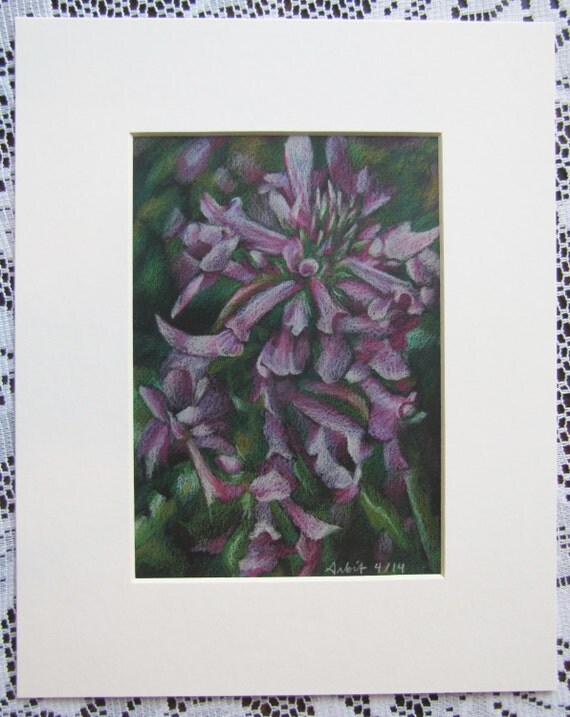
Flowering Herb

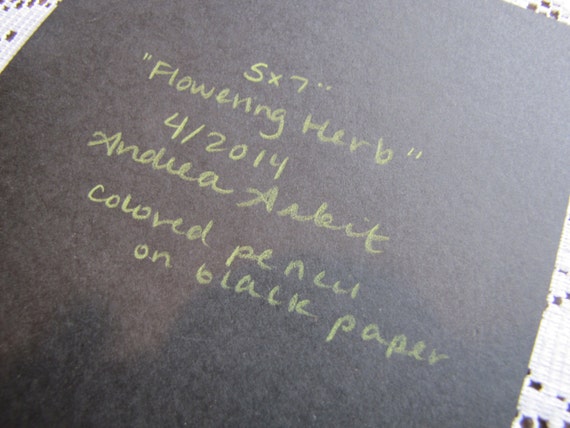
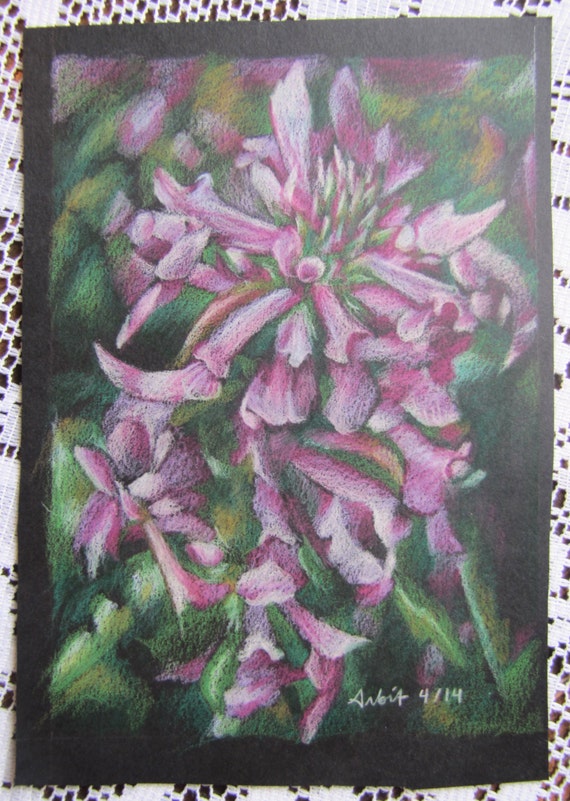
This is a 5"x7" colored pencil drawing I created in April of last year. It is for sale through my Etsy shop for $39 and comes with a 8"x10" arctic white Crescent mat suitable for framing.

"Flowering Herb" - 5"x7" Colored Pencil Drawing
Andrea Arbit

"Flowering Herb" - 5"x7" Colored Pencil Drawing
Andrea Arbit


I called this "Flowering Herb"... because I didn't know what plant it actually was. Was it lavender? Lilac? I can never tell the difference. I feel like a tool admitting it, but in the interest of full disclosure, I will - I know almost nothing about plants. My interest comes purely from the aesthetic side. I've never studied botany or gardening - I just walk through life and take pictures of the beautiful plants I see, and use those photos to create drawings and paintings. 

I do try to figure out what plants they are. I have a few apps on my phone that analyze pictures and make a "best guess" of what plant it is, and I've been known to bother the people in my life (or "experts" on the internet) who do know a thing or two about gardening for their opinions. But sometimes even with crowdsourcing, I still come up short with a definite answer.

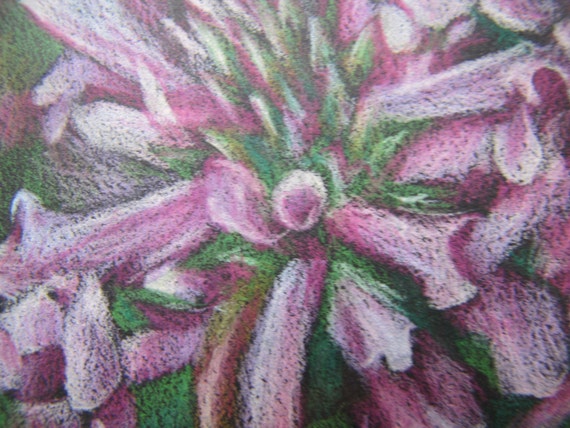
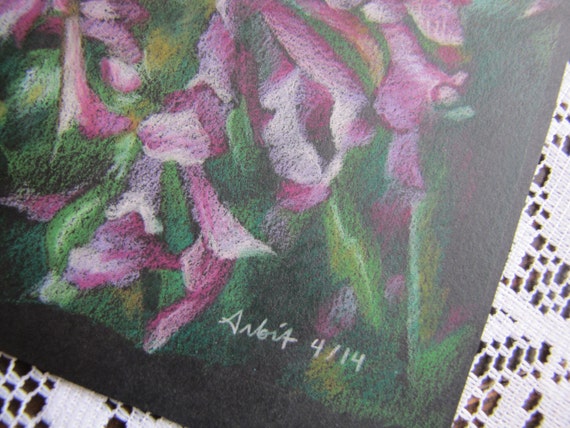
Here are some detail shots -

"Flowering Herb" - 5"x7" Colored Pencil Drawing (detail)
Andrea Arbit

"Flowering Herb" - 5"x7" Colored Pencil Drawing (detail)
Andrea Arbit


I just love the way the purple and green look together on the black paper! They really jump out. :)


Wednesday, September 9, 2015

Bandaged Duality & Ace Bandage Field

The last few entries have been pretty long. I keep going off on tangents - feminism, my adolescence, etc. I mean, they're not really tangents, I guess, in that they are a part of me and end up influencing my work. But they are topics other than what I intended to write about when I sat down to write the entry. So I will try to be briefer in these next several entries, as I finish up talking about my honors thesis paintings. I will try to keep my message more focused. :)

The next two paintings I created for my thesis were Bandaged Duality and Ace Bandage Field.

(Purchase Bandaged Duality in my Etsy shop!)


"Bandaged Duality" by Andrea Arbit - Watercolor on paper, 22"x30"

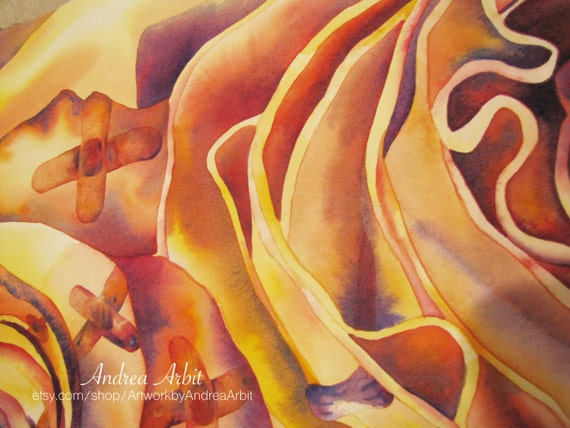
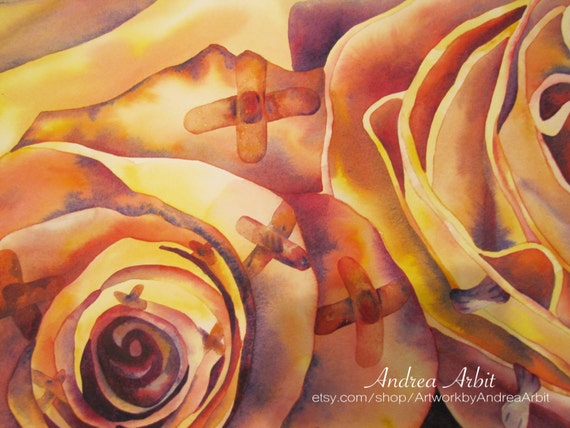
I used a similar composition for this painting as I did for Silk Caution, which I talked about yesterday. But in this painting, instead of pairing a hesitant rose with a spiral of silk, I paired a rose covered in Band-Aids (the plastic, disposable kind) next to a spiral of Ace Bandage cloth (the stretchy reusable material used to wrap larger injuries, like pulled muscles and sprained ankles). Together, the two circles evoke breasts.


As I note in the written part of my thesis, the rose looks relatively healthy - it is sort of the bluish-yellow color of a bruise, and it has a series of small Band-Aids taped onto it in "X" patterns, but the petals are still intact, and the rose is whole. "It will clearly be able to make a full physical recovery, despite any residual damage." About the Band-Aids I added: "The “X”s the Band-Aids create are a way to say “do not enter” without including caution tape, or they simply “mark the spot” of the rose’s injuries.

(Purchase Ace Bandage Field in my Etsy shop!)

"Ace Bandage Field" by Andrea Arbit - Watercolor on paper, 22"x30"

Ace Bandage Field steps away from the rather symmetrical two-circles composition in favor of a triangle of circular forms - a rose and two Ace Bandages wrapped up into spirals. The triangle is, like the rose, another symbol for female genitalia used throughout history (Judy Chicago used a long triangle-shaped table for her famous, feminist "Dinner Party" installation), but that wasn't the only reason I changed the composition up a bit. As an artist, I didn't want to (or wasn't supposed to want to) do the same thing over and over. And as a student, I was discouraged not to. (Keep in mind that I painted all of these watercolors for a studio art class. They were critiqued by my instructor and other watercolor students in the class, and I received grades on them.)


Besides the largest two Ace Bandages, there are others in the background. None of these bandages are doing anything to protect the flower. They aren't being actively used; they are simply sitting next to the rose. The rose itself is "slightly malformed and pale in color, but doesn't have any visible bruises or wounds." Are we supposed to believe something has damaged the flower, and that the Ace Bandages will be used to help the flower heal? Maybe the rose has internal damage - the kind of damage flimsy bandages can't treat. Maybe the rose isn't actually hurt at all, and is just pretending. Maybe the rose has been thrown into this pile of Ace Bandages, where it nearly blends in, because it is hardly different from an Ace Bandage itself. Maybe a rose, maybe female sexuality, is something that can be worn to heal its user from other physical or emotional or mental or spiritual injuries, maybe an orgasm is a salve women can use to repair or strength or protect themselves in whatever way they may feel they need repair, strength, or protection.


If you've been following this blog chronologically, you know by now the struggles I've dealt with myself, in trying to reclaim confidence in many different areas of my life. (If you haven't and want to get a sense of what I mean, I suggest you go back and read the last few entries.) For me, sexual confidence and sexual pleasure is something I've had to work on. But just because it's something I'm trying to change doesn't mean that it can't also help me in other areas of my life in return. It's amazing how everything is so interconnected. If I feel good about myself in other ways - like if I feel like I've had a productive day writing or painting or drawing - then I am also more likely to feel good about myself sexually (that is, I am more likely to want to have sex, or I am more likely to be able to achieve orgasm). And if I feel good about myself sexually, that also makes me feel more confident in general, which leads to be having more productive, great days with my artwork and writing.

By the way, it feels very, very strange to write about my personal sex drive or reaching orgasm on such a public forum like this. If I were talking in person instead of typing to a computer screen, I would never say any of this stuff. That doesn't mean I wouldn't want to say it - just that I would chicken out from doing so. I hope it's worth it, this putting myself out there. If reading about and thinking about me wanting to have sex (or not wanting to have sex, as the case often is, haha) makes you uncomfortable, just know that you're not alone. I'm uncomfortable too. But I wouldn't do this if I didn't think it was important - for me, mainly, but maybe for others too, if there are others who find this and understand, others who read this and relate.

Don't forget to check out my Etsy shop for these paintings and others in this thesis series!


Tuesday, September 8, 2015

Silk Caution & Poisoned Rose

Alright, so in yesterday's blog post, I started talking about my thesis from 2010. I hope this topic is interesting to you, because I plan to say a lot more on the topic, and go through all of the paintings I created for it. Today I'll be looking at the second and third paintings I completed for the thesis: Silk Caution and Poisoned Rose.

As you may remember from yesterday, my thesis was born because I both yearned for self-confidence in my body and my sexuality, and felt that such self-confidence was out of my reach.

I was raised in a Baptist church in Michigan. I even attended a private Christian academy for Kindergarten and first grade, and it was in Kindergarten that I "accepted Jesus as my personal savior." In fifth grade, I won a "Teen Study Bible" for memorizing the names of the books of the Bible and reciting them to an adult Sunday School class. I was 10. The Teen Study Bible had several glossy, colorful pages sprinkled throughout that offered Biblical advice on topical issues like friends, family, school, etc. - and the very first of these colorful distractions was bright orange and had the word SEX in big neon green letters at the top of the page. Unsurprisingly, it taught abstinence. There were a few FAQs at the bottom of the page where kids (or adults writing copy, posing as kids) asked how important it really was to save themselves for marriage, and what to do if someone was trying to pressure them into having sex, but there were no FAQs that might actually be helpful to someone who might have had real questions.

This sort of attitude about sex was the attitude I continued to hear about once I graduated into our church's middle school youth group. Sex was always presented as this Thing That Was to Be Avoided At All Costs, a Thing That Might Accidentally Happen To You If You're Not Careful Enough and Stand Too Close to a Boy, a Thing That Is Supposedly Wonderful and Amazing - But Only Allowed For Married, Heterosexual Adults. I was pretty terrified of the whole idea of sex, to be honest. It wasn't a big sacrifice for me to "pledge" myself to God, to promise that I wouldn't have sex before marriage. Sex wasn't something I actually wanted to do. I asked my parents for a silver ring with the words "True Love Waits" engraved on it. I read Christian books. I did not masturbate. I half-heartedly tried to use tampons but couldn't figure out how to get them inside my vagina, so I stopped trying - even when that meant my mom had to send my (male) gym teacher an email to explain that it wasn't fair for him to jeopardize my straight-A average because I couldn't wear tampons. During our swimming unit, I had to sit out for one week out of every four, and then I had to come in to school at 6 AM every Wednesday to make up the hours I'd missed while I was bleeding into my sanitary pads on the bleachers.

I saw sex (in general) and my vagina (specifically) as shameful and mortifying. Still, I happily, willingly, and actively participated in my own sexual repression because I thought it's what I was supposed to do, what good girls did, what good Christians did. I was even kind of perversely proud at the extent of my vagina's "purity" - that it had never even been besmirched by my own fingers or a tampon.

And then I took a Humanities class my senior year of high school, and I learned about other religions and historical attitudes and I started considering the negative side of gender roles for the first time. And then, as I grew enlightened and liberated in my thinking, I also grew ashamed and mortified of my shame and mortification. I decided everything I had grown up believing was wrong. I decided I wanted to figure out how to use tampons and I wanted to have sex and I wanted to explore my body and find confidence in my sexuality and I wanted to experience an orgasm. I also decided that my Christian upbringing was at least partly at fault for the attitudes I had about myself and my sexuality, a realization that led to (but was not the sole reasoning behind) my decision to step away from Christianity. I realized that I no longer believed in God. I tried to have faith in myself, instead. But I had no precedent in these new life changes, and I struggled to find my confidence - in many areas, but especially in my sexuality. I met my husband as a freshman in college. He too was inexperienced. We were each other's first relationship.

With all that back story, I think it becomes a lot clearer why I might have painted the watercolors I did - not only did I look at the first watercolor in what would become my undergraduate honors thesis and interpreted the patterns on rose petals as tattoos on flesh, but I was jealous of that rose's self-expression and felt that my own rose could never get away with such pretty decoration.

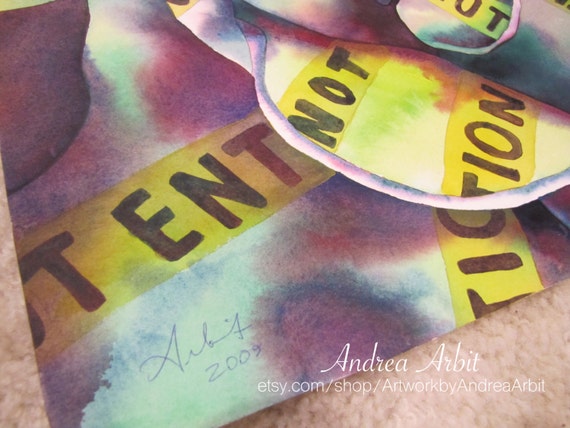
The next painting I created was Silk Caution. (Available for purchase through my Etsy shop.)

"Silk Caution" by Andrea Arbit - Watercolor painting on paper, 22"x30" 

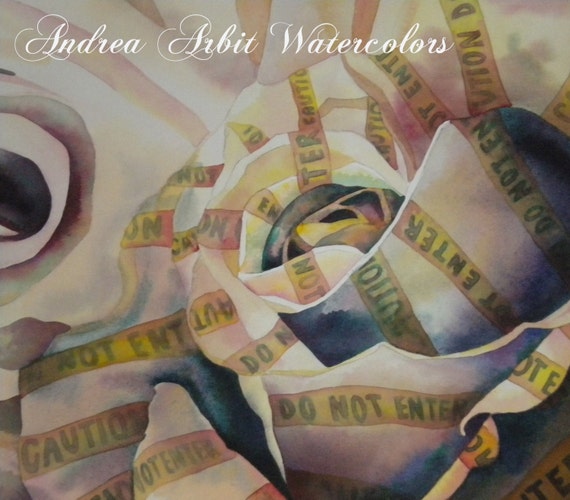
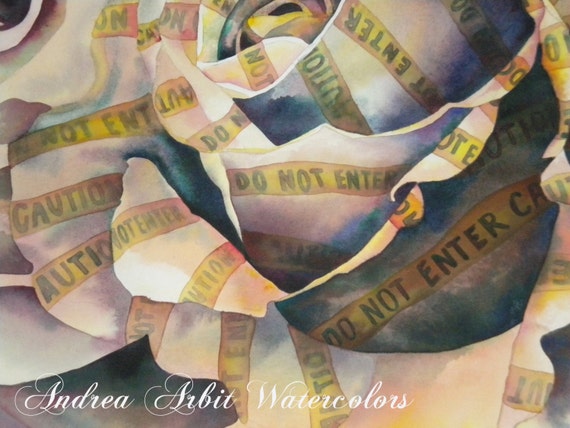
Instead of patterns, this rose is branded with yellow police tape reading "Caution" and "Do Not Enter." The rose is not actually wrapped in the tape; the actual rose petals themselves display the ribbons like birthmarks. I think of them as literally part of the petals, like the caution tape was manufactured and maintained by the rose. Maybe the rose was encouraged to grow that way, maybe she was cultivated by gardeners to display that particular message, but the message still comes, at least in part, from the rose itself. It was not forcibly held down and wrapped in tape. Like me, it participated in its own repression - because it was taught to do so.


Next to the rose is a spiral of silk, mimicking the shape of the rose. Other watercolorists in my studio class interpreted these dual circles as making the shape of an infinity sign, or as forming a pair of women's breasts. It was also noted that comparing the rose with silk made the rose seem even more soft, more delicate than it might already be, and that it was strange to see something so harmless covered in "caution" warnings. I was asked if the caution tape was in place to protect the viewer from the rose or to protect the rose from the viewer. When I was painting it, I'd thought only of protecting the rose. I identified with the rose. I imagined that it had put the caution tape on its own petals, as a way to avoid the world.


In my thesis, I said that the caution tape might be unjustifiably used, that perhaps the rose and viewer do not need to be protected from each other. But now I question where caution tape even can be "unjustifiably" used. Who decides what's justifiable? Does it matter if there are "real" dangers - to either the rose or the viewer - if either of them perceive the real possibility of dangers? Is it not enough for the rose to want the safety net of wearing that tape - does she need a specific trauma she's responding to, a specific reason? And is it not worthwhile for the viewer to be warned that things might not always be what they seem - even if, in this case, the rose is what it seems to be: a flesh-colored flower, harmless and meek and not inherently dangerous?


"Poisoned Rose" by Andrea Arbit - Watercolor painting on paper, 20"x22"

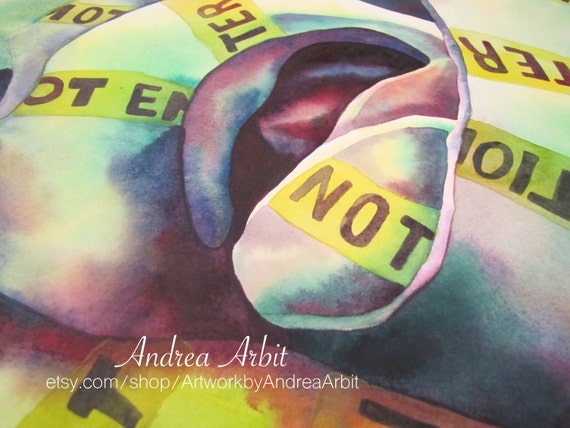
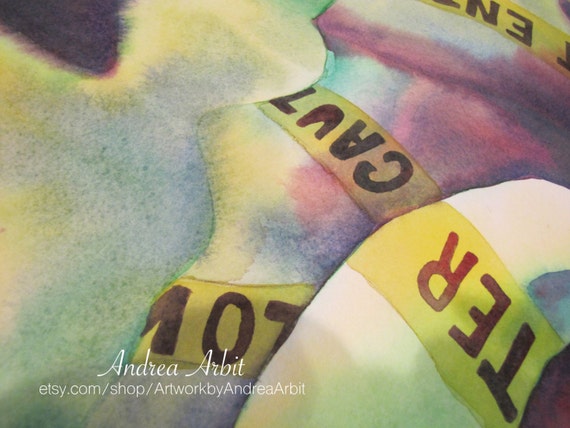
For the next painting I created, Poisoned Rose (also available for purchase through my Etsy shop), I changed the color palette so that the rose would actually look unsafe. The green and purple and yellow look like bruises, like sickness, like poison. In my companion written thesis, I again asked the reader to consider who put the caution tape on the rose, and what the intent of the caution tape was. Even though this rose looks more dangerous, that doesn't mean it actually is. I wrote: "The wings of a non-poisonous butterfly might mimic the bright colors of poisonous butterflies as a survival tactic. Might the rose be green to ward off potential predators?"


Of course, this doesn't apply only to sex, to sexuality, or even only to women. Many of us put up walls to hide behind. We might project a "don't come near me" vibe in new, uncertain situations, until we get a feel for the other people around us and whether or not they can be trusted. As an extreme introvert with avoidance and low self-confidence issues, I do this a lot. I stay in a corner. I don't reach out. When I am spoken to, I keep my answers short, on the verge of impolite. I'm not trying to be mean, or rude. I do it because I'm anxious, or apprehensive, or afraid. I do it because I'm not used to acting extroverted, because I feel comfortable and safe doing what I've always done. I do it to protect myself, even when I don't actually want to protect myself so much from life that I miss out on experiencing the joys of life around me. I might even sometimes do it because of a misguided attempt to protect others from having to get to know me, if I'm riding a particularly cruel wave of self-imposed, self-sabotaging low self-esteem. I don't always know why I do it. Maybe this rose doesn't know either.


I named my thesis painting series "Hesitant, Hurt, and Healing Flowers." These two paintings fit in to the "Hesitant" category. We don't know what - if anything - is actually "wrong" with them, but we are told to stay away. In that sense, these two paintings are me. In other, later paintings, I show evidence of physical damage; the roses in other paintings have been victims of abuse or rape or female genital mutilation. They are not hesitant - often they are so freshly wounded that they don't really have the opportunity to be hesitant just yet - but if, in the future they chose to be hesitant, I don't think any viewer would blame them.

But what about those of us, like myself, who have no real, obvious trauma that they are working to come to terms with? What about those of us who are uncomfortable with themselves, with their bodies, with their sexuality, with any displays of confidence - not because they've been obviously abused, but simply because of how they were brought up, or because of something ingrained in their genetics or their brain chemistry that is keeping them from being their happiest, most confident self? I have to remind myself often that I do not need a concrete reason to feel something. My feelings have value. I don't need to have been raped to be cautious and hesitant with my body; I don't need to be struggling with PTSD in response to a specific trauma. That is not to say that my "issues" are comparable to someone else's "issues," someone who <i>does</i> have a history of assault or sexual trauma to deal with. But that also doesn't mean my "issues" don't matter in their own right.

It's like systems of privilege. As a white woman I am not going to experience the same discrimination that a woman of color will in her lifetime. I am not trying to compare mine to hers. In fact, I am actively trying not to compare mine to hers. Because when I compare mine to hers, I know she "wins." She will have it worse off than me. And so then I think - how can I complain about A, B, and C, when there are other people who have to deal with X, Y, and Z, which are so much worse. So then I feel bad about feeling bad, because I feel like I don't have a right to feel bad. But using my privilege to beat myself over the head like that doesn't help anyone.

Six years later, I'm still a "hesitant" flower. But I'm trying to work on being less hesitant - another reason for going so "full disclosure" and talking about all this in a blog. I want to better myself by sharing myself, by removing the caution tape I've put up over the years, by dismantling it layer by layer.

Don't forget to check out my Etsy shop for these paintings and others in this thesis series!

Monday, September 7, 2015

Feminine Layers

Before I get into the art I've created more recently, I want to take a step back and discuss a little about my senior honor's thesis, which I wrote for my BFA in 2010. This thesis is what I am still best known for today, and is available on EMU's website for free.

Not long ago, I googled my name (both in its current form, and under my maiden name, Andrea Frownfelter, which I was still using when that thesis was finished), and was pleasantly surprised to find that my thesis is currently being used as a citation on the Wikipedia page for "Flower" (look under the subheading "Symbolism"), and that it was referenced in a Prezi presentation for someone's final project about Dracula and in a July 2014 blog post by cavalcadeofcookies. I was also recently contacted by Eureka, a television production company based in Montreal, because they had read my thesis and wanted to interview me for an upcoming series on sexuality/sensuality in contemporary art.

This thesis is definitely the most politically/socially charged work I've done to date, as well as the most cohesive series I've created. There were 11 large watercolor paintings in the series (ranging in size from 20"x22" to 22"x30"). All are still available for sale (although I currently have "Pinned for Safety" and "Stabbed" hanging in my dining room, and am a little more reluctant to part with those two).

And the thesis all started with this painting, which I named Feminine Layers. (Available for purchase through my Etsy shop.)

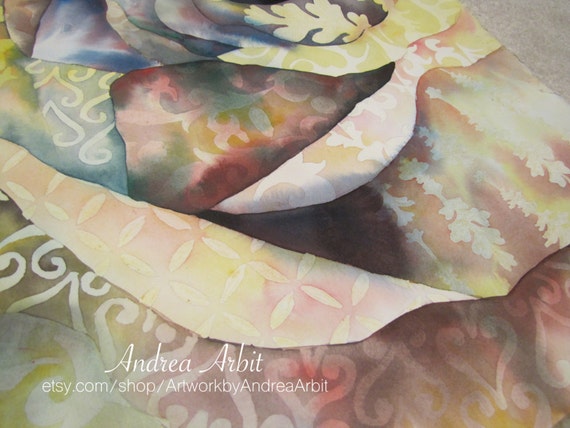
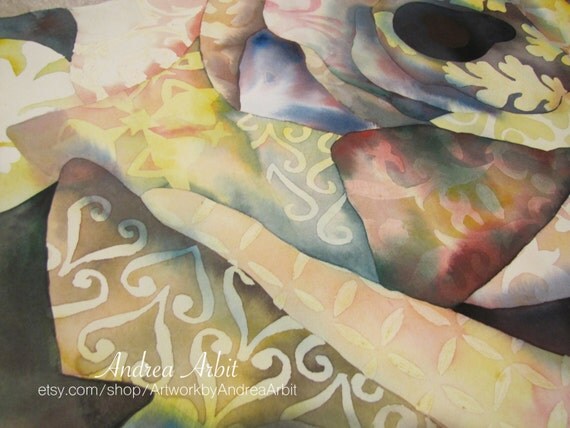
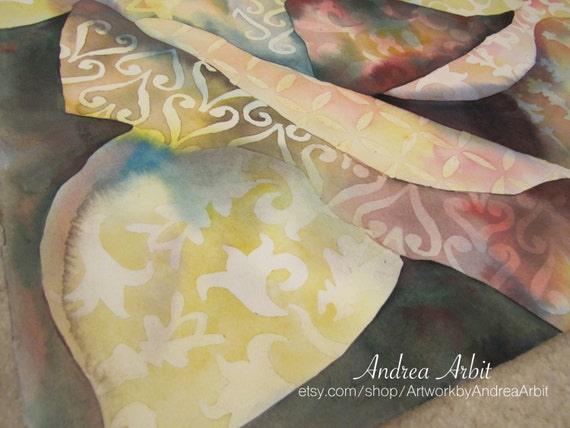
"Feminine Layers" by Andrea Arbit - Watercolor painting on paper, 20"x22"

I had taken a few watercolor studio classes at Eastern and had found that I was particularly fond of painting flowers - something about the organic shapes just appealed to me more than any other subject matter. I was also, at this time, taking graphic design courses for my second art concentration, and so was playing around a lot with Photoshop and Illustrator, creating my own patterns and designs. In this painting I decided to combine the two, layering patterns onto the petals of a rose, with the effect that the rose was "flattened" into a more abstract design. Other than experimentation and a desire to merge the two disciplines I was studying, I also leaned toward this less realistic style because I did not have confidence in my ability to pull off something that was hyper-realistic. I still considered myself a watercolor novice and I saw other women in class who were so talented in realism that I did not think my own watercolor skills would ever compare.

I say "women," by the way, because there were only a dozen or so of us pursuing watercolor as a concentration (either at the bachelor's or master's level), and we were all women, with only one exception - and his focus was on using watercolor to illustrate comic books, not to create large-scale realistic (or semi-realistic) paintings. This gender distribution was a stark contrast to the near 50-50 gender split in my graphic design classes, and to my life drawing classes (drawing from nude models), which were also close to 50-50 but slightly skewed toward more male students in each class. Let me drive home this point further, because I think it's so interesting - there were more male students in the Jewelry making studio I took as an elective one semester than there were in any watercolor class I took. My guess is that, even though women are the bulk wearers of jewelry, working and shaping metal was seen as a more "manly" art than painting watercolors - and that, subconsciously or not, this "gender bias" influenced which artistic fields the male art students gravitated toward.


Watercolor is seen as feminine, as dainty, as soft - even as relaxing. I have told people that I paint watercolors and heard wistful sighs because they, too, would love to spend all day just painting watercolors - "It must be so relaxing!" No. It's not. Maybe I'm doing it wrong, but watercolor is not relaxing to me. It's in fact fraught with worry, because once the paper is wet, I have only so many minutes to play around with the pigment before it starts to dry. The speed at which it dries depends on the temperature and humidity of the space, and can vary from one day to the next in the basement studio in which I work. (It's not that great a space, I guess.) And, unlike acrylic paint, I can't lighten a watercolor later by adding white paint on top again. Watercolors are translucent, which means that every layer you add still shows a little of the layer underneath it. So with every subsequent layer, the colors will only get darker. If you need a light color - a white, a pale yellow, a pale pink - you need to preserve those areas ahead of time, because once you start painting you can never go back. It's like writing something and not being able to use Ctrl-Z, not being able to backspace. It's a little terrifying, to be honest. Once you put water down, you're sealing everything underneath it. It can't be easily changed back. This is where I get anxious, where I struggle to finish a painting - because if it starts to look good, I worry that subsequent layers are going to just mess it up, that maybe it would be better to leave it as is, when it still shows promise.

Watercolor requires a lot of forethought, a lot of planning, and a lot of patience. After one layer is down, I have to walk away from it until it dries completely before I can move on to the next layer. It requires a lot of control. I don't know if that is an argument for why it is seen as stereotypically feminine - because "boys will be boys," they can't be tamed, they can't be expected to have that kind of quiet patience - or if that's an argument for why it shouldn't be seen as stereotypically feminine - because it's an intellectual art, requiring premeditation and dexterity. Maybe it's simply an argument for why categorizing fields of art (or any profession for that matter) into "feminine" and "masculine" areas is stupid, and why the words "feminine" and "masculine" are stupid words that only have meaning if we continue to give them meaning, words our society should've "gotten past" by now, if the sexes were truly equal. Why can't boys be quiet and patient? Why can't girls be cerebral and skilled?

But I'm getting off track.


When I started this painting, I wasn't necessarily thinking of flowers as symbols for female genitalia; I chose flowers and I chose patterns for aesthetic reasons. But as I painted, and as I started thinking about what drew me to that aesthetic choice, and as I heard what others in my class were saying about the painting during critique, I realized that I could create a pretty powerful message (or, rather, pretty powerful messages - because I don't believe any art can be or should be interpreted in only one way, even if the artist had one specific way in mind) if I used that well-known symbolism to guide a viewer's interpretation in a certain direction.

And so my thesis was born. I read about Judy Chicago and her paintings and drawings and sculptures of vulva-shaped flowers and butterflies, and I adjusted my painting to emphasize the center of the rose. As I said in my thesis:

"The most abstracted part of the flower is also the watercolor’s emphasis – a dark organic shape in the top right of the painting, which is meant to act as the core of the flower, from which the petals radiate. At the time that I created this piece, I was still in the beginning stages of researching flower symbolism; one artist whom I had already stumbled across, however, was Judy Chicago. I was immediately drawn to Chicago’s so-called “cunt imagery,” that is, paintings with brightly-colored, centralized, symmetrical designs radiating from a center. Though Chicago’s imagery resonated with me, it evoked a feeling I only aspired to, rather than one I had actually felt. With Chicago’s imagery and also my own worries in mind, I created this dark abstract flower center, to symbolize the mystery and shame that many women associate with their vaginas. As Eve Ensler so aptly puts it in her play The Vagina Monologues, “There’s so much darkness and secrecy surrounding them – like the Bermuda Triangle. Nobody ever reports back from there. In the first place, it’s not easy even to find your vagina. Women go weeks, months, sometimes years without looking at it.”"

You may be wondering what I meant by "my own worries." This blog entry is already getting lengthy, so for now I will leave it at this - I painted this watercolor when I was 20 years old. I had only had one boyfriend (and still have only had one relationship, for that boyfriend became the man I married), and had very little sexual experience. I was - and often still am - ashamed and mystified by my own body and by the idea of sex. I did not know how to talk about it or what to think about it. I understood that it would be great, would be liberating, to have positive feelings about my body and about sex, but I was not there yet (and would argue that I am still not there today, six years later).


In any case, I paired that dark, mysterious rose center with decorative petals in lighter colors and fanciful patterns. Maybe I was thinking about how I wanted to feel, or about how other women might feel (Judy Chicago, for instance, who I imagine would be skeptical or disappointed or disgusted or exasperated that a 20-year-old, a 26-year-old today might feel more inhibited, more restrained, more embarrassed, than she ever had about herself decades earlier). Maybe I just liked the way they looked, liked the contrast between the dark colors and the light colors.

In my thesis, I wrote that the patterns referenced domestic life - upholstery, wallpaper, tablecloths - and therefore a stereotypical feminine aesthetic. I exhorted myself for this, asking how I could "admonish feminine stereotypes if I'm so willing to work within them myself". Six years later, I still have no real answer for this. I still find myself absorbed in delicate patterns. I still want to paint them, to draw them, to pair them with other feminine stereotypes - flowers and teacups and fabric. I wish I didn't; I wish my tastes gravitated instead toward more neutral or masculine subjects, so that when I say women should not be asked to fit a certain mold, I can demonstrate how that would look, a woman who paints what a man might paint. I do not know if my tastes are intrinsic, or if I've developed them because of what I've been taught to prefer. It is the age-old nature vs. nurture debate. I don't know if I should fight these tastes, strive to develop new tastes, or if I should accept where I am now, who I am now, what I'm drawn to - as part of the female sex, a sex that is far more varied than feminine stereotypes would lead us to believe.


Once I recognized that flowers could be symbols for sexuality, for sexual organs, for flesh; once I continued painting watercolors with this idea in mind, I couldn't help but reinterpret this painting, my first in this thesis series, again. If the petals are skin, then the patterns painted on the petals would be tattoos, a way of branding one's own body, a mode of self-expression. As I said in my thesis, "Tattoos on a rose... would then speak to defining a woman’s individual sexuality." I wanted those tattoos, I wanted that self-expression, but I felt that I didn't deserve it, or hadn't earned it, or shouldn't exert it. I avoid displaying confidence in most things, my sexuality included. For some women, I know, it is easy to get past society's prevailing attitudes. For others, for me, it's been unbelievably hard, an ongoing struggle. In an ideal world, women would feel comfortable expressing their own opinions, of being their own sexual beings - but we do not live in an ideal world. In my thesis, I ask if a woman can get past our country's, our religion's, our culture's history of embarrassment and shame with regards to female sexuality, any sexuality. I ask if society's attitude is too pervasive to overcome.

My answer to that question depends on my level of optimism.

Don't forget - this painting is available for purchase through my Etsy shop!

Tuesday, September 1, 2015

Here I Am

Here I am, starting another blog. This time, my main goal is transparency. I want to write honestly. I want to show you - whoever you are - who I am and what I am working on.

I am an artist. I design patterns on my computer, I design digital compositions for watercolor paintings, weaving patterns and photographs together in Photoshop or Illustrator, and I use those designs as a basis to create watercolor paintings. I take photographs, especially photographs of flowers. I also turn these photographs into colored pencil drawings: lines of vibrant color cutting through harsh black paper, a mask of something decorative or feminine or pretty over something mysterious and brooding. I love layers - layers of imagery, multiple steps of process, layers of meaning. I think a lot. I get stuck in my head. I procrastinate a lot. I get scared.

"When Fear Gets in the Way" 15"x11", watercolor on paper
I started this in 2013. Originally, it was supposed to have a lot more layers of paint, so that the dahlias would look like real dahlias and less like "dahlia abstractions." But I could never bring myself to finish. I was too worried that I would mess up the parts that were looking good so far, that I couldn't make it look any better than it already did, in its half-finished state. So I called it "done," stuck a title on it, and signed the corner. In Victorian Flower Symbolism, dahlias stand for dignity. This painting is my dignity: half-naked, half-exposed. Fear stopped me from bringing it to the level I wanted it to reach.
(It's available for purchase, half-finished, as-is, if you're interested. I'm doing a great job selling this, right? Contact me: afrownfe-at-gmail-dot-com.)

I am also a writer. I come up with incredible fictions - whole worlds, whole families, whole characters - and they dance in my head while I sleep, while I lay in bed trying to sleep, while I'm wide awake, walking through my day. I plot. I organize. I outline. I reorganize. I reoutline. And once and a while, I write. I string words into phrases, into sentences, into paragraphs, into chapters, into novels. And I edit those novels, and reread them, and re-edit them, and send them to a select few to read and offer commentary on. I delete entire pages. I move entire chapters around. I start over from scratch from another character's point of view. I debate sending queries out to literary agents, to publishing houses. I search for self-confidence. I haven't quite found it yet.

I am a woman, a human, a Caucasian-American, a Michigander, a feminist. I am a wife, and - as of about a month ago - a puppy parent. (More on our new puppy Ginny in another post, I'm sure.)

Ginny, at about 3.5 months old

I am (occasionally, temporarily) a substitute teacher. (It's not fun, but it helps pay the bills. A little.) I graduated from Eastern Michigan University in 2010, and, five years later, still have almost no idea what I want to "do" for a job, for a career. I earned a BFA degree with a double major - Watercolor and Graphic Design - and a minor in art history. I earned university and art department honors. My cumulative GPA was 3.97 (my one B+ was in a Jewelry studio class). I graduated when I was 21 years old, in four years - although I had enough credits to graduate after three years, if I'd wanted to stop. (I had a full tuition scholarship. I hadn't wanted to stop.) I loved school. I always have. I love to learn. I taught myself to read before I entered Kindergarten. I still read a lot - my goal this year is to read 85 books in 2015, and I'm currently on track/ahead of that goal. I have a Goodreads account, where I post reviews of everything I read.

I have a store on Etsy, where you can purchase some of my artwork. I also had a website, until a year or so ago, for a custom stationery design company I called "Invites by Andrea." The website is down now - I felt like I wasn't reaching anyone with it, that it wasn't worth the annual cost of $100 to maintain it, to pay for the domain name, to pay for web hosting - but I'll still design stationery for you if you want. I have several hundred brochures all made up listing prices for invitation designs and printing out save-the-dates. I passed a lot out - at bridal shows, mostly - but I still have two boxes that never left my house. Brochures collecting dust, waiting for me to figure out how to be entrepreneurial enough to properly use them. Most of my business was (and continues to be) word of mouth. My customers are family members, and friends, and friends of friends. It's fun work, it's a little extra cash, but it never turned into what I'd imagined it might when I first started out, when I first signed up for that website, when I paid money to set up a table at a bridal show, when I got all those brochures printed.


A watercolor sign I painted to hang at bridal shows to attract traffic to my table. It normally hangs from the wall on three binder clips balanced on nails in my "office" (a spare bedroom in my house). I can see it while I type these blog posts.

I had a blog I was using for a while - "Ideas by Andrea" - which was set up as a compliment to my invitation design business. There, I posted images of stationery projects, and DIY ideas, and color combinations. I got a surprising number of hits - 58,000 total pageviews - but no one ever commented on my posts, or followed the bread crumbs to my stationery website to contact me, to commission invitations for their event. They took my ideas and left. I made no money.

And that's fine. Life isn't all about money. I like the idea that someone found something useful on that blog, that my thought of pairing jade green with coral - which I did for my own wedding, in 2011 - was a thought shared, or absorbed, or repeated by others because of pictures I posted, because of words I wrote. I suspect that's all this blog will do, too. Strangers will stumble onto it, stay for a page, make note of something I say, and move on, without me ever knowing the extent of my impact, without me ever making a buck.

Jade green ribbon and coral roses adorning our delicious wedding cake in 2011

But see, last time, I made the blog for other people. I offered suggestions for what kinds of parties they might throw, what sorts of decor they might employ, what cool invitations they might like. I didn't know who was reading it, but I wrote it for them anyway, those anonymous people Google tracked for me, those numbers that showed up on my stats page. This time, I'm going to write for myself. I'm going to explain things that are important to me - things that might not even be art related, political things, maybe, or social justice things. So that other people might understand me or the artwork I create or the stories I write, if they wished to, but also just for my own records, so I remember how I saw the world and my place in it back when I was twenty-six years old. I'm also going to show current projects I'm working on - and be totally transparent about the emotional struggles that go along with them. I'm going to show you who I am; I'm going to show myself who I am.

I think this will translate into fewer pageviews, but - hopefully - deeper connections. Maybe my readers will want to follow my blog because they relate to my struggles or appreciate who I am. Maybe they'll want to purchase a watercolor painting from my Etsy store if they've seen on this blog the steps it took for me to create it, the blocks I had to overcome, the time and effort that went into it. Maybe they'll still just read one post (or skim one post - let's be honest, I'm verbose and the average Internet peruser does not care for verbose), and move on, just like they did on my other blog. But if my main goal is to write for me, to be authentic and transparent because my most important reader is myself, the myself of the future that will come back to reread these entries to remember my life, the myself of the present who is reading them now, as she writes them - than any other positives that come out of this blog will be icing on the proverbial cake; not the cake itself.

(Although, I always did like the icing the best.)