Showing posts with label genitalia. Show all posts

Monday, October 15, 2018

Missed Miscarriage


Trigger warning: Discussion of miscarriage, including emotional grief and graphic descriptions of the physical process

***


Today, October 15, is Pregnancy and Infant Loss Remembrance Day.

I wanted to make a happy social media announcement this week - the week that would have marked the beginning of my second trimester of pregnancy. Instead, I'm making a different sort of post.

At my eight-week ultrasound at the beginning of September, I learned that I was having a missed miscarriage. Though my body had yet to get the memo, the ultrasound showed that everything was measuring only six weeks and five days along, with no detectable heartbeat. I had no symptoms of miscarriage, and over the next few days, while I researched what might happen next and talked to my doctors, I would still never have any symptoms.

And so I was faced with a series of awful options:
1. Anxiously wait several more days (or weeks) for my body to start naturally expelling what the medical field calls "the products of conception"
2. Take medication to induce uterine contractions to speed along the process
3. Get a D&C - a surgical dilation of the cervix and removal of the uterine contents by suction

I read several accounts online of women who had chosen options 1 or 2 (or been forced to endure them by nature, their doctors, or financial limitations), and knew from their stories that the experience was often physically and emotionally traumatic. For one thing, it would almost certainly include some degree of labor-like pains as I “birthed” into the toilet the blood clots and tissue of what could’ve, in an alternate universe, become an April baby and its placenta. Furthermore, there was a chance I could end up in the ER if I started hemorrhaging or fainting due to blood loss - or that I wouldn’t be able to pass everything naturally anyway, and still end up requiring a D&C to prevent infection. It all sounded horrific, from both a physical and emotional standpoint, and more than anything, I didn’t want to do it.

Option 3 carried its own risks - as any surgical procedure does - but on the whole it seemed the “least awful” to me. At least a D&C would get the physical process over with faster, less painfully, and on my own terms - something I longed for in a situation where I felt like I had so little control about what was happening. (It is worth noting that my husband has health insurance through his work which covered the majority of my D&C, and we have the means to cover what’s likely to be our $1000-1400 out-of-pocket expense. I didn’t have to factor in the financial cost when making my decision - a privilege that I wish every person had when weighing important options about their health.)

I told my doctors I wanted a D&C, and they quickly scheduled the procedure for me, on the day that would’ve-could’ve-should’ve been one day shy of a nine-week pregnancy. My first pregnancy was thus completed in the span of exactly two months, from July 13 to September 13.


Left: At my 6-week ultrasound on August 24 we were told that everything was measuring slightly behind, at maybe 5 weeks 5 days - but that it was common for dating to be off by a day or two that early in the pregnancy, especially if there was a chance it implanted later than expected. The ultrasound tech insisted that she could see a fluttering signaling the beginnings of a heartbeat, and while it was "still too weak" to officially measure the heart rate, she remained optimistic that it was just because it was so early that a day or two can make a huge difference in the embryo's development. We had no reason to believe I would have a miscarriage, and the ultrasound tech spent time showing us which parts were the gestation sac, yolk sac, and fetal pole.

Right: In the two weeks between my early ultrasounds, I watched some of my early pregnancy symptoms lessen or disappear - while other pregnancy symptoms ramped up. Part of me worried that I might be having a missed miscarriage, but as this was my first pregnancy and I had nothing to compare it to, I had no REAL reason to believe that these changes meant anything. Still, I was much more nervous going in to my 8-week appointment on September 7 - and not just because I'd told more people about the pregnancy in the interim and was getting rather attached to the idea of being pregnant and becoming a mom. The ultrasound tech at my 8-week appointment was much quieter, making her measurements quickly and silently. Before she said the words, I already knew. She handed me tissues while I cried. After a moment, she said: "This may seem weird, but would you like a picture?" I didn't think it was weird. I was grateful. And even though I already had one from my 6-week ultrasound, I said yes, I wanted another one.


Pregnancy loss is a grief that is hard to reconcile, with very few answers to explain why, and very few memories or pictures to draw on for comfort. And all of these feelings are compounded by changes in hormones, which come crashing back to pre-pregnancy levels after weeks of steadily rising. I am not often a crier about Big Things - I tend to grieve more silently - but there were days before and after my D&C when I was surprised at how emotional I felt.

There is so much to process - not just the loss of someone you'd never met but somehow started to bond with anyway, or even the loss of potential: what that baby could've been, what our family could have been. There's the fear of what will happen physically: the potential pain and loss of blood if the miscarriage should start to happen naturally, the possible complications of a surgical procedure, and anxieties about how long physical recovery will take. There's the feeling of being cheated out of a joyful pregnancy and birth and sharing that happiness and excitement with the world - and the awkwardness and grief of telling family, friends, and coworkers that you miscarried, many of whom never even knew you were pregnant. There's the loss of the sense of pride and accomplishment in carrying a child to term, giving birth, and becoming a mother. There's envy towards women to whom pregnancy seems to come easily, and anger that I was not one of them.

There's even difficulty readjusting back to a state of non-pregnancy: planning meals for the week that suddenly aren’t restricted by pregnancy diet requirements, re-adopting my pre-pregnancy blood glucose targets, unsubscribing from weekly pregnancy update emails (and trying to ignore all the targeted pregnancy-related ads on my Facebook feed that I couldn’t unsubscribe to), and packing up maternity clothes I purchased prematurely and never got to wear. These mundane tasks might seem like nothing - but they’re not unlike the tying up of loose ends that many mourners go through when a loved one dies: sorting through their belongings, stopping mail, contacting other people or businesses to let them know of the loss, and paying off medical bills.

There's also resentment stemming from never knowing the cause of my pregnancy loss. I never truly blamed myself, but many women do. I’d read so many articles and statistics even before I’d been through my own that I knew miscarriages were caused by unpredictable chromosomal abnormalities; furthermore, I was fortunate enough to hear from many people (including my very kind doctors) that it was nothing I did or didn't do, nothing I ate or drank, and not even anything related to my diabetes, which is generally very well controlled (and a discussion for another time). But that didn’t stop me from WANTING to find a way to hold myself culpable - because then at least there would be a reason it happened, and something I could do differently to prevent a recurrence. Without that, I'm left with the unsatisfactory truth that life and death are unknowable and uncontrollable; I'm left with a loss of innocence for potential future pregnancies and the fear that this could all happen again.

In my particular case, preparing for my D&C, there was also a longing for my pregnancy to "not be taken away" from me, or (to put in other words) for me to somehow find a way to both get the physical process over with as quickly and painlessly as possible while also not being "complicit" in having my pregnancy terminated. Of course, it was already ended, whether I was "complicit" in it or not - my hCG hormone levels were dropping, the “products of conception” were starting to break apart, and my pregnancy symptoms had been disappearing or gone for days if not weeks. But despite all the evidence from blood draws and ultrasound screens, it was still hard to believe that it was over - and hard not to ask the doctors to triple and quadruple check for signs of potential viability.

I'm sure that initial disbelief affects all women who go through a pregnancy loss - denial is one of the stages of grief, after all, and there are undoubtedly women who pass golf-ball sized clots or survive unimaginable hemorrhaging and pain and still hold out hope for the continuation of their pregnancy - but I also felt like it was a hurdle somewhat harder to cross when I wasn't experiencing any of the telltale bleeding or cramping symptoms. Not only was I upset that my body was unable to maintain the pregnancy, I was also angry that it couldn't seem to "miscarry properly" either, leaving me stuck in a horrible limbo.

Getting a D&C was not a decision I settled on lightly, but one I ultimately chose for my mental and physical health. I hoped to at least avoid the worst of the pain and bleeding - and I'm sure that I did, compared to what it could've been - but in doing so, I forgot that getting a D&C was hardly nothing. My post-op paperwork told me that bleeding for up to six weeks after the D&C was not uncommon (mine lasted on and off for about two weeks), and recommended that I take 600 mg of Motrin every six hours as needed for pain. To be sure, there were days when I had very little cramping or bleeding, and no need for Motrin. But there were a few days, more than I had anticipated, where the opposite was the case and I needed that pain medication to get through the day. A D&C is still a miscarriage.

It took three and a half weeks (and seven pokes for blood draws at the doctor's office) for my hCG hormone to get completely back to non-pregnant levels after my D&C, but thankfully only about one week to start to feel like my body was my own again - that I could count on it to look the way I expected it to look, feel the way I expected it to feel, and behave the way I expected it to behave. Even though I'd been early in my pregnancy, my body had still gone through several changes: by 8 weeks, for instance, the uterus has already grown to twice its typical size - which isn't really visible from the outside, but feels and looks very different to the person it's happening to, as things get more crowded in their abdomen. It was such a relief, then, when I started to feel like "myself" again; after weeks of emotional and physical turmoil, it was a comfort to be back in familiar territory. But that relief was also colored with guilt, shame, and anxiety that were hard to dispel. What if my relief meant I hadn't wanted to be pregnant enough, or that I wasn't ready to be pregnant again?

I tried to tell myself that if I had carried this pregnancy to term, no one would fault me for my happiness at seeing my body return back to normalcy - and indeed, that no one would likely fault me for feeling this way after this ordeal, either, and that I was once again being my own harshest critic. I also reminded myself that pregnancy can be difficult to endure even when it’s at its easiest and least complicated - and that I would never accuse another person who hated or feared the physical changes of pregnancy of not loving their child or looking forward to parenthood enough. But it’s hard to rationalize your emotions away, and what ultimately helped me feel better (about this and so many other aspects of the healing process) was confirmation from others going through similar situations that they felt the same way I did - that it was normal to feel conflicting emotions even over things as seemingly innocuous as the speed/ease of digestion, the frequency of urination, or the shape of my stomach in my favorite shirts.

When I was pregnant, I thought about being pregnant nearly constantly - from worries about when nausea might strike and how that might affect how much insulin I should take, to the excitement of planning the paint colors for the nursery. When I learned of my missed miscarriage and all those pregnancy thoughts vanished, I filled the vacuum they left behind with other anxieties: Was that twinge a symptom of impending miscarriage? Will I “make it” to the date of my scheduled D&C? Is it typical to have these cramps and on-and-off bleeding after the procedure? When will I feel normal again? As more weeks passed and my body healed, it was hard to stop obsessing. I wasn’t sure if I should toss aside all my memories of what I’d been through or if I should continue to dwell on them, to mourn, to read online articles about grief.

And if I do let all the thoughts about my pregnancy loss fall away - what should I think about instead, to fill that new vacuum? Is it too soon to start checking my temperature and peeing on sticks in an effort to chart what would likely be an irregular first couple of menstrual and ovulation cycles? Is it unhealthy to keep switching out one obsession for the next - pregnancy for miscarriage, miscarriage for trying to conceive again?

Once enough time has passed, it all starts to feel like it never really happened. It feels weird to say “when I was pregnant” when I have nothing to show for it but a couple grainy sonograms and weeks-old, already-fading memories of early pregnancy symptoms. It feels like something that happened to someone else. That, too, is painful. This was my first and (so far) only pregnancy; this was the closest I ever came to having a child and becoming a mother. Until I get pregnant again, these memories are all I have. And I don’t want to forget them.

Statistically speaking, at least 1 in 4 pregnancies end in loss - and yet, we hardly ever talk about it. It is remarkable, when you start talking aloud about your miscarriage, how many people come back with “me too” - people who you would never know had a miscarriage until you mention yours. To quote Angela Garbes in her amazing book Like a Mother: A Feminist Journey through the Science and Culture of Pregnancy: "Many people are uncomfortable talking about pregnancy loss, so they don't. And it's no wonder - any meaningful discussion of it requires acknowledging death, blood, tears, and items being expelled from the vagina." But just because it's difficult doesn't mean it should continue to be taboo.

I'm choosing to share my story publicly because I want other women who have experienced pregnancy loss to know that they are not alone. Pregnancy loss can feel very isolating - but it doesn't have to be. I am so grateful to everyone who showed me support in the days before and after my miscarriage, including family, friends, coworkers and strangers on internet forums.

I’m also choosing to share my story for my own sake. There is a lot of societal pressure to bury this topic, presumably to save other people a few minutes of feeling uncomfortable or sad, and I often feared that no one wanted to hear any of this - let alone hear me “still” talking about it, weeks later. What can I do, then, when talking or writing helps me, but I feel like I’m not allowed to talk/write about it? Share my thoughts anyway, I suppose, without waiting for other people to give me permission to do so. I still want that outpouring of love and support that I would’ve gotten if I’d had happier news to share today; I don’t deserve it less just because my pregnancy is over too early.

To again quote Angela Garbes: "When it comes to pregnancy loss, there is no script to follow. To help a woman navigate it, you don't need to offer advice or perspective. It is enough to show up, however awkwardly, and be there, to listen." Writing has always been a form of therapy for me. Thank you for listening.

Friday, May 12, 2017

Gender is a Spectrum

There are two terms that we use more or less interchangeably - sex & gender - but which actually mean slightly different things (depending on who you ask). 

As I see it, sex usually refers to someone's biological sex (as characterized by the genitalia and other secondary sex characteristics you were (or weren't) born with, or by the chromosomes you were or weren't born with), whereas gender is the outward expression of one's sex - how you think of yourself/label yourself or how you are thought of/labeled by outsiders who interpret your behaviors (how you dress, how you wear your hair, your mannerisms, your ways of speaking, how you process or express emotion, how you interact with others, etc.) through the lens of contemporary gender stereotypes.

Often (but not always), one's sex and one's gender are the same - such as when a biological female considers herself to be a woman, and embraces/identifies with many (but rarely all) stereotypical behaviors of contemporary womanhood. These people are cisgender, also known as "gender-straight" or "gender-normative," meaning they conform to the gender/sex based expectations of society. 

Other times, a person's self-concept of gender does not match the sex they were assigned at birth. These individuals might identify as transgender. They may reject the stereotypes of the sex they were assigned at birth in favor of ones that better match their self-concept, may dislike the parts of their biology that do not represent the gender they feel they truly belong to, and may request that those they interact with change the gender pronoun they use to refer to them. They may take hormone treatments or go through surgeries to transform the parts of their biology they dislike, so that their physical appearance better matches their true gender. Some individuals who are transgender know from a young age that there is a disconnect between their minds and bodies; others do not realize it until much later in life. It is best not to assume any of these things, because every transgendered individual (just like every person in general) is unique and experiences life differently. 

>> Side note #1: Rejecting some gender roles does not automatically change someone's gender - "effeminate" men and "tomboyish" women exist, and they are not less of a man or less of a woman than manly men or feminine women (unless they want to be). 

>> Side note #2: A person's gender identity is not the same as their sexual orientation. Though being attracted to women is a stereotypical gender characteristic for many men, it is only one of many. Someone could be a gay man (and therefore reject one of the stereotypes of their male gender role), or even an effeminate gay man (and therefore reject many of the stereotypes of their male gender role), but still identify as male. Similarly, a woman could be attracted to women, or even be attracted to women and reject other female gender stereotypes, but still identify as female.

Behaviors or proclivities are gender-specific only because we have made them so. Women are not inherently "more nurturing" or "more domestic" than men. All genders/sexes are capable of providing quality childcare, and in completing household chores; like any other tasks, these are tasks that one gets better at with training or practice. Behaviors that we see associated with women, and behaviors we see associated with men, are things that women and men do because of how they are brought up, what they are taught, how they are treated, and social norms they are exposed to and encouraged to emulate (whether consciously or subconsciously).

Gender characteristics are fluid, changing throughout time and differing among cultures. For example, in America, it used to be acceptable for all children, regardless of gender, to wear dresses, and the color pink used to be associated with boys and blue with girls. In another example, some cultures associate displays of emotion as exuding manliness, while others associate emotional sensitivity with femininity. It doesn't take too much research to realize how arbitrary those characteristics are assigned to one gender or another - and not too much further thinking, once one has reached that realization, to conclude that it is ridiculous to insist that women or men "should" act a certain way. There is more than one way to be a man; there is more than one way to be a woman.

Gender is therefore more of a spectrum than a simple binary between male and female. You can have supposedly masculine traits even if you're a woman; you can have supposedly feminine traits even if you're a man. In recent years, this has developed into some people choosing to identify as neither a man nor a woman, or choosing to identify as both man and woman. They are the same person they always were; they are merely looking for a more appropriate label to use for themselves - a label that recognizes the arbitrariness of gender characteristics/the lack of a gender binary, and a label that encompasses how they truly feel about themselves and what group(s) they belong to, or want to belong to, or want not to belong to.

Some terms you may hear include:
  • agender: a person who is internally ungendered or who does not have a felt sense of gender identity
  • bigender: a person whose gender identity is a combination of a man and a woman
  • pangender: a person whose gender identity is comprised of all or many gender expressions
  • gender diverse or gender non-conforming: a person who either by nature or by choice does not conform to gender-based society expectations
  • gender fluid: a person whose gender identity or presentation shifts 
  • genderqueer or gender non-binary: a person whose gender identity is neither man nor woman, is between or beyond genders, or is some combination of genders; often used as a reaction to/commentary on the social construction of gender, gender stereotypes, and the gender binary system
Sex characteristics seem more rigid at first glance (males have penises; females have vaginas), but are actually just as fluid as cultural gender conventions. There are different ways to define one's biological sex, and all of them are less clear-cut than the strict male-female binary we suppose. 

You could define sex by observable, external characteristics (penises and scrota and facial hair, vulvae and hip width and breast size), or by internal sex organs (ovaries, uteri, prostrates) - but to use such a narrow definition would be to exclude or shame those who have had hysterectomies or mastectomies or other surgeries, those whose secondary sex characteristics are inconsistent with their primary sex characteristics (i.e. a "bearded lady" or someone with "man boobs"), and those who were born with conflicting or absent characteristics (i.e. an intersex child born with male and female organs, or a child born without any reproductive organs at all).

A male does not stop being male just because he's had surgery on his prostrate. A large-chested female is not "more female" than a small-chested female. Nor does a starving female who starts to grow extra body hair (to keep her skeletal frame warm) or lose the ability to menstruate (due to a lack of key nutrients in her diet) stop being female because of these physical changes to her body.

Every body is different; these differences can occur naturally, from genetics or environmental factors (such as diet), or they can occur medically, due to life-saving surgeries, medications, or elective procedures. They could even occur through abuse, such as someone who has had their genitals mutilated or altered. Girls who have had their vulvae stitched shut are still girls, just as the man whose wife famously cut off his penis is still a man.

How then can we insist there is a standard body that every male should have, or a standard that every female should have? Every female body looks different from every other female body, every male body looks different from every male body, and there are still other bodies that do not fit cleanly into a male or female category at all.

You could also try to use hormones to divide humans into males and females, looking at levels of testosterone, progesterone, or estrogen. But some males or females have naturally occurring levels of hormones that are typically found in someone of another sex, and others see altered hormone levels due to medical treatments, surgeries, or medication side effects. 

Females with Type 2 diabetes, for instance, have pancreases that must produce extra of the insulin hormone - and sometimes increased production of other hormones, as well, including testosterone, which can affect ovulation and fertility. PCOS (polycystic ovary syndrome) is another common illness which can affect hormone levels and impact reproductivity. 

Should such individuals no longer be considered female, just because of hormone imbalances or fertility difficulties? Of course not! If being female only meant that one was capable of ovulation, then girls could not be considered female before menarche either, nor older women after menopause. As much as it sometimes seems like we're heading in that troubling direction, we are emphatically not living in Margaret Atwood's The Handmaid's Tale; females are worth more than their ability (or willingness) to bear young.

Finally, you could also classify people by chromosomes - XX for female, and XY for male. But there are other chromosome combinations that naturally occur in humans, including Turner syndrome (X0, or only one sex chromosome), Triple-X syndrome (XXX, or even XXXX or XXXXX, where multiple X chromosomes are inherited), Klinefelter syndrome (XXY or XXXY, where extra X chromosomes are inherited with a male Y chromosome), and XYY (aka Jacobs) syndrome. 

Some of these individuals see their fertility compromised because of their condition; others see no obvious symptoms that they have a chromosomal abnormality and go through their entire lives never knowing. 

People who are born with any of the non-typical XX or XY chromosome combinations listed above, and/or people whose reproductive or sexual anatomy at birth does not seem to fit the typical definitions of female or male are known as intersex. These individuals are proof that gender is a social construct; there are not "only" two sexes, and therefore not only two genders, either. Sex/gender is a spectrum, rather than a simple either/or. Whether you look at physical characteristics, hormone levels, or chromosomes, there is more variation than the dichotomous "female" and "male" categories we are taught.

And so, if sex and gender are divided rather arbitrarily into different categories, than it makes no logical sense to treat people differently or give people different privileges or limitations based on their sex or gender. This is what feminism is - an insistence that woman and men should have equal rights and equal opportunities. Women and men should earn equal pay for equal work, should be treated with the same dignity and respect, and should feel valued and safe in whatever realm of society they choose to inhabit. 

"Woman" and "man"; "female" and "male" - these are just words, just labels that we came up with in an attempt to understand our world. Their definitions can change, just like any word evolving over time. Furthermore, new words can be added to the lexicon if needed (and I would argue - they are needed). There should not be any controversy in this - it is just people trying to explain their experience, use words carefully and conscientiously, and have some say in how people are or aren't labeled. There is no harm to it, and in fact often a great deal of good. Discovering who you are and who you want to be, and being allowed to define yourself as you see fit, are important aspects of being human and being free.

Thursday, September 22, 2016

Characteristics of a Rose

I've started a new colored pencil project recently that focuses on the subtle differences of roses. This large drawing will include thirty different rose pictures, spaced out in a grid of five rows of six roses each. It's still in progress, but the real reason I'm delaying posting photos of the drawing so far is because first I wanted to write a few things about where the idea came from and the thought I put into this piece - before I ever picked up a colored pencil to draw it.

I know there are many types of roses - Wikipedia says there are over a hundred species and thousands of cultivars (ornamental garden roses) - but I'm not a botanist or gardener, and haven't educated myself on these categories. Instead, what I mean by "differences" are variations in characteristics that any rose can have - from species to species, but also within a single species. For instance:

- Color: Is the rose one color? Two? Several? Is the inside a different color than the edges of the petals?

- Shape/Fullness/Openness: Is the rose mature or is it a rosebud? Do the petals curl outward, or back inward? Is the inside of the rose visible, or are petals covering it? It is round and full? Is it wilting?

- Texture: Are there any lines or wrinkles visible on the rose petals? Are the edges of the petals browning, crinkling, drying up? Are there any holes or tears from insects or other outside forces?

- Environment: What is touching the rose? Other roses? Insects? Dewdrops? What is in the background? Leaves? Grass? How tall is the grass? Is the background too dark to see what is in the background at all?

What's more, I looked at these differences through the lens of metaphor, continuing with the symbolism I started using for my thesis watercolors in 2009. In those paintings, I compared roses to female genitalia. I called those roses "core imagery," and said that they were symbols for actual body parts, for female sexuality as a specific or abstract concept, and even symbols for women - that the "core imagery" could also be a metaphor for a woman's life or personality, related or unrelated to her sexuality or sexual organs.

So looking at the different ways I could describe a flower through that lens, the questions become:

- Color: What might the different colors mean? Red could be pain, anger, menstrual blood, love. Pink could be warmth, romance, the beginning or end of a period. White or cream could be purity, or perhaps coolness - a desire not to be touched. Or it could signal ovulation/fertility, discharge, mucus, or other physical symptoms of a woman's cycle (and therefore most likely signify a desire to be touched). Orange could be passion, self-confidence, exuberance. Bluer purples would then be days that are more cerebral than physical - days of self-reflection, meditation, relaxation. And roses that display more than one color would have a hybrid of these characteristics.

- Shape/Fullness/Openness: What might a rose's shape then signify? A mature, full bloom could be interpreted as a physically mature woman - one who has gone through puberty but not yet hit menopause, a woman who is fertile and "in bloom." Or perhaps it could be a woman who is "mature" in another way - emotionally mature, spiritually mature, etc. A woman who is comfortable taking up space; a woman who has healthy self-esteem. A rose whose petals are reaching out, opening the flower as wide as it can, might be a metaphor for acting extroverted, feeling bold, being comfortable, or searching for friendships or a mate. A rose whose petals are curling in on itself might signify shyness or reticence, or a woman looking back on herself, her life, or even masturbation. A rose that is open and exposing its inside for pollination might be a metaphor for sexual desire or sexual openness; a rose that is closed off might be "closed off" - in all sexual or emotional connotations of the phrase.

- Texture: What might different textures mean? Lines or wrinkles might symbolize life lived, experiences experienced. Blemishes could be age marks, or wounds (as they were in my thesis - holes and tears indicative of physical or emotional traumas). Dryness might symbolize physical dryness - due to a lack of sexual desire or simply from changes throughout a woman's cycle - or emotional fragility, with a petal's brittle, brown edges acting as a metaphor for suffering. Or, conversely, such dryness might be interpreted as emotional strength - hardness, numbness, stoicism. It depends on the person, I think, and what she sees as important.

- Environment: Things in the environment around the rose would obviously also transfer into symbols of the things (or people) around a woman's life. Dark, mysterious surroundings could signify disturbing traumas, disturbing dreams, general life stress, or even something as innocuous as time of year (short days, long nights, colder weather). Grass and leaves could be items on a to-do list, with some days requiring more work and more effort than others; or they could be people talked to on that day; or general life stressors that were considered, ignored, or triumphed over; or grass could be a metaphor for pubic hair, with shorter or longer grass revealing personal grooming habits. Visiting insects could similarly be conversations with other people - or, if sticking with a strictly sexual interpretation, a sexual act. Just as roses open to let bumblebees pollinate and spread their seed, so too could an image of birds or bees stand in for..."the birds and the bees." Other roses in the background could stand in for other women - friends, coworkers, family members, sexual partners, etc. Raindrops or dew could be physical dampness (due to sexual desire or cyclical changes), or they might symbolize tears and emotion, or even stand in for perspiration - endorphins released during exercise, or "fight or flight" anxiety, manifesting as shakiness and sweat.

Many of these interpretations contradict themselves, and many depend on how far exactly one wants to take the idea of "core imagery." Is the rose a whole person, or just part of a person? Is the rose a person's emotions and personality and mood? Or is it simply sex and nothing greater - sexual organs, body parts, genitalia.

It is these sorts of questions that I kept in mind while I decided what rose images to use in starting my large 30-rose colored pencil drawing (which I'll start posting pictures of on here tomorrow). The drawing is going to be called "30 Days," with each rose standing in for a single day in a woman's life. I chose 30 because it's about the length of my personal cycle (and because I was particularly intrigued with how different colors or textures might symbolize different parts of a cycle, rather than just the week of menstruation we typically think/hear about), but also because it happened to fit nicely in a grid. I could've just as easily gone with 29, or 31, or 32 - but 30 is a number that led itself best to the proportions of the paper I'm using, where five rows of six roses fit just about perfectly.

Sunday, July 31, 2016

Bedroom Mural

Nearly four years ago, soon after my husband and I bought our house, I painted a "Once Upon a Time" inspired mural on one wall of our bedroom. I detailed the process of painting it in this blog post on my old blog - Interior Design: Blue, Gray & Black Woodsy Bedroom.


My inspiration was the Regina's office in season 1 of "Once Upon a Time" on ABC. I have since stopped watching this show (the last season finally went too far off the deep end for me to care at all about the characters or plot anymore), but the first few seasons were really solid, the first season especially.

Set design for Regina's Office on "OUAT"

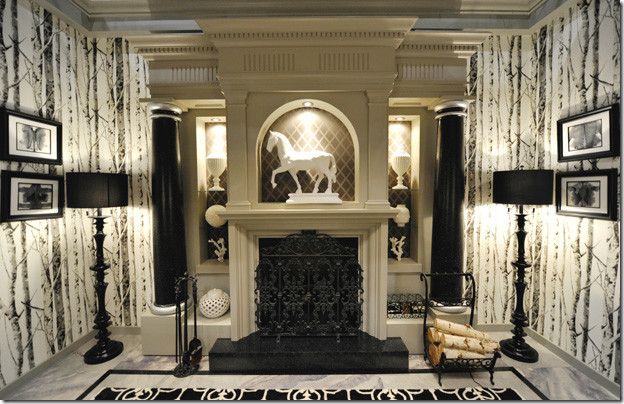
Now, my design was obviously a simplified version of these trees, with only four trees and no "background" trees fading into the distance. But the general "black and white" woodsy idea is the same.

The lines are pretty crisp (with very light gray and dark black, the contrast was pretty high - I didn't have much choice on "crispness") but I tried to keep the insides of the trunks loose. The "details" in the bark are just dabs the size of my paintbrush, and every once and while up the tree I made a little circular tree knob in the bark.

I didn't go into it planning on making vagina symbols, but a lot of them sort of ended up looking that way, if you looked at the knob details up close:


I didn't initially intend the genital imagery, but I didn't exactly tone it down once I noticed they sort of looked like stylized vulva folds, either. I continued on with the mural, painting many more of those "knobs" along the trees as I went. Partly for consistency's sake, partly because I liked the way it looked, partly because I liked what it represented, and partly because it's a painting on the wall of my bedroom, the room I share with my husband, and I don't really care what people think of it. Very few people ever see it anyway; if I didn't post these pictures on this blog (or my previous blog, four years ago), even fewer would.

Maybe I see vaginas because I've looked for female genital symbolism in other artworks and purposefully incorporated them into my own; but given how prevalent seeing vaginas in Georgia O'Keeffe's work remains to this day, despite how ardently she denied using intentional vulva imagery, I'm betting I'm not the only one who sees it.

I don't always mean to make my work feminist or feminine or to have a specific message, but sometimes that stuff creeps in anyway - just because they are things on my mind, or things I've done before. It's like "muscle memory" - after working on my thesis watercolors from 2009-2010 the idea of incorporating female genital symbolism was still familiar enough in my mind and to my paintbrush-holding hand that I added it in even when I didn't start out with that goal.

I don't think, "Oh, vaginas!" every time I go into my bedroom. I think of that stylized sort of design as sort of a mix of genitalia and general "femaleness" anyway - the idea of "central core imagery," which includes but is not limited to vaginas. They're little vortexes folded into lines of paint dabs. They don't have to mean anything if I don't wish them to. We can always choose what we see or interpret in art, and that interpretation may evolve over time, or vacillate from day to day. But on days when I need a reminder that femininity is not weak, that bodies are beautiful, that sexuality is not something to be ashamed of, or that moments of meaning can be hidden in anything if we look hard enough or choose to put them there - it is nice to have those vaginas on my wall to give me that reminder.


Wednesday, May 4, 2016

Scarab Club Exhibition

I'm pleased to announce that one of my paintings, "Silk Caution," has been selected for the juried "Blooms, Bugs, Beasts" Exhibition at the Scarab Club gallery in downtown Detroit!


This 22"x30" watercolor painting was completed as part of my Eastern Michigan University senior honors thesis series in 2009-2010. It was also recently included in a French-Canadian art documentary TV series "L'Art Erotique" on ARTV (February 2016). For analysis on this painting (and the other works in that thesis), search the "thesis" tag on this blog or read my thesis here.


The Exhibition runs from Wednesday, May 18 - Saturday, June 25, 2016. There will be a reception Friday, May 20th, from 5-8 pm. The Scarab Club is located at 217 Farnsworth St. in Detroit.

Hope to see you there!! :)

Wednesday, January 6, 2016

L'Art Erotique - Broadcasting Schedule

As I've mentioned before, last May I was flown to Denver to interview with Eureka Productions, a company based in Montreal, Canada, for their upcoming TV series "Erotic Art," which will show on ARTV. They talked to me about my thesis paintings, which feature flowers that were restrained, pierced, and mutilated as metaphors for female sexual oppression, assault, and female genitalia and sexuality in general. (Search the "thesis" tag on this blog to read more about my thesis specifically, or read the thesis online for free at: http://commons.emich.edu/honors/238/)

Well, now is the time for the TV show to air! I'm not sure which episode my specific interview will be a part of, but here is the list of episodes that will be airing, for those who may live in the Montreal area and are interested in checking it out. The first episode airs tonight (January 6th).

If I find out where my interview is online, I will post that here as well, but for now watching live on ARTV is the only option. Here is a description of the episodes, as sent to me by Eureka Productions in an email: (French first, with English to follow.)

-

Encore un grand merci pour votre participation et votre implication dans notre projet de série documentaire intitulé l'Art érotique.

Grâce à votre généreuse collaboration, nous avons réussi à rassembler des artistes inspirants issus de disciplines variées, autour d’un même sujet : l’érotisme et la sensualité dans l’art.  L’équipe d’Eurêka! Productions est heureuse de vous présenter le résultat de ses rencontres à travers le monde, dès le mois de janvier 2016.

Voici les horaires de la télédiffusion sur la chaine canadienne ICI ARTV :
 1/ Ode à la beauté, mercredi 6 janvier 2016 à 21h - Les modulations du corps dans l'art : réinvention des perceptions de l'érotisme
 2/ Ã‰ros et Thanatos, mercredi 13 janvier 2016 à 21h - L'érotisme entre vie et mort, le corps dans une frontière trouble.
 3/ Jeux Jouissifs, mercredi 20 janvier 2016 à 21h - L'érotisme quand il n'est pas pris au sérieux, place au plaisir.
 4/ Ã‰ros au futur, mercredi 27 janvier 2016 à 21h - Entre machines et robots, voyage de l'érotisme et des corps à travers le temps 
 5/ Désirs secrets, mercredi 3 février 2016 à 21h - Pèlerinage dans les confins du désir et de l'interdit, l'érotisme caché sous la symbolique.

Suite à la diffusion télé de l’épisode dans lequel vous apparaissez, Eurêka Productions vous fera parvenir un DVD de celui-ci. Au plaisir de vous revoir à travers vos nouvelles Å“uvres !

-

Thank you once again for being part of the documentary series and its web project "l'Art érotique" ("The Erotic Art"). Your collaboration made it possible for us to be proud of the good quality work we did.

Now, the time has come to present you the good result of Eurêka! Productions’s work.  By going on ICI ARTV, Canadian Channel, on January 2016, you'll be able to watch the collaboration of our work in the five episode of the series.

Here is the TV broadcasting schedule on ICI ARTV :
 1/  Ode to Beauty, Wednesday January 6th 2016 at 9 p.m. - The body's curve, eroticism and sexuality as creative sparks.
 2/ Eros and Thanatos, Wednesday January 13th 2016 at 9 p.m - The dangerous line between death and living: erotic tension between two bodies.
 3/ Game and Pleasure, Wednesday January 20th 2016 at 9 p.m - This episode will explore the playful side of erotic art.
 4/ Eros and the Future, Wednesday January 27th 2016 at 9 p.m - Eroticism through machines and robots.
 5/ Secret Desires, Wednesday February 3rd 2016 at 9 p.m - A journey through the hidden erotic uses of everyday objects.

Following the television broadcast of the episode in which you appear, Eurêka! Productions will send you a DVD of it. Hope to see you through your new works!

Sunday, December 6, 2015

Childhood Journal Excerpts - Ages 8-11

As I said yesterday, for the next couple of posts, I'm going to share a sampling of some of the words I've written throughout the years.

Below are (selected) entries from ages 8-11, in which I measured my self-worth based on my looks, weight, sexual development, clothing, material possessions, what boys thought of me, physical health, grades, and devotion to God (and fell short in every category).

-

12/14/97 (age 8)
Well, five days ‘til my birthday party and my throat is sore, my nose is stuffed up and I’m mad at my body for causing these problems

04/18/98 (age 9)
God, so much has changed. Me for one thing. I swear now. I can’t help it. Went to a rummage sale. Got lots of things. So did my crappy brother – oops. Told you I swear. Sorry, but I don’t really want to ever write in you again. Bye forever.

09/07/98
I got a TV! For 25 dollars! So now, like in the song “Part of This World” in “The Little Mermaid,” “I have everything.” Phone, TV, and bunk beds. COOL.

09/25/98
I feel… young. My best friend is getting a bra. And [another friend] already had her first period. I know I’m the youngest in my class, but still. I feel like I’m young. Really young. Every fifth grade girl is wearing a bra. Well, at least in my class. But I don’t need one yet. And I haven’t had my period. Oh well, sometimes you’re younger than you think.

10/18/98
I’m depressed. I’m not supposed to be writing this. I’m in my room, being punished. So bye, I guess.

11/19/98
I’m getting a BRA! Yes! Now I won’t feel as young! I can’t wait ‘til I get it! A BRA! Finally!

01/01/99 (age 10)
Happy New Year! [My friend] slept over on New Year's Eve. She has a boyfriend. They’ve kissed on the lips before! He gave her a $24.99, 24 karat gold heart necklace. Whoa! They are only in the fifth grade. She is almost 11. Way too young.

[I guess I thought $24.99 was really expensive??]

03/12/99 
Today we saw the human development video. They gave us two pads (with wings), deodorant, Crest toothpaste, 3 shampoo packets, tablets for teeth, and two small booklets. According to one of the booklets, about two years after you start growing breasts you’ll start having periods. I’ve been growing maybe… oh, since July. About 8 months. So I have about 1 year and 4 months until I start my period. I’ll start near July 2000.

[In reality it was April 2003]

12/23/99 (age 11)
I want to love someone, but I just DON’T! Hmmmmm. [A friend] told [a boy] that she loves him. She kissed his cheek. I think about boys in general, not certain boys. I wish the boys would just grow up. [A different boy] got [a different girl] an $80.00 necklace! Solid silver chain! Wow!

[Apparently I was obsessed with how much jewelry cost?]

01/03/00
It feels weird to write 2000. I can’t believe it really is. Y2K – no problems, thank the Lord. Everyone was soooo worried. Why? Just to have nothing happen?

03/17/00
Dance today. Saw [a boy] dancing with [a girl]. No one asked me to dance. I don’t know what I’d say if they did, but I was hoping SOMEONE would. I just want to fit in. Feel loved – by someone OTHER than my pals and family. You, know, like a BOY! I knew [the aforementioned boy] hearted “her.” I just, I don’t know, thought that somehow he’d see me differently today. But no. I’m not mad. Just disappointed. Not in him. In me. Maybe someone out there does like me. I’ll hope.

04/14/00
I don’t cry when I’m injured. I don’t cry often. But today I’m a basket-case. In Social Studies right this minute I have a C. I almost cried. Grades are important to me. At least I have an A in Science. Still 8 weeks to go. I can bring it up. I hope. Being a teen is hard work, N’book. You have to worry about so many things – friends, boys, family, school, my fat belly. N’book, I weigh 100 lbs. and I am only 11. My thighs are huge! And also, I want bigger breasts.

[The "N'book" nickname came from The California Diaries book series, where Maggie, an anorexic thirteen year old, wrote in her journal about weighing too much and called her journal "N'book." I mimicked it because I thought it was cool.]

04/21/00
I have a thing with backwards lately. Maybe because my life is backwards. And inside out and upside down. Chaotic, yet calm. Rowdy, yet sensitive. Loud, yet quiet. Funny, yet serious. Moody, yet peaceful. Creative, athletic, intelligent. I’m smart, artsy, athletic. Overall, a good person. A + for being friendly. I’m a student, sister, classmate, friend, teammate, cousin, girl, artist, writer and Christian. I do my best. At least I try. But do I try hard enough?

05/03/00
I am bloated! Enormous. And I have no self-control. Tonight I ate an ice cream sandwich AND three Oreo cookies. Do you know how much fat is in those? Too much. P. S. My new motto is eat to live, not live to eat. Memo to self: MUST LOSE FOOD 2 LOSE WEIGHT!

[Still imitating that book.]

05/04/00
I may not think I’m great
May always put me down
But God really does care
And through his love he’s shown…
He is mighty
He is kind
He is Just

11/18/00 – 9:15 pm
Around 7:30, [my other grandpa] died. I never was that close to him. No word on funeral dates. Mom said that her and Dad would give us each $100 cash for Christmas – like he once did as a memory. I feel REALLY BAD saying this, but I kind of wanted him to die so I could miss school and wear my new dress, but that’s cruel. So, today I told myself to help him live a happy life the rest of his life and not to be in pain, and to be nice, and don’t will him to die. So, I did, and so did he. Die, I mean. I’m not really sad. I only saw him once in awhile. I’m not trying to sound like I don’t care, ‘cuz I do, I care about Grandma and Mom, and my uncles. How will they react?

-

If I could go back in time, I would tell my elementary/middle school self to:

1. Stop blaming myself for things that didn't go right in my life, while complimenting/praising/thanking the world (or God) when things actually did go right. I did this a lot more in middle school and high school too, but you can see it in my journal as early as eight years old. I wrote: "I’m mad at my body for causing these problems" - when I had a cold. Like it was actually my fault/my body's fault that I got sick. I still do this. I very rarely let myself actually be proud of myself and acknowledge successes, attributing my success or happiness to some outside force that just "happened" to work out for me. But then when things don't go my way, I do blame myself. It's not a healthy pattern, and it apparently started early. I'm tempted to blame Christianity (everything good is a gift from God, but anything bad is either a "test" from God or some sort of punishment I've brought on myself for falling short of what He wanted me to do) - but I think it's a bit more than that, and that Christianity was not solely to blame for that attitude I established (though it probably didn't help).

2. Stop acting like I was anxious/worried about stuff just because I thought I was supposed to; because that's what teenagers did. Pretending to be concerned about my weight or my looks or grades or anything else just turned into REAL worries, and I think if I had only worried when I was legitimately worried anyway instead of talking myself *into* being worried about things, I might have been a bit happier.

3. Stop being in such a hurry to grow up and savor my childhood more. I think everyone falls into this trap, and there's not much we can do about it, but still. It would've been nice if I'd appreciated it a bit more.

Thursday, November 26, 2015

Why Roses?

I was recently contacted by a high school student who read my thesis and was wondering why I'd chosen to use roses in my watercolor paintings. I've touched about that a little on here already, but today I thought I'd share the response I wrote to her, since I go into the rose in more detail.

She asked if I used the rose for personal reasons, just because I think it's a pretty flower, or if I feel as though it best represents the female anatomy.

I replied:

-

I don't know if I would say the rose *best* represents female anatomy. It has been used historically to represent female genitalia in some cases, but in other cases it represents purity, chastity, almost the *absence* of female genitalia/female sexuality. In Northern Renaissance art, the rose and lily both became popular symbols for the Virgin Mary - and her anatomy is only important as it pertains to her ability to act as a vessel and to give birth (both passive activities), but not to be used for sex or self-expression or anything that might grant her agency. Throughout the Victorian era too, roses were very commonly used as symbols of sexual innocence and purity.

(I talk more about the negative symbolism of roses on my blog -
untilthewaterfalls.blogspot.com/2015/09/negative-symbolism.html)

I liked that ambiguity - the fact that the rose has been used as positive symbolism and negative symbolism both. I think it widens the variety of interpretations viewers might see in my work. 

If the rose is a stand-in for sexual purity, and my watercolors show that rose being stabbed with straight pins, it could indicate a desire to eradicate sexual purity - that is, the antiquated ideas about chastity and the double standards of sexuality the different genders face. If the rose is, on the other hand, a stand-in for sexuality and female genitalia, then the rose being stabbed demonstrates the desire many people (unfortunately) have to continue to restrain female sexuality and self-expression. The patriarchy. So-called "meninists." Anyone who is desperate to uphold the current systems of privilege and oppression so that men continue to benefit and women are limited.

As for personal reasons, I talk a lot on my blog about my struggle to find and maintain confidence (with sexuality, but also just in general). Particularly in this post -

untilthewaterfalls.blogspot.com/2015/09/feminine-layers.html

"When I started this painting, I wasn't necessarily thinking of flowers as symbols for female genitalia; I chose flowers and I chose patterns for aesthetic reasons. But as I painted, and as I started thinking about what drew me to that aesthetic choice, and as I heard what others in my class were saying about the painting during critique, I realized that I could create a pretty powerful message (or, rather, pretty powerful messages - because I don't believe any art can be or should be interpreted in only one way, even if the artist had one specific way in mind) if I used that well-known symbolism to guide a viewer's interpretation in a certain direction."

"I painted this watercolor when I was 20 years old. I had only had one boyfriend (and still have only had one relationship, for that boyfriend became the man I married), and had very little sexual experience. I was - and often still am - ashamed and mystified by my own body and by the idea of sex. I did not know how to talk about it or what to think about it. I understood that it would be great, would be liberating, to have positive feelings about my body and about sex, but I was not there yet (and would argue that I am still not there today, six years later)."

And in this post -

untilthewaterfalls.blogspot.com/2015/09/silk-caution-poisoned-rose.html

"I saw sex (in general) and my vagina (specifically) as shameful and mortifying. Still, I happily, willingly, and actively participated in my own sexual repression because I thought it's what I was supposed to do, what good girls did, what good Christians did. I was even kind of perversely proud at the extent of my vagina's "purity" - that it had never even been besmirched by my own fingers or a tampon."

"And then I took a Humanities class my senior year of high school, and I learned about other religions and historical attitudes and I started considering the negative side of gender roles for the first time. And then, as I grew enlightened and liberated in my thinking, I also grew ashamed and mortified of my shame and mortification. I decided everything I had grown up believing was wrong. I decided I wanted to figure out how to use tampons and I wanted to have sex and I wanted to explore my body and find confidence in my sexuality and I wanted to experience an orgasm. I also decided that my Christian upbringing was at least partly at fault for the attitudes I had about myself and my sexuality, a realization that led to (but was not the sole reasoning behind) my decision to step away from Christianity. I realized that I no longer believed in God. I tried to have faith in myself, instead."

-

Though I don't mention roses specifically, I think it's clear that I was looking at the negative symbolism of roses. I've always liked roses and sort of identified with them, probably because of their connection with purity, chastity, sexual innocence.

Also, there was the simple fact that roses are easy to come by at any florist shop, so they were easy for me to acquire and work from. I do like their shape, and had some experience painting roses already, which was helpful. There are plenty of cultivated varieties to work from, which gives me a wide range of choice for composition, even while staying within the rose family. And because roses are so ubiquitous, everyone is able to recognize them.

As with any decision we make in our lives, there's not really *one* reason I chose to use the rose in my paintings.

Hope that helps! There's a lot more about my thesis on that blog too, if you just click around and read the blog posts with the "thesis" label.

Let me know if you have any further questions. :)

-

I love talking about my artwork, so if you have any of you have any questions, hit me up! I'd love to start a conversation.