Showing posts with label goals. Show all posts

Sunday, December 20, 2020

Turning 32

My 32nd year was not exactly what I pictured... but I think that was the case for all of us. 2020 has been a wild ride, y'all. But I'm really hoping things are looking up (or will be soon) where the pandemic is concerned, and we'll finally start feeling safe enough in 2021 to start venturing farther outside our homes again.

Here are some of my hopes/goals for my 33rd year, leading up to turning 33 on December 20, 2021:

  • Stay healthy while we all ride out the end of this pandemic.
  • Successfully move in to our new house, organize and unpack everything, and make it feel like home for us, our daughter, and our dog.
  • Prepare our old house for the housing market and sell it.
  • Find a groove again with creating artwork - I was doing well for awhile, and making sure to prioritize working on colored pencil drawings while our daughter was sleeping... but then we decided to move, and in the process of packing everything and planning for the new house, my art fell by the wayside again for this last part of 2020. Once we're all moved into the new house, with a new art studio, art will begin again!
  • Submit my artwork to be shown in various local art exhibitions or art shows. I had grand plans to do this in 2020 (after I settled in to motherhood a bit) - but then the pandemic hit, and what few art exhibitions were still happening in-person were not things I felt safe participating in. Here's hoping 2021 will be better!
  • Start working part-time as a graphic designer again, too. I had planned to continue working from home for Temple Israel as a contract designer after our daughter was born - but then with the pandemic, they were hosting a lot fewer events and had much lower needs for graphic designers this past year than anticipated. I'd love to start designing graphics again - if not for Temple Israel, then for others. My new studio in the new house is going to be big enough to fit my easel and tables for watercolors and colored pencil drawings AND my computer desk, and I'm so stoked to be able to work on all aspects of my creative work from a single room in the house.
  • And of course - watch our daughter continue to amaze as she grows every day! She'll turn one in less than two weeks, and I'm so excited to see what her 2nd year brings!

Friday, December 20, 2019

Turning 31

It's crazy to think I've already lived through the first year of my 30s! It was an eventful year, too - trying to get pregnant, and then *being* pregnant. One of my goals this year was to practice resilience (despite whatever challenges I might face) regarding my dream of becoming a mother, and to remain hopeful and make decisions based on those hopes (and not my fears or anxieties) - and I'm happy to say both that I achieved that goal, and that it turned out to be easier than I worried it might be. Thankfully, I faced most of my challenges when I was 29, and the universe gave me a bit of a break when I was 30. :)

I made non-pregnancy goals for myself as well, to try to ensure that I accomplished things I could be proud of, even if getting pregnant didn't pan out. I submitted my artwork to local exhibitions and created lots of new art (more on all that in a coming post). I read 60 books and watched 60 movies, TV series, or theater productions (more on all that in another coming post, too). I also continued to prioritize my mental health, answering "positive thinking" questions every day to remind myself what I'm looking forward to, what I have to be thankful for, and what matters to me most.

Naturally, I've made some goals for this coming year too - the year I'm 31. Some of the goals are much less (reading 20 books instead of 60, for instance), to try to account for all my time that will be taken up by taking care of my new baby and figuring out my transition to motherhood. Others represent a temporary shift in priorities from one of my passions to the other. This past year I really prioritized working on artwork, so that I would have plenty of recent drawings and watercolors to market, sell, make notecards of, and submit to local exhibitions, even if I didn't have time to create much more in 2020. Next year, my goal is to focus more on my writing instead, returning to various novels I've been writing on and off for the past several years. (I'm hoping it might be easier to sneak in pockets of writing or editing here and there between feedings and diaper changes and playing with my new baby, than it might be to settle down with some paints or colored pencils to produce even a small sized piece of artwork.)

I'm so excited to turn 31 - with a new baby due basically any day now, and one of my lifelong dreams therefore on the cusp of coming true, I just know 31 is going to be my best year yet. :)

Thursday, December 20, 2018

Turning 30

30 is a big one - simply because our society likes base ten and thinks of any age or anniversary ending in zero as "a big one," and not actually because anything TRULY changes. Still, I'm not above such sentimentality, so I've taken turning 30 as an excuse to reflect back on my 20s and make plans for my next decade.

Turns out when you look at an entire decade, it's easy to feel accomplished. You can do a LOT in ten years! My 20s were no exception; they were certainly my most accomplished decade yet, if not likely my most accomplished decade I'll ever have (depending on how you define such things). I experienced many milestones that are universally considered significant in my 20s - as many do - but I also had some great experiences that were meaningful on a more personal level, too. 

My 20s included*:
*a non-exhaustive list

SCHOOL & PROFESSIONAL ADVENTURES
  • Finishing my thesis and earning the thesis award
  • Graduating with highest honors from EMU and earning a double-concentration BFA in Graphic Design and Watercolor, with a minor in Art History
  • Working at EMU Campus Life
  • Working at Charming Charlie
  • Working as a substitute teacher
  • Working as a graphic designer at Temple Israel
  • Working as a freelance custom invitation designer for several weddings and bar/bat mitzvahs
  • Being flown to Denver to be interviewed for L'Art Erotique, a Quebec art TV show
  • Selling my artwork on Etsy and at Paint Creek Center for the Arts
  • Creating artwork commissions for family, friends, and strangers
  • Showing work at EMU art galleries, the Detroit Scarab Club, the Canton Village Theater, the Carr Center, and the Grosse Pointe War Memorial
TRAVEL ADVENTURES
  • Going on a Mediterranean cruise with my soon-to-be-husband's family
  • Honeymooning on the Greek islands of Santorini and Mykonos
  • Taking a road trip out west with friends
  • Nearly annual trips to Virginia Beach
  • Visiting Universal Resort's Harry Potter World in Florida
  • Spending eight days visiting museums and seeing plays in New York City
PERSONAL ADVENTURES
  • Getting engaged
  • Planning a wedding and getting married
  • Buying a house and moving to Rochester Hills
  • Completing lots of home improvement projects, including new bathrooms, patio, roof, siding, insulation, and windows
  • Adopting a puppy
  • Prioritizing self-care and self-esteem building
  • Being diagnosed with diabetes and starting insulin
  • Getting a tattoo
  • Getting pregnant
Of course, there were some not-so-great experiences with the great ones. Some of the items on the list above were challenging times (or led to challenging times) - but I wanted to include those moments as well, because they have helped shape me into the 30-year-old I am. Of course I wish I was never diagnosed with diabetes, or that my first pregnancy hadn't ended in miscarriage - but I can't change those things; I can only change how I feel about them. As for things I DID have some control over, even at the time - things like jobs I worked or decisions I made or paths I pursued: I don't tend to feel regret about my past; I don't tend to think of anything as a "mistake." Instead I romanticize challenges as Things I've Survived, focusing on what I gained or learned from them. If I had my 20s to do over again, I'd probably do it all over again in a very similar, if not identical, way. Sure, there are some things I wish I'd figured out earlier - like how to prioritize and take care of myself more - but I'm getting there. It's all part of my journey, which, being MY journey, I get to do at my own pace.

I started trying to make a list of things I'd like to accomplish in my 30s, but it's hard to think that far into the future. There are some obvious choices for things to put on the list - things I want immediately or soon, and hope to accomplish in the next few years. But then what goals should I make for the REST of my 30s, after I complete those? It's hard to imagine what my goals will be for the years I'm 37, 38, 39... 

But here are my immediate goals and priorities, the things I'm already working towards, thinking about, planning, setting the stage for, etc.:
  • Having artwork shown in more galleries/exhibitions
  • Getting a novel published
  • Getting pregnant again; having children
  • Doing "short vacations" around North America (e.g. returning to Stratford, Ontario for more theater experiences; finally seeing the Tulip Festival in Holland, Michigan; taking long weekend trips to interesting cities around the U.S. I haven't been to yet)
  • Doing more home improvements (e.g. adding built-ins to the living room and/or dining room; renovating the kitchen)
I'm sure I will add so much more to the list as my 30s wear on and I come up with more ideas, more things to pursue.

A lot of people fear turning 30 (or 40, or 50, or 60, or whatever they've decided is their arbitrary designation of Real Adulthood or Old Age), but I'm not one of those people. I'm not immune to the existential anxieties that come from starting a new decade; I just try to find other things to focus on instead. I find things to look forward to, things to dream about, goals to write down. And I also like to send presents into the future to myself - things that can help me get through potentially challenging times. When I was 23, I wrote myself a letter to open on my 30th birthday. I wrote another such letter when I was 26. I sealed these letters in envelopes and put them in my desk drawer; I see them every time I open that drawer to grab a stamp or address label. By now, I've totally forgotten what I wrote, and I'm really excited to read them all again. I am so anxious to see what stupid and wise things I wrote to myself, what questions I wanted to know, and what I was hoping to accomplish by 30 or feel at 30. It will be like rediscovering a lost corner of my mind, it will deepen and bolster my sense of self, and it will contribute to the narrative of my life I am continually writing and rewriting. As a result of those time-traveling letters, then, my primary emotion associated with turning 30 is not anxiety about growing older, but excited anticipation.

So naturally I'm doing it for when I turn 40 as well. Just today I wrote a letter and sealed it in an envelope: "Do not open until your 40th birthday - December 20, 2028!"

Monday, January 15, 2018

Dahlia Tattoo

Exactly one month ago, as a five-day-early birthday present to myself, I finally got a tattoo! It's something that's been on my bucket list for several years, but I kept putting it off because I wasn't entirely sure what I wanted to get a tattoo of. I considered Harry Potter quotes for awhile - but there's too many good ones and not enough short good ones, and I didn't want an entire paragraph written on my skin. Then, I stumbled on pictures of floral "watercolor style" tattoos on Instagram several months ago, and that opened up an entirely new world of possibilities. I was really drawn to the idea of getting something pretty and artistic on the inside of my left forearm, near the inside of my elbow - something that would act as an extension to my body of artwork (floral, colorful, and heavy on the symbolism), and something that I would love and appreciate - and be able to see - every day.

But knowing that I wanted a colorful flower wasn't enough for me (of course). I wanted my tattoo to mean something more specific than just "a pretty flower" or "beautiful colors" or "a reference to my floral artwork". I carefully considered (as I do with much of my art) what the message of my tattoo should be - that is, what type of flower I should choose.


Brand new tattoo!

I settled on a dahlia flower because dahlias stand for a lot of cool things, including wisdom, creativity and art, drawing upon inner strength to succeed, maintaining kindness, grace and dignity in the face of adversity, embarking on new adventures, making positive life changes, and forging my own unique self-identity. They also symbolize a lasting commitment - and I don't know what's a more lasting commitment than a permanent tattoo. :) My dahlia tattoo is a promise I'm making to myself 1) to be kinder to myself (that is, to stop all self-abuse and negative thought patterns and start treating myself with the same kindness and respect I show my friends), and 2) to be unashamed and unafraid to be who I am, feel the things I feel, or want the things I want.

I designed the tattoo myself. I drew/traced several images of dahlias until I got one that I thought would work. I also played around with the amount of petals, cutting some of them away to simplify the flower a bit, given the size it would be on my arm. Then, I blew it up to 8x10 size (to make it easier to paint), traced it onto watercolor paper, and added some light watercolor washes, just to decided what colors I wanted to use and where I wanted those colors on the tattoo design.


The watercolor sketch before I added black outlines back in.

I chose purple, blue, pink, and green for the colors. Purple is often associated with wisdom, elegance, intellect, depth, and beauty. Blue and green symbolize new life, fresh starts, and changes. The pink I added just because it's pretty - and I wanted a lighter color to make sure the darker purples and blues didn't make the tattoo too dark. These are also probably my four favorite colors (though I like so many colors, it does change a lot), and I have a lot of clothes in those colors, which will help my tattoo "go" with most of my wardrobe.

When the watercolor paint was dry, I went over the light pencil lines with a black Sharpie. Then, I used my copy machine to shrink it back down until it was the smaller size I wanted/the size that would fit on my arm.


Printing copies to try to figure out what size it should be on my arm. (The leaves point down to my wrist.)

The copier made the colors a lot duller, but I made sure to pick out with my tattoo artist the bright colors I actually wanted. I also told her I'd like to extend the extra pigment out further from the black outlines, to give it a more abstract/painterly quality. She used my to-scale copy to trace the design onto my skin, then inked the black outlines and the areas of color.

It hurt less than I thought it would, and went quicker than I thought it would too. It only took them about 1-1.5 hours to finish the tattoo. It also healed faster than I was told to expect, which was another nice bonus!

Here's what it looked like last week, three weeks after I got it:


It can be hard to get a good, clear picture of it... Not sure if that's the nature of this kind of tattoo, or just a problem specific to my phone camera (but I'm guessing probably the latter). :)

Now if only the weather would stop being so cold, maybe I'd actually be able to wear more short sleeves to show it off!

Thursday, December 28, 2017

2017 Art Year in Review

I spent a lot of time on my art this year - and accomplished a lot of cool things!

  • Eight large format colored pencil drawings, five 8x10 drawings, and ten 5x7 drawings were on display at the Village Theater in Canton, Michigan throughout the month of November as part of a two-person exhibition "GRRRLS Like Us".


  • I was commissioned to create eight custom watercolor bouquet paintings through this listing on Etsy, from people as far away as Alabama, Colorado, Georgia, Washington D.C., and the United Kingdom. I also added a "Rush Order" option, which promises a finished custom painting at your doorstep in five days.


  • I had artwork available for sale at the Paint Creek Center for the Arts in Rochester, Michigan all year - including original Michigan-themed watercolors, original floral colored pencil drawings, and lots of boxed notecard sets.


  • My Great Lakes Notecards have been selling well on Etsy, with several orders places around the holiday season.


  • I reached over 630 followers on Instagram (and received lots of great comments!) by posting pictures of artwork in progress.


  • I was commissioned to create a large acrylic triptych (a painting on three separate canvases), which I'll be working on soon in early 2018. (More on that to come in future blog posts!)
  • And I finished lots of exciting artwork (including the aforementioned colored pencil drawings and the custom watercolor bouquets)! Here are some of my favorite art pieces I completed this year:
"Anticipation" - 8"x10" Colored Pencil Drawing on Tan Paper (SOLD)

8"x10" Custom Watercolor Bouquet commissioned by Blake (SOLD) 
8"x10" Custom Watercolor Bouquet commissioned by Brent (SOLD)


"Great Lakes in Rainbow" - 8"x10" Watercolor Painting

"28 Years" - 22"x30" Colored Pencil Drawing on Black Paper

"Religion Bouquet (Stronger Together)" - 19"x25" Colored Pencil Drawing on Black Paper

"Shame" - 8"x10" Colored Pencil Drawing on Tan Paper

8"x10" Custom Watercolor Bouquet commissioned by Mark (SOLD)

"Great Lakes in Metallic Copper & Red" - 8"x10" Watercolor Painting

"Gender Bouquet (Stronger Together)" - 19"x25" Colored Pencil on Black Paper

8"x10" Custom Watercolor Bouquet commissioned by Michael (SOLD)

8"x10" Custom Watercolor Bouquet commissioned by Paul (SOLD)

"Sexuality Bouquet (Stronger Together)" - 19"x25" Colored Pencil Drawing on Black Paper

You can find many of these pieces for sale at my Etsy shop: etsy.com/shop/ArtworkbyAndreaArbit. I will be adding more inventory soon (including the items that didn't sell at the GRRRLS Like Us exhibition!) so definitely check back to see what new stuff gets added in 2018. :)

I hope you continue to follow me on this blog as well as my Twitter and Instagram accounts as I keep creating into 2018! Happy New Year, everyone!

Thursday, May 4, 2017

No New Notecard Sets

I really wanted to make some notecard sets of my "30 Days" and "28 Years" colored pencil drawings, to sell on Etsy and at the Paint Creek Center for the Arts in Rochester, Michigan (where many notecard prints of other colored pencil drawings and paintings I've completed are already for sale). My vision was to have a notecard of the entire drawing and then several close-up details of the flowers, available in box sets. I figured it wouldn't be too hard, since I've done notecards like this before. Unfortunately, I was wrong.

The problem is the size of the drawings. Each one is 22"x30", which is too large to scan all at once on the size scanner I have at home (which can only go up to 11"x17" size). I have made notecards of watercolors this size before, but I didn't scan the artwork - I took a picture of it with a camera. When I tried to do this these drawings, however, the pictures were not a great quality for printing. For starters, the only camera I have right now is the one on my cell phone. Usually my cell phone takes pretty good pictures, but because of the texture of the colored pencil and the detail in these drawings, I just couldn't get one I was happy with that didn't look either blurry or pixelated when I printed them out. I also tried to scan the artwork in four different 11x15 quadrants (top-right, top-left, bottom-right, and bottom-left), so I could at least get some good detail shots - but this also didn't work out as I'd hoped. I don't know if the problem is the colored pencil itself, the texture of the paper, or the fixative I sprayed over the final drawings, to prevent the colored pencil from rubbing off as I move it around and store it - but even the scans had trouble getting good quality images. Everything ended up out of focus, or still ended up pixelated when I printed them out.

I spent about two days on this. The first day, taking photos with my cell phone and trying to make those work. Then, more recently, I spent another day scanning them, cropping them down to the detail shots I wanted to use, and printing some out. Both times, I ended up wasting some of my notecard paper on images that were too pixelated to sell. It was more than a little frustrating.

I don't want to say I'm giving up, because I still would like to have notecard sets of those two drawings available sometime in the future, as well as for my "Race Bouquet (Stronger Together)" drawing, and the other drawings I'll be doing in that series - but I am putting this on the back burner for now. I would rather spend my time right now making artwork than figuring out how to make my own prints of them; once I finish my "stronger together" series I should have more time to revisit this problem and think of a better solution. Maybe the answer is getting a better digital camera, and getting some good photos of the entire drawing (and completely scraping the idea of also doing "detail" shots on notecards). Or maybe the answer is to send my artwork out somewhere to have it professionally scanned and made into high-quality prints (higher quality than I can print at home anyway). Maybe there's even some middle ground there, where I can find a printing service that has a scanbed large enough for 22"x30" paper, which can scan my artwork for me.


In any case, as much as I would like to say I have some new designs available as notecard sets, that's simply not the truth. I do, however, have many other colored pencil drawings, acrylic paintings, and watercolors available as notecard art prints. I recently restocked my notecards at PCCA in Rochester, MI, and I also have all notecards available through my Etsy shop. These make great gifts (and Mother's Day is just around the corner)!

Sunday, April 9, 2017

Diabetes Type 1.5/LADA

As some of you may know (and I've written about it before on this blog), I have been seeing an endocrinologist (hormone/diabetes specialist) for several months for "elevated fasting glucose levels." My numbers were more in the pre-diabetic range for a while, and I had none of the classic diabetes symptoms (excessive thirst and urination, etc.) - but because I was young and otherwise healthy, with a normal BMI (and therefore also without the classic Type 2 "red flags"), my doctor was concerned enough to refer me to an endocrinologist. 

It turns out there is a third kind of diabetes besides Type 1 and Type 2 - and it's called Type 1.5, or LADA (Latent Autoimmune Diabetes in Adults). It sometimes masquerades as Type 2, because it starts off gradually and gives plenty of "pre-diabetic" warnings (if you're checking your blood glucose and looking for them), and because it doesn't start until adulthood. But in reality, it's more similar to Type 1.

(What follows is an oversimplified explanation. I'm no medical professional, but I have read a few articles and books on diabetes in the last couple months, and here's the general impression I got of differences between the types.)

The pancreas produces insulin to process glucose in the bloodstream. If there isn't enough insulin produced, or if the insulin cannot do its job properly because a person's cells have become resistant to it, then there will be excess glucose in the blood. This is called hyperglycemia (high blood sugar) and can often go undetected for many years - until it's bad enough or has persisted long enough to cause serious complications, such as impaired vision, sores or loss of feeling in the feet, infections, kidney problems, heart attacks, strokes, or diabetic comas.

In Type 2, this excess in blood glucose is because of insulin resistance. The pancreas still produces insulin normally, but there either isn't enough of it to absorb all the glucose, or the insulin malfunctions. It is often caused or exacerbated by obesity, poor diet, or lack of exercise. Type 2 diabetes can therefore be treated with changes in lifestyle - better eating habits, more exercise - or with oral medications that help insulin work properly or more efficiently. If Type 2 has persisted for too long without being controlled, the pancreas might start to lose its ability to produce insulin; in these instances, Type 2 diabetics might also require insulin injections, to ensure that their body has enough insulin to work with.

Type 1 is different. It is an autoimmune disease, meaning that there are antibodies in the blood (produced by the immune system), which mistakenly believe that the pancreatic beta cells that produce insulin are foreign invading cells which need to be fought. These antibodies prevent the pancreas from being able to produce the insulin it needs to. Without insulin, glucose remains in the blood and causes complications. People with Type 1 therefore can only be treated with insulin injections. Though changes in diet and exercise may decrease the amount of insulin they require (because there will be less glucose in the blood that needs to be processed), some amount of insulin will always be necessary.

Usually, people with Type 1 are children when they are diagnosed. Their symptoms may come on with little or no warning. Their pancreas suddenly no longer produces any insulin, or only produces very little insulin, and for the rest of their life they must inject insulin manually.

In recent decades, while doing studies of Type 2 adult diabetics, scientists discovered another class of diabetics - adults who had some Type 1 antibodies in their blood. They were misdiagnosed as Type 2, and were being treated as if they were Type 2, but the truth was their immune system was destroying the pancreatic beta cells' ability to produce insulin - albeit at a slower rate than what is typically seen in Type 1 diabetics (possibly because they had fewer antibodies, or fewer types of antibodies, than people with classic Type 1). Changes in diet and exercise, or even taking oral medications, did little to help these individuals manage their glucose levels - because what they needed was more insulin, to make up for the insulin their pancreases were no longer producing. There is still some disagreement among medical professionals about this new type (Type 1.5, aka LADA) - whether it is a subtype of Type 1 or a distinct third type all of its own. There is also, therefore, disagreement with what to call it.

Personally, I like Type 1.5 and LADA both. If you know enough about diabetes to be able to discern what "Latent Autoimmune Diabetes in Adults" might mean, the LADA moniker gives a good description of what it looks like (latent = slow moving; adults = found in adults) and what treatments should be used (autoimmune = requiring insulin). But "Type 1.5" is a good description for the layperson who has only heard of Type 1 and Type 2 diabetes, because it really does have characteristics of both. It often manifests like Type 2, but has a cause more similar to Type 1 and therefore should be treated more like Type 1.

Thankfully, my primary doctor and the endocrinologist she referred me to are both up on the latest in diabetes care. Unlike many Type 1.5 diabetics, I was not misdiagnosed at Type 2. As soon as I saw my endocrinologist the first time, he ordered antibody blood testing done, to confirm what he suspected - that I had GAD antibodies, and they were slowly inhibiting my pancreas from producing insulin.

Because my blood glucose was only slightly elevated, I was not started on insulin yet. I made some small changes to my diet, keeping track of the amount of carbs I was eating. I also checked my glucose every day (or almost every day) to keep track of where I was at and if my condition was getting more serious. As long as my numbers stayed only slightly elevated, nothing else would have to be done. We took a "wait and see" approach, and waited for my pancreas to get worse.

For about two years, I saw my endocrinologist every few months or so for an A1C test. The A1C measures an average glucose level over the last three months - a non-diabetic should have an A1C level at 5.7 or below, "pre-diabetics" might have an A1C in the range of 5.7-6.5, and anything above 6.5 is considered a characteristic of diabetes, often prompting a diabetes diagnosis. The American Diabetes Association recommends diabetics try to keep their A1C below 7.0. My A1C was gradually rising (5.7, then 5.8, then 6.0) and my fasting glucose in particular was too, but as long as it didn't get too high, we would continue to "wait and see."

Since this past November, however, my fasting numbers were getting noticeably worse. Instead of being occasionally in the 120-130 range, they were creeping into the 150s. ("Normal" fasting glucose is supposed to be between 70-100.) At first I thought it was just because of stress or trouble sleeping (since I hadn't made any changes to my diet that might account for the change), but as the fasting numbers continued to be in the 150s on more than just an occasional basis, it became clearer that it was just going to gradually worsen, no matter what I tried to do. 

Now, having numbers in the 150s is still not super high; undiagnosed diabetics may often get into the 300s or 400s without even noticing. But the push in diabetes treatment lately has been all about prevention - which is why they try to screen people early, to find them when their numbers are still "pre-diabetic" and start treatment early. The earlier it is caught and treatment is started, the less serious the complications will be in the future. Some recent studies with Type 1.5 diabetics have also indicated that starting insulin sooner rather than later might be better in the long run - because it might preserve the remaining insulin production the pancreas has for longer.

In February, my A1C was 6.2. Again, not super high; in fact, not yet in the range considered "diabetic." But the trajectory was clear - it kept rising, and would continue to rise toward that 6.5 cut-off. My endocrinologist said the "wait and see" approach might finally be over. Because I'm young (28 years old) and have a long life of trying to avoid diabetes complications ahead of me, it might be best to start the insulin sooner rather than later. Furthermore, keeping blood glucose levels as close to normal (non-diabetic levels) as possible is extra important during pregnancy - especially during the first trimester - and now that my husband and I are approaching the time in our lives when we want to expand our family, it would be better to be on insulin and keep careful track of my glucose levels for the sake of any potential babies, even if it wasn't yet required for my own health. Before, my endocrinologist was saying I would probably have to be on insulin when I was pregnant; now, he was saying I should start it now, so that when my husband and I want to start trying to conceive, we will 1) be able to (high blood glucose can affect fertility), and 2) the baby will be healthy during the first few weeks of pregnancy (before I might even know I was pregnant yet).

Long story short, I started taking insulin at the end of February.

I am on Levemir, which is a long-lasting basal insulin. I take it at bedtime, and it lasts for 24 hours, keeping my glucose levels as steady as possible throughout the day. I do not (yet) take any bolus insulin, which is the type taken with meals, to account for the amount/type of food being consumed and to prevent after-meal spikes in glucose.

My endocrinologist had me start with 12 units of insulin at night, but that seemed to be a bit much, giving me low blood sugar - a problem I never thought I'd have! Now I do 10 units of Levemir at bedtime, or 6 units if my bedtime glucose level is under 100.

Within three days, my glucose readings improved. My fasting numbers are always less than 100 now, and usually in the 70s or 80s. In fact, my biggest problem so far has been occasional mild hypoglycemia (low blood sugar) overnight or during the day, especially between breakfast and lunch, if I eat lunch late. Low blood sugar is anything under 70; my hypoglycemic episodes are usually just below that, or only very occasionally as low as the low 60s/mid 50s. It wakes me up (if I'm asleep) with fairly obvious symptoms (sweatiness, rapid heartbeat); during the day, though, I find it harder to recognize.

I check my glucose much more often than I used to - several times a day, instead of just once a day (or less). I check at bedtime (to figure out how much insulin to take), and I check my fasting number (which is the number I always checked before). But I also check now before I drive home from work - since it's a 45 minute commute, and if I haven't eaten anything lately, I need to make sure I'm not going to start dipping low while I'm driving. And I often check about 1.5-2 hours after eating a meal, to see how much of a post-meal spike I'm getting.

It is that last category that has been most disappointing lately. My post-meal numbers are sometimes as high as 250 (when they should be less than 180, or, if I was pregnant and trying to be as close to non-diabetic levels as possible, less than 140). I do not remember having this problem before I started taking the insulin - though I also checked my glucose a lot less frequently, so it's possible my levels were that high, but I just didn't realize. More likely, I think, is that despite my insulin injection regime, my personal pancreatic insulin production is still gradually getting worse. I wonder if the next time I see my endocrinologist (in June), he will start me on bolus (mealtime) insulin now, too, to counteract those spikes. I guess we'll just have to see what my A1C level is at in June, to determine how much the insulin is helping and figure out what else can or should be done to make my glucose readings even better.

In the meantime, I should probably try not to obsess over it too much. Part of me worries if I keep track of too much - counting calories and carbs and fiber intake, testing my glucose several times a day - to the point where it's starting to border on obsession. On the other hand, every study about diabetes ever concludes that the more often you check your glucose, the better control you have over your diabetes - and the better the control, the less problems with serious complications. Early detection, self-advocacy, and taking a personal stake in your diabetes treatment are key. So I'm trying to find that good balance - especially since I'm still new to a lot of this, many of my numbers are still in the pre-diabetic range anyway, I've never had a super high glucose reading/landed in the hospital from my blood sugar, my insulin dosage is small, I'm healthy otherwise, and I'm not pregnant. 

There is no real need for me to test too often (other than idle curiosity for what my glucose is at any given time), and in fact two pretty good reasons not to: 
  1. The cost of test strips, which are about $1/each and really start to add up if I'm testing 5-6 times a day. (My insurance pays for the insulin, but not the test strips, because my endocrinologist never wrote me a prescription for them.)
  2. My poor fingertips, which have to be stabbed with a lancet anytime I want to test. (In case you're curious - finger pricks for blood testing hurt more than my Levemir insulin shots, which go into the abdomen and usually don't hurt at all.)
But despite this, I do like knowing what my numbers are. I figure as long as frequent testing doesn't cause extreme financial hardship or too many unnecessary finger calluses - or make me too anxious, tying my mood to whether or not I get a "good" glucose reading - then knowing how my body reacts to different things (different types of food, exercise, etc.) can only help me in learning how to care for and manage my diabetes.

Tuesday, December 20, 2016

Turning 28

This year has been a busy one! I started working mornings as a graphic designer for Temple Israel in West Bloomfield in March, and in between those scheduled work hours I tried to find time to work on other projects as well - several paintings and drawings, writing and editing my novel(s), and writing posts for this blog. I even got my artwork shown in a couple exhibitions in the summer, and I'm already working on getting some new things done for a future exhibition in 2017.

As far as productivity (and the corresponding self-image) goes, I'd say this year was pretty great. In fact, the only things that weren't great were a couple things related to my physical health - my "elevated fasting glucose" and, recently, my TMJ problems. These are not things that started when I was 27, but they are things that worsened and/or I was made more aware of in the last year. Still, I feel like they are pretty minor complaints (so far), and I am doing everything I can to try to alleviate them - I am not ignoring them, but making sure that I stay proactive in being aware of them and working towards managing the symptoms as best I can.

I feel like I have continued to make strides for myself in self-care this year, managing my mental and physical health. (See my previous post regarding "grieving losses.") I also feel like I am generally pretty content with my life as it is right now, and that I am "in a good place" in a lot of areas (artistically, mentally, emotionally, professionally).

Today I turn 28 years old. My goals for this year are more or less to just keep on doing what I've been doing - to keep pushing myself with art projects, to keep working on my novel(s) and sending out query letters to find a literary agent, to keep up with my journaling and self-reflection and seeing what I can do to take care of myself. There are always going to be some things I can't control (like blood sugar or TMJ flare-ups), but there is a great amount that I can control - including my attitude about the things I can't.

I won't pretend that there aren't things about the current political climate that concern me, or things that I would like to see improve - in the world at large, or in the lives of people close to me. And there is probably more I could do, personally, to try to improve these things. Maybe that should be one of my goals for this coming year as well - to find a way to help others while still maintaining my current level of self-care.

I wish I had more time to do all of the things I want to do (more time to write, make art, read, journal), but I'd much rather have too many things I want to do and not enough time to do them all than too much time on my hands and nothing to fill the hours with. If that's the kind of life I'm living - a life that seems like it's going by too quickly, a life that I've filled up with people and projects that mean a lot to me - I'm okay with that.

Here's to 28 being just as good (or better!) than 27!

Tuesday, November 1, 2016

Novel Update

Last month, I (again) finished going through and editing my novel (or rather, the first book in an intended series of novels). That means my goals for the month of November include doing research on literary agents, sending out query letters, and starting to go through and edit my draft of book #2 in the same way I just went through and worked on book #1.

Of course, November is NaNoWriMo (National Novel Writing Month), and with all the editing I've been doing lately I feel like I haven't done a lot of actual "writing." But there are definitely some things I want to add in to book #2, now that I know what changes made book #1 so much better - and some of those changes will feel more like "writing" than "editing." Plus, just working on book #2 instead of book #1 will be enough of a change of pace to keep me excited about this project.

It's not that I don't like editing. It's a certain kind of excitement to watch something you were already proud of get even better - and thus more proud-making. It's just that sometimes editing feels a little stagnant, and it can be hard to notice the "hey this is actually worth it" changes until you step back and look at it from a bit more distance.

So for this year's NaNoWriMo, I'll probably be doing more editing than writing. But what is editing other than "rewriting"? And shouldn't rewriting also count?

Sunday, October 30, 2016

Diabetes & The Waiting Game

For the last five or six years, I've had "high fasting blood glucose" levels. When it was first brought to my attention, my husband and I were still living in Grand Blanc (in fact, it may have been before he was "my husband" at all). I went in for a regular annual ("annual-ish") check-up, my doctor ordered some standard labs, and I went in for a fasting blood test - a blood draw first thing, before eating breakfast. The numbers were slightly high, my doctor advised me to keep an eye on my diet and maybe increase my exercise a little from the sedentary lifestyle I was leading, and nothing more was done about it. When I next went in for an "annual-ish" check-up, I got blood work done again, and my glucose was still slightly elevated. It took several more years of this and moving to a new city (and therefore getting a new doctor) before my doctor started to get a little concerned. Clearly this was not a one-time thing; this was a pattern.

About a year/year and a half ago, I went to my doctor because I wasn't feeling well - for something totally unrelated to my glucose levels. But maybe that's what the difference was - that this time I went in with an actual complaint, instead of just going in to meet the doctor and have a healthy check-in. Even though my complaint was unrelated, my doctor again suggested some blood work, and this time when it came back with elevated fasting levels, she referred me to an endocrinologist.

I do not fit the "stereotype" of a diabetic - type 2 or type 1. My dad has type 2 diabetes and for a couple decades now has worked at changing and maintaining his diet, weight, and exercise to keep his glucose in check. One of the biggest changes he did soon after his diagnosis was swapping out daily soft drinks for daily diet soft drinks. We've both always had a sweet tooth, but I feel pretty confident saying he was consuming a lot more sugar/carbs daily than I ever was. He was overweight and had a lifetime of bad eating habits to overcome; I'm a 27-year-old female with a BMI in the low-normal range who is actively trying to eat healthier. Even before I knew I had this fasting blood sugar to watch out for, I was already trying to diversify the types of foods (especially vegetables) that I ate, and I am certainly not the picky eater my dad is when it comes to healthful foods.

I've also known people with type 1 diabetes, and I don't resemble them, either. They were children or teenagers when they were diagnosed. (It wasn't known as "juvenile" diabetes for so many years for no reason!) They are insulin-dependent, because their pancreas no longer functions appropriately - or never did - to maintain normal glucose levels. One of my friends in first grade was a type 1 diabetic. She carried around a kit with her with all her insulin and blood test strips and lancets - and knew how to use it to give herself an insulin shot every day during lunch. We were six years old. In the years since, I've heard of others my age with diabetes, who have dealt with it (and in some cases, struggled with it) for years. Just recently I saw one of my Facebook friends post a link to a GoFundMe account, where she was trying to raise money to pay for her diabetes-related health care. At twenty-six, she was unable to keep a full-time job because of the time her diabetes care required her to take off work. She'd developed a brittle case (or perhaps had always had difficulty controlling her diabetes - I'm not sure), and was particularly struggling due to a lack of quality health insurance.

So needless to say, I was a little confused at how I could have such a pattern of high glucose when I didn't outwardly resemble any of the diabetics I'd ever known, or any of the textbook symptoms (excessive thirst and urination, dizziness, fainting, etc). Was I diabetic or not?

The answer is... Not yet.

Per my general practitioner's recommendation, I started seeing an endocrinologist, a doctor specializing in hormones (insulin is a hormone; the pancreas is the gland that produces insulin). I don't know if this is the case in all areas, but in Rochester Hills, Michigan, the endocrinologist is super busy. To make that initial appointment, there was a several month wait. Since then, I've been back several times for three-month A1C check-ups; because they're so busy, it's more like four months instead of three. (Note to all med students and new doctors trying to figure out what to specialize in - apparently a lot of people need an endocrinologist, and the supply can't keep up with the demand.)

At my initial visit, the endocrinologist looked at my blood work, ordered some more tests, and hooked me up with a special monitor that would attach the skin just above my navel and take consistent glucose readings every five minutes for five days. After the five days, I removed the monitor and returned it so they could download the data; I then got the other blood tests done, including a test to check for pancreatic antibodies. This test came back positive.

The presence of antibodies indicates that I am at risk for developing type 1 diabetes. Not everyone who has type 1 diabetes has these antibodies, but nearly everyone who shows the antibodies will eventually develop type 1 diabetes. The question is just a matter of when. The way my endocrinologist explained it, it may be a few months, it may be a few years, or it may be a few decades away - but probably, eventually, some day, I will be a type 1 diabetic. The antibodies will kick in and start preventing my pancreas from producing the insulin it needs to do its job, and I won't be able to self-regulate my glucose without medication or insulin injections.

I think this is fascinating. If in 2016 they can already predict, possibly decades out, the likelihood of someone developing diabetes, then what will they be able to do in a few more years? Delay it indefinitely? Cure it? It's amazing.

Right now there is little known about how to prevent or delay the onset of type 1. There are some medicines my endocrinologist said we could try, but the most they might do is delay onset by a couple months - and if we don't know how long it's going to be anyway, neither of us were really sure how helpful that would be. Especially since so many of the medications are still in experimental stages, and come with a whole host of side effect possibilities, including pancreatitis and other potentially dangerous diseases. It seemed like very little payoff for a pretty big (unnecessary) risk.

So for the moment, I am not on any medications. The continual monitor and my home finger pricks in the months since that five-day monitor test all indicate that my glucose levels work as they should during the day, when I'm eating. Two hours after a meal or snack, my sugar is right where it should be. It is only the fasting number that is high; when it's overnight and I haven't eaten for several hours, that's when my glucose starts to creep up. When I check in the morning, it is almost always above 100 and it is often in the 120s or 130s; even occasionally the 140s.

My endocrinologist says that the cut off for a diabetes diagnosis used to be a fasting glucose of 140; now they've made the cut-off 125. Not because diabetes has changed, but because there has been such a push for prevention in recent years, and because a lot more is understood about the relationship between diabetes and eye diseases such as diabetic retinopathy and glaucoma. People with diabetes are much more likely to have glaucoma, and glaucoma is better the earlier you catch it - so they lowered the bar for diabetes so that it would trigger a diabetic diagnosis, get the patient to visit their eye doctor sooner, and help diagnose and treat glaucoma earlier.

Either way, whether the cut-off is a fasting glucose level of 140 or 125, I suppose I could fall under the diabetes diagnosis already. But my A1C numbers are good (the ones that show the average level over three months), because my during-the-day numbers are good. More to the point, my endocrinologist has not given me an official diagnosis, or written me any prescriptions for medications or for testing strips - which means any finger-pricks I do I have to pay for out of my own pocket. Insurance doesn't cover test strips without a prescription.

Furthermore, I don't really feel like I deserve to call myself a diabetic - especially a type 1 diabetic - because this is not something that is much of a struggle for me. I am "keeping it at bay" for the moment, and I have no outward symptoms of diabetes. Everything I've done in the past year or so (changing my diet so that I eat fewer carbs, keeping track of how many carbs, calories and grams of fiber I eat, and doing blood sugar checks a few times a week) were things I elected to do, just to make sure that I was aware of my body and would notice if anything did start to happen. They are not things that I have to do to survive, or even things that my insurance will pay for.

These small maintenance procedures I've adopted are not going to prevent type 1 diabetes, but they may delay the onset a bit. (As I said, they don't really know what works. Diabetes prevention is still a very new topic of study.) In any case, I figure it can't hurt to be aware of what I'm eating and try to start developing healthy eating habits now. Then, if/when I do become diabetic, it'll maybe be a little bit easier to control, or to transition into whatever new health plan I will need to adopt at that time.

My endocrinologist gave me an emergency insulin pen to use if I start to notice my glucose levels snowballing out of control. He said I could just call his office and he would figure out the dosage and I could give myself my first insulin injection. I am supposed to be particularly watching my glucose if I get sick. When my immune system is fighting off something else is precisely when those pancreatic antibodies will decide to kick it into overdrive and prevent my pancreas/insulin from doing its job. I've started taking vitamin C to stave off colds or other random illnesses. I will also apparently be getting a flu shot every year for the foreseeable forever.

Just recently I got a bad cold that lasted about a week and a half. It started off with a tickle in my throat, then a stuffy nose, then just general congestion/a cough for awhile. I did notice my glucose get a little higher (in the 130-140 range fasting) for a few days at the onset, but it mostly stayed in the 120s range, which is pretty typical for me. I avoided the dreaded Diabetes Snowball this time. But there's only so much you can do to prevent getting sick, and I'm sure someday it'll catch up to me.

In fact, my great-aunt Dorothy (my father's mother's sister) was a type 1 diabetic - and became type 1 when she was 40 years old. (I had always assumed she'd been diabetic since her childhood, but my grandma recently cleared up this misconception for me.) Dorothy got sick with something (not sure what), went through a surgical procedure, and after the surgery she was diabetic. She lived at least four more decades after that, but her diabetes was always a struggle for her. She had wide swings, with glucose levels that shot up to the 400s and then down to the 60s. This will probably be me - one day I'll get sick, and overnight I'll become a diabetic. Hopefully it won't be quite as hard to manage for me; maybe by the time I finally get to the point where I need a lot of care (medications, insulin, etc.) they'll even have developed a cure for type 1 diabetes. It's just a waiting game, I guess - to see how long it is before my "elevated glucose levels" turns into real diabetes.

I will also, I've been told, have to go on an insulin regimen when I get pregnant. It probably won't be a "permanent" issue - I will be on insulin while I'm pregnant, for the safety of the fetus, but then I won't have to continue it after pregnancy, and the "waiting game" will be back in session for when the type 1 will really kick in. I'm not much looking forward to that complication, so it's definitely something to keep in mind, given that I'm 27 and my husband and I will probably want to have children sometime soon.

After seeing my endocrinologist for a year, he told me at a recent appointment that he had never seen someone last in the "honeymoon" phase of diabetes for as long as I have so far (5-6 years, I guess, if we're counting those early fasting tests as evidence that I had already entered this honeymoon phase). I find that hard to believe if someone like my great-aunt could be forty years old before she got type 1. I suspect it's just that a lot of people don't know they have high fasting glucose. They won't know they've spent their whole lives in the honeymoon phase until they're no longer in the honeymoon phase anymore.

I guess my point is - knowledge is power. If I hadn't had my blood checked and had those other tests done and learned that I had these pancreatic antibodies, I'd have no idea. And now that I know about it and know what to look out for and what to expect, diabetes won't be able to take me completely by surprise. Maybe it'll be years or decades down the road before any of this turns out to matter, and maybe that means extra years of effort trying to take care of my body that I wouldn't have done otherwise - but it's not like the only benefit from eating well and exercising and being mindful of your habits is preventing or delaying a life-changing diagnosis. They're good things to do regardless, and if I end up being "more" prepared and healthy than I need to be, I think I can deal with that.

Friday, July 1, 2016

Scanning Artwork

One of the things I've been doing lately is taking the time to scan in my artwork. I have a very nice scanner that can accommodate even my 11"x15" watercolors (though unfortunately not much larger than that) and I've been scanning them into my computer at 600 dpi so that I can start making prints of my artwork.

Because so much of my recent artwork is smaller in size anyway (the 5"x7" and 4"x6" colored pencil drawings and watercolors), a lot of people think they're prints rather than the originals. If I were to actually make prints the same size, it would be relatively easy to do, and I could sell them cheaper (which I think would make a lot of people more interested). I could also upload my designs with online stores that print artwork on items like totebags, cell phone covers, pillow cases, etc.

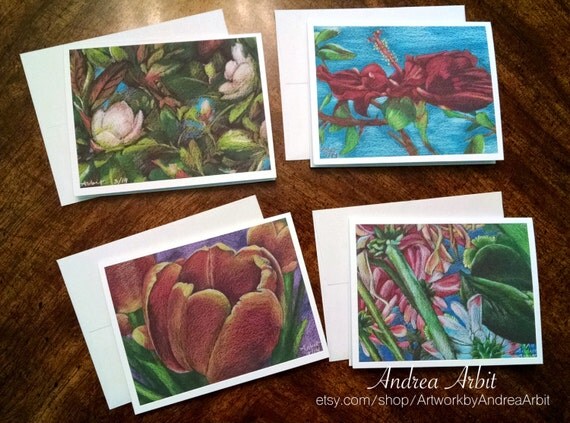
Several months ago when I first started thinking on this idea, I bought some blank, printable notecards at Staples. They're perforated for folding and they have texture, so they're nice quality - but they (theoretically) should work in my HP printer just fine, meaning I could make reprints of my artwork on blank notecards right from home.

Now that I have everything scanned in, that is my next goal - to see what quality prints and notecards I can produce on my own computer/printer, figure out what would be a good price point so that I can sufficiently cover the cost of materials, and start stocking prints and notecards of my favorite artworks in my Etsy shop, at the Paint Creek Art Market in downtown Rochester, Michigan, and anywhere else that I might take my work to try to sell.

Once I have that figured out, maybe I'll do some research into those websites that sell artwork prints on-demand; but one thing at a time for now.

Wednesday, June 29, 2016

Travel Bucket List

Well, I've finally done it - I've posted photos from all of the places I've traveled to.

(At least, all the ones I've traveled to since 2005, when I got my own digital camera and started organizing my photos on the computer. Somewhere there are photos of other places I've visited - but they were trips I took with my family in elementary school and middle school, and either I didn't take the photos myself or I otherwise don't have easy access to them in digital form.)

My point is, that I am all out of source material to post about. I am far from out of source material to use in artwork - very few of the photographs I've posted on this blog have actually been made into drawings or paintings so far, and I still have a lot I could work with for future works - but as for photographs to sort through and post here, my digital folders have run dry.

It's been a long time since I've traveled anywhere or had a "vacation" to speak of. My husband and I join his family in Virginia Beach every year for a week, so we do have that. But rarely do I take photos on that vacation, since we stay in the same place and go to the same beach that we do every year. I've already taken those photos; there is no need to take photos of the same things again.

Lately I have been trying to capture "local" moments. I take photos of the plants in my own front and back yard, or in my parent's or grandma's yard, or at nearby parks, or the landscaping and gardens along Main Street, or the Detroit Riverwalk, or other lovely local places - even supermarkets and local nurseries that have bouquets and potted plants for sale. I have also made a list of gardens around Michigan that might be fun to take a "day trip" to photograph some weekend; maybe one day soon I'll start in on that list.
But the fact remains that it's been a while since my husband and I have traveled anywhere; we certainly haven't traveled internationally since our honeymoon, which was almost five years ago now (!) - not counting Canada, of course, which we did drive through on a short road trip to upstate New York for a wedding. For a while, I was crossing the Atlantic every couple years. I went to France in 2005, I studied abroad in Switzerland/Italy/Greece in 2008, I joined my husband's family on a cruise to Spain/France/Italy/Croatia in 2010, and my husband and I honeymooned in Greece in 2011. But since 2011, we haven't left Good Ol' North America.

We went on an extensive road trip in 2012 - but we crammed it all into a week, so we hardly had time to really settle in or look around in any one place for more than a few hours. We drove to upstate New York for the aforementioned wedding - again, crammed into a weekend. We've driven to see my husband's family near Chicago, Illinois several times over several weekends. And we go to Virginia Beach for a week every year. But that has been the extent of our Married Life Travels so far.

Part of the reason we haven't traveled much has to do with finances. I wasn't working for much of that time, or only working part-time, and my husband was not getting paid enough working as a high school teacher. We also had little time to travel - even though he got summers off as a teacher, he had to do a lot of prep work for the next school year and was often taking summer/evening classes to work on his two Masters. We also prioritized buying a house over travel, investing money and time in our house in Rochester Hills - adding landscaping, getting a new roof and new siding and new installation. And then we got a puppy - which made traveling even harder.

I don't know when we'll plan our next big trip, but that doesn't stop me from dreaming. For the longest time France was my biggest item on my Travel Bucket List; then, once I visited France, it was replaced with Italy. I wanted to see art, and the cities that saw so many important art movements and nurtured so many artists. Now that I've been to the Mediterranean three times (!) those are no longer priorities.

My current Travel Bucket List is as follows -

IN NORTH AMERICA:

1. New York City. I've never been! And for someone who is into looking at art museums and who loves live theater, this is an obvious travesty.

2. Harry Potter World. My husband and I have been talking about making a trip down to Orlando to see the Harry Potter World for ages. One of these days it'll happen!

3. Holland, Michigan. It's only a few hours away, but I have yet to make it to Holland during its renowned tulip season! This could even be a little weekend trip and is totally doable - if the husband and I just schedule it right for peak tulip color. Think of all the floral photo opportunities!

4. Hawaii. Not exactly North America, perhaps, since it's way out there in the Pacific. And I am a little concerned about the Burn Factor. But maybe the heat/sun wouldn't be so unbearable if it was a winter trip? I'm sure they have lots of lovely gardens to see out there!

5. San Francisco & Vancouver. Cities on the Pacific that I've never visited.

6. Philadelphia. My family went on a road trip that included Pennsylvania when I was in middle school - but the stops we made were only for Pittsburgh (to see a friend), Hershey Park, and Gettysburg. We missed Philly!

7. Stratford, Ontario. I have been several times to this little town with a Shakespearean-inspired theater, on field trips in high school. But high school was ten years ago, and some day I would like to return to see another play.

INTERNATIONALLY:

1. The U.K. & Ireland. I've covered the Mediterranean pretty well, but haven't been to Northern Europe. I would love to visit England, Ireland, and Scotland - for the nature, the landscapes, the gardens, the castles, London, and yeah - perhaps a tour of Important Harry Potter sites, as well. :)

2. The Netherlands. For the same reason I always wanted to visit France and Ireland, I'd love to visit Amsterdam and check out it's art museums and art history.

3. Eastern Europe: Switzerland, Germany, Austria, Hungary, Poland. Yes, I have already been to Switzerland - but it was only Zurich, and it was for only two days. My father's ancestors came from a little German-speaking town in Switzerland many many generations ago, but it would be kind of cool to go see it anyway, though I know nobody there. I bet there are also some lovely landscapes and castles and gardens around near the Alps. Similarly, I'd love to see Germany. I've only been to the Frankfurt airport; I'd love to explore Munich or Berlin. My uncle recently took a river cruise down the Rhine and his photos looked really beautiful. I know Germany has some great forests and castles and charming towns. And while I'm in the area, might as well check out Vienna, Austria, or maybe Budapest, Hungary... All the non-Mediterranean cities I haven't visited yet.

4. Sweden, Finland, Norway. Some sort of Fjord cruise would be really beautiful I bet. I know next to nothing about these countries and what there is to do for a tourist, but if I cross off England, Scotland, Ireland, The Netherlands, Switzerland, Germany, Austria, Hungary, and Poland... somewhere in these three Scandinavian countries would probably be next on my list.

5. Spain. I have been to Barcelona, it's true. But Spain's a pretty big country, with other big cities to explore and plenty of interesting art history.

6. Russia, Turkey, Morocco. I've considered these places before, but don't know if I'll ever actually make it there. I'd love to see some of the major cities, like St. Petersburg, Moscow, Istanbul, Marakesh - the places I always see on TV, with the awesome architecture and colorful marketplaces. But I'm also a little wary to travel to places that aren't exactly the most politically stable/safe and friendly toward American tourists, especially when said American tourists known very little about the countries. Maybe if I did enough research and looked into exactly what I would like to see (and the best ways to do so), I could make one of those trips work out some day.

I realize all/most of these are in Europe... And I am not against traveling to Asia or Africa or South America some day. I just know so little about the world outside of North America/Europe that I haven't learned anything that has really sparked my interest to want to travel there yet. It's Western bias, I know; but I spent semesters upon semesters being fed anecdotes and histories and slides of artwork from the Western world and getting excited about all there was to see. I find that I get the most out of a trip if I know something of it's history; if I know what I'm looking at. And even if I were to find a way to easily/safely explore Asia or Africa or South America (i.e. with a local guide, or at least someone who spoke the language and/or knew the area and what things I should be looking out for), I still wouldn't really understand what I was looking at.

And also I am super pale and burn easily, so the closer something gets to the equator, the more I'm Not Sure if I actually want to travel there. Southern Italy and Greece were already bad enough for my poor skin... ;)