Showing posts with label family. Show all posts

Monday, August 9, 2021

Parenting Lessons Learned

It's hard to believe I've already been a mom for one and a half years! Time really does fly when you're having fun. :)

True to form, I have a list (a Google Document) that I routinely update with things I want to remember for a potential future parenthood round 2 - things that went well (or didn't) with our now-toddler daughter, as well as things I was needlessly concerned about (or not concerned about enough). Now obviously every kid is different, and what works with one won't necessarily work with another, but still - I feel like it can't hurt to try to be prepared (my motto for pretty much everything), which is why I started making this list anyway.

And then I thought - maybe other Type As like me would also be interested to hear my takes, just in case they experience something similar. I could make this a blog post! So here we are.

This public version of my list is only part of my list - the things I learned and pieces of advice I have to offer that I thought would be most universally applicable/adaptable for different kinds of families with different parenting styles (though I'm sure even in this curated list my parenting biases shine through).

Without further ado, the eclectic assortment of parenting experience/advice I've (so far) accumulated:

  • Buy newborn size diapers. I knew I'd be having an above-average-size baby (she ended up being 8 lbs 10 oz at birth), that newborn size diapers were only recommended up to 10 lbs, and that size 1 diapers fit well starting at around 8 lbs - so I figured if we wanted to use newborn diapers at the beginning it would only be for a few days before we'd switch to size 1s anyway, and that the diapers we took home from the hospital would more than cover those few days. Alas, I was wrong - in my parenting inexperience, I severely underestimated 1) how many diapers a newborn can go through in a day, 2) how long the umbilical cord stump can stay on (our daughter's didn't come off until the pediatrician took it off at her 3-week appointment), and 3) the fact that all babies lose weight during the first 24 hours - and can take 2-3 weeks to get back up to birth weight again. The newborn size diapers have that little cutout for the umbilical stump (at least, the Huggies brand does), but size 1 diapers don't. For that reason alone (but also because our daughter hovered around the 8 lb mark for several days longer than I thought she would), we ended up using newborn size diapers for at least 3-4 weeks - which necessitated running out and buying a couple boxes past the freebies the hospital gave us.
  • If you're breastfeeding, use diaper rash cream/ointment after every diaper change for the first two months. I bought diaper rash cream/ointment for each changing table (we put one upstairs and one downstairs), and another set for the diaper bag and car. One and a half years later, we haven't used it all; since our daughter started solid foods around 6 months old, we've had to use it maybe once or twice a month. BUT I do wish we'd used it more frequently when she was a newborn, especially those first few months. Breastfed babies have soft poo, and a LOT of poo (at least ours did - I swear, nearly every diaper we changed had some poo) - and when they're pooping that frequently, the bum is sure to get irritated. Just trust me on this. Better to over-cream/ointment than not do it enough, and then have to make a pediatrician appointment to get a prescription for the high-quality cream/ointment stuff.
  • If you are concerned about any aspect of breastfeeding - call a lactation consultant! I thought I was doing pretty good with everything, and knew what I was doing - but when our daughter hadn't gained back to her birthweight yet by two weeks, our pediatrician recommended we either call a lactation consultant, or supplement with formula. We started with the first (and ended up also doing the second) - and let met just say, the lactation consultant we saw was so amazing and reassuring. Yes, it turned out, I did know what I was doing - but it was great to hear that from a professional... and get tips for how to do certain things even better. In those hectic early weeks, it was such a relief to get that professional reassurance. And most insurances (including ours) cover up to two sessions! Ours was an at-home consultant (it was January 2020, just before the pandemic), and she came over and watched me do a feed in our own living room. It was great! And then she was available via text when I had follow-up questions during the next couple weeks after that, too.
  • It is okay to supplement with formula. I dreamed of "exclusively breastfeeding," so it was really hard for me to hear that it might be a good idea to give our daughter some formula. I worried that there was something wrong with my breastmilk (quality-wise and/or quantity-wise) that made me "unfit" to breastfeed. I worried that she would struggle with differentiating between the bottle and breast (and would prefer the bottle). And I worried that if I started supplementing with a little formula, there would be no going back to "exclusive breastfeeding" at a point in the future - like once you start formula you can never go back again. Thankfully, all those worries were completely unfounded. We gave our daughter one bottle of formula a day for a few weeks, until she was back to birthweight and her bilirubin levels were back to near-normal levels (she had a bit of "long-term" jaundice). She took to the bottle just fine, and didn't have any confusion between the two. And when she was healthy, we dropped the formula, and she was just as content to go back to exclusive breastfeeding... Of course, if it hadn't worked out that way and I hadn't been able to continue breastfeeding after all - that also would've been okay. My mother formula-fed me in the '80s, and I turned out just fine. Breastmilk, formula - it doesn't matter. Fed is best. (Looking back with several months of hindsight, it really does seem silly how much we worried over something so minor - but that's life parenting a newborn, I guess. Every decision seems so fraught, because their little lives seem so fragile.) 
  • If you want your baby to be able to drink from a bottle, keep giving bottles once they are introduced. For a bit after we stopped the formula, we still gave a bottle (for one feed per day) of pumped breastmilk, both so my husband could help with feeding, and so that she would continue to be competent with bottle drinking if we were to need to leave her in someone else's care while we went out for a date night or something. We did that once (her aunt babysat her, and gave her a bottle) - but then the pandemic hit, and socializing/leaving-the-house-at-all were out the window, and when the only reason we were giving bottles was so my husband could do a feed, it just didn't seem worth it anymore. I still had to pump while he was giving her the bottle, to keep my milk production up, and it was more work to pump and clean all the pump parts (and bottles) than to just breastfeed instead. So for a few months, I exclusively breastfed. No more bottles... but by summer 2020, things were opening up again, and there would be occasions (rare, but still not never) when I wouldn't be around for a feed (e.g. if I had a doctor's appointment). And when my husband tried to give her a bottle - she refused it. Thankfully, she was almost 6 months by that time, and once we hit that milestone, if she was hungry when I happened to be out of the house, my husband could just feed her some food purees instead until I got home (since I was only ever gone for an hour or two at most anyway). Not using bottles had some perks (we never had to wean her off the bottle!) - but definitely some drawbacks, too. For one thing, I had to do every. single. feed. Even the ones in the middle of the night. Every night. For another, what was the point of having an "emergency supply" of frozen, pumped breastmilk if she was never going to drink it? (I creatively used it to make a bunch of frozen food purees instead.) And finally, to this day she does not like drinking milk from a cup, even now that we're trying to do cow's milk now, rather than breastmilk or formula. Even adding chocolate or strawberry flavoring to it, she will not do it. I suspect she wouldn't have that aversion if she'd had milk more frequently from sources other than me.
  • Replace your breast pump parts regularly! You're supposed to get new parts and switch them out every 3 months. This includes the flanges, filters, tubing, and collection bottles. I figured it was just a "recommendation" and didn't really bother being super vigilant about it at first - the pump still worked just fine, so why change them? But then I caved and gave it a try - and it was worlds different. I thought my pump was working just fine with old parts, but I was wrong. It's like changing the toothbrush head on your electric toothbrush - you know how it feels crazy powerful that first week after you replace it, and your teeth have never felt cleaner? Suddenly I was getting like twice the amount of milk I'd been getting before. Of course, with everything else going on with parenting, it's easy to lose track of time and forget when it's been three months - so make it an alarm on your phone/calendar app! (And if you're noticing any issues, or see any cracks in the plastic, definitely feel free to change the parts out even sooner!)
  • Once your baby starts eating solid foods, make sure you clean the food bibs really well. (I'm talking about the plastic bibs here, which are easy to wipe food off of. Teething bibs are another story.) We just kind of wiped the food bibs off after a meal, or washed them in the sink when we did the rest of the dishes at the end of the day. After a few months of this, we noticed black spots on the little velcro strips - mold. We tossed the bibs and bought new ones, and this time we did two things differently: 1) We still usually waited until the end of the day to thoroughly clean them, but in the meantime, we didn't just throw them in the sink with other dirty dishes to sit in water. We kept them separate (and dry), on the counter, until they were ready to be cleaned. And 2) whenever we did a load of our daughter's laundry (so once or twice a week), we threw all the bibs in the washing machine with her clothes, and then hung them to dry.
  • Keep nursing pads stocked until you are completely done with breastfeeding. Once I had my supply well-established and we were past the first couple of months, I (wrongly) figured I wasn't going to have any leaking problems anymore. I even returned an unopened box to the store. But then she started solid foods (and so she nursed a little less); and then we moved her to her crib in her own room (and so she nursed a little less); and then we did some sleep training so she would sleep better through the night (and so she nursed a little less)... and every time one of those transitions happened, and my body had to readjust to a new schedule, there would be at least a day or two of leakage problems. Needless to say, I ended up buying another box to replace the one I'd returned.
  • Don't be afraid to sleep train! - and to get help from a sleep consultant. Figuring out how to get your child to sleep is HARD. Especially because - it keeps changing! What your little one is capable of, and the amount of sleep they need, keeps changing as they grow up. And so many things disrupt sleep - Developmental milestones cause sleep regressions! Teething causes sleep regressions! And everything you read online is contradictory and different. Sleep training (which for the uninitiated means helping your child learn how to put themselves to sleep without relying on nursing or rocking to sleep) comes in many forms, and there is countless debate about what process is best - but the truth is, ALL of the processes involve at least SOME amount of crying. And it is SO hard to hear that crying. But just because your baby is crying doesn't mean they are in Major Distress - it just means they are acknowledging that their routine, and the process that they used to use to fall asleep, has changed; they can't speak yet, so the only way they can communicate is crying. We tried sleep training a couple different times, in a couple different ways, and kept struggling to stay consistent until we finally hired a sleep consultant to give us reassurances (and hold us accountable), throughout the process. And it was SO worth it. Our daughter is now an amazing sleeper (knock on wood), with very little effort on our part other than "suck it up and endure hearing her crying a little more than usual for a couple days".
  • The ideal two-nap schedule is: naps at 9 am and 1 or 1:30 pm. Most kids do two naps from about 7-8 months until sometime between 14-18 months, when they drop down to one nap. This was one of the things we learned from our sleep consultant - there are natural time periods when a baby of that age is more likely to be tired, and thus more easily able to fall asleep for a nap. If you can line their napping schedule up with those times, napping won't be such a struggle every day. And wouldn't you know it, a few small adjustments to her napping schedule so that she woke up for the day around 7 am, took her first nap starting at 9 am, and her second nap starting at 1 or 1:30 pm (depending on how long the first nap was), and she was sleeping SO much better.
  • Teething does not always follow the "schedule." On two separate occasions, we took our daughter to the pediatrician, because she was having symptoms of teething, but "according to the schedule" she shouldn't have been teething again yet. The first time was around 9-10 months, when she seemed to be teething on and off for about 6 weeks straight, as her 4 lateral incisors came in. We thought there was no way she'd STILL be teething 6 weeks later, right? So we brought her in to see if maybe all her ear-tugging and rubbing was due to an ear infection. It wasn't. The second time was just after she turned a year old, when she was swallowing so much saliva she was wheezing a little. It seemed like she was getting her first molars in, "but how could she be?" we reasoned, when she wasn't "due" for molars for at least another two months? Again, we were wrong; it was just teething... I can't tell you the number of times I searched for teething schedules online, to check when her next teeth were "supposed" to be coming in - And it seemed the more I looked at those charts, the more wrong they were for our daughter. Her teeth did not come in the "right order" or during the anticipated time range - especially the older she got. For example, her bottom canine teeth came in first, even though the top canines are "supposed to". According to the chart, the bottom canines typically come in between 17-23 months; hers both came in early, at 13.5 months. At 1.5 years old, she now has all 20 of her baby teeth.
  • You don't have to listen to age recommendations for food or toys. Because many of our daughter's teeth came in early, before the "typical range," she seemed ready to try other foods sooner. When she was 10 months, I was feeding her snacks and meals marked "12+ months" and now at 18 months, I've already been feeding her some snacks marked "2+ years" for a few months now. Unless there's an ingredients-related reason to wait (like not giving anything with honey in it until after 1 year old), the age recommendations are really just that - recommendations - and you can feel free to ignore them. You know your child best, and what they're capable of. I was always around to supervise when she tried something new, and if she seemed to struggle with it too much, I'd wait a couple weeks or months before offering it again a second time. Same with toys - the age recommendations on a box are there either 1) to tell you what age range MOST kids would get the MOST out of that toy, or 2) for liability reasons (e.g. just in case a small part broke off the toy and became a choking hazard). Our daughter had a crawling tunnel at 9 months that she loved to army-crawl through - but according to the box, the recommended ages were 3+ years! Then there were other toys we got her that were certainly a little advanced to what she was able to do when we first introduced them - but she found other ways to play with them that she enjoyed, even if it wasn't what the toy manufacturer intended. We got her a little car ramp toy marked 18+ months, which we gave to her when she was a year old. She could not put the cars on the little ramp herself at that age, but she loved watching us put the cars on the ramp for her, and she liked playing with the cars on their own. There were four cars of different colors, and she liked lining the cars up with the different colored ramps that matched the cars. She played with the toy that way for a few months, until around 15-16 months old, when she was finally able to line up the cars to fit them onto the ramp, so that she could play with the toy by herself as intended.
  • Be prepared to waste food. Lots of food. Advice for feeding toddlers is like: "Offer a variety of foods, so they are introduced to a variety of flavors and textures!" "You may need to offer a food upwards of 20 times before they're ready to try it - so even if they don't like something the first time, don't give up; try again!" "Every meal - AND snack - should be balanced, with protein/dairy AND fruit/veg." "Give your kid options - they'll be more likely to eat if they're choosing what to eat!" "Don't force them to eat. Offer food and then let them decide how much to eat." All of those are great advice - BUT they also necessitate food waste. Keeping the house stocked with fresh fruits so that I can offer a banana or a kiwi as a snack, means sometimes the bananas (or kiwis) won't get eaten in time before they go bad. And that's not even counting the balanced plates that are prepared, only for them to refuse any of the things on their plate (even if they're things they asked for). I knew there would be some food waste, but I gotta say - I was not prepared for just how much food would end up in the trash every day (or, to our vet's chagrin, the dog's mouth). You either have to get creative for how to store and repurpose leftovers, or you have to just give in the inevitable food waste, try not to feel guilty about it, and get used to taking the trash out more often before the trash bags start to smell.
  • Children develop at their own pace - and that's perfectly okay! Our daughter was not an early walker, or an early talker. (I blame the pandemic and our limited ability to socialize and take her out places to see other kids for at least some of that - but even during non-pandemic times, there are still always kids who walk or talk earlier, and others who walk or talk later, so who knows.) There were even times when her doctors expressed some concern that she wasn't hitting certain milestones soon enough - but from our standpoint, I was much less concerned. She likes to do things on her own, and if we tried to push her to practice cruising or walking, or tried to prompt her to repeat sounds or words after us, she would have zero interest. I knew she was capable; she just didn't want to yet. I could see that she was making progress in her own way, at her own pace, and was perfect fine with that - so I tried to be fine with that too. :)
I'm sure there's a ton more lessons I've already forgotten - but at least that list is a pretty good start. :)

Sunday, February 21, 2021

Recreating the Nursery

In October 2018, in between my two pregnancies (the first which ended in a miscarriage and the second which led to the birth of our daughter in January 2020), I spent a few days painting yellow ombre stripes on the walls of the room that would become our nursery. I wrote about the process in this blog post, but the "tl;dr" of it was that 1) it gave me something to do to transform my grief after miscarriage into hope that we would get pregnant again and use that room as a nursery some day after all, and 2) it involved a lot of painter's tape. Like, a LOT a lot. And then a lot of touching up once the tape was removed and we saw all the oopsies we managed to make despite the painstaking measuring and taping. But I loved the end result, and I loved it even more when we had furniture in the room too, and we started using it for our daughter.


(See more pictures of the finished nursery in this blog post.)

So when we decided to move... of course I had to recreate stripes again in her new bedroom. It was one of the things I was saddest about leaving behind in our old house, and something that I knew would make our new house feel like ours. I also hoped that it might ease our 1-year-old's transition - I reasoned that if her new room looked similar to her old room, it'd be easier to get used to living in a totally new house. On the other hand, we have a pretty easy-going child, and I think her general go-with-the-flow attitude about moving had more to do with her personality and her age (being just young enough still that she doesn't quite yet *expect* things to stay the same from day-to-day) than about me painting stripes. Saying it was "for her" would be a lie. She doesn't say any words yet (other than "mama mama mama" all day long) and I have no idea what her favorite color is, or what her feelings are about stripes. In all honesty, painting stripes on her walls for me, and for me alone. ;)

What I didn't anticipate about painting stripes the second time around was how much longer it would take, thanks to 1) the aforementioned 1-year-old, and 2) the fact that we weren't yet living in the house when I painted them. We wanted the room painted before moving our daughter's furniture (and ourselves) in, which meant I could only paint during the few short hours we would drive down to our new house on weekends. My husband did all the measuring and marking with a pencil, and helped with some of the taping. Those processes took at least a weekend in total (it was so long ago I don't remember at this point). Then once we were ready to go, I painted two stripes one day, another two the next, and then didn't get to paint the fifth and final stripe until the following weekend. And then the touch-ups... First the room was pink when we bought the house - light pink on 3 walls and dark pink on the 4th wall - and some of the lighter yellows I chose did not cover the dark pink wall very well, and required two coats. I also had to do white touch-ups on the ceiling, trim, and door frame. And of course the touch-ups along each "seam" where the paint changed color. All in all I was painting for 1.5 months - an hour here, an hour there, when we were in the new house for a short time between our daughter's naps (which we tried to time with the drives back and forth between our houses, since it was an hour-long drive each way, and it was convenient for her to be able to nap in the car). It was SO MUCH work. But again... I loved the end result! And I loved it even more when we moved in, added her furniture (and books and toys) and it really became *her* space.

There is one big change I made from the first room - instead of doing 5 shades of a slightly greenish yellow, I did 5 stripes of warmer (slightly orangeish) yellows, and orange. In her old room, there was a brown hardwood floor, and we had a light green area rug that I had to coordinate the colors with; going too orange with that yellow was not an option - it just didn't look nice with the rug. But her new room has white carpet, which means the area rug didn't come with us (we had no use for it elsewhere in the house either), and I wasn't restrained in color choice trying to coordinate with it. Instead, I focused on choosing colors that would go with the artwork I created for her, and something that would pick up the browns in her wood furniture. I decided to branch out from just doing one color family (yellow) and used both yellow and orange instead. So the first stripe was a pale yellow ("String Cheese"), the second stripe was a slightly yellower/darker ("Vanilla Ice Cream"), the third stripe was a really saturated yellow ("Yellow Jubilee"), and then I transitioned to more orange with two shades of yellowish-orange, one lighter ("Solar Storm") and one darker ("Splendor Gold").


I won't write up the whole process again, since it was the same as the first time I did it - measure, draw pencil lines, tape alternate stripes, paint, take the tape off, put new tape up, paint more, etc. - but here are some of the in-progress pics so you can get a sense of the steps I took:


Doesn't the room just look so much brighter and happier with yellow and orange than it did with those pink walls? I have nothing against pink in general (though I do find it far too cliche for a baby girl's nursery)... but the pinks the previous owners selected were really "cool" pinks (meaning pinks that leaned more purple/blue than red) and it made the room look dark and a bit depressing for a toddler's room. I just LOVE how happy and sunny the yellows and oranges look! They fit our daughter's personality so much better.

Finally, here are some photos of the finished nursery, once we moved in:


Lots of work? YES. Worth it? Also yes.

Sunday, December 20, 2020

Turning 32

My 32nd year was not exactly what I pictured... but I think that was the case for all of us. 2020 has been a wild ride, y'all. But I'm really hoping things are looking up (or will be soon) where the pandemic is concerned, and we'll finally start feeling safe enough in 2021 to start venturing farther outside our homes again.

Here are some of my hopes/goals for my 33rd year, leading up to turning 33 on December 20, 2021:

  • Stay healthy while we all ride out the end of this pandemic.
  • Successfully move in to our new house, organize and unpack everything, and make it feel like home for us, our daughter, and our dog.
  • Prepare our old house for the housing market and sell it.
  • Find a groove again with creating artwork - I was doing well for awhile, and making sure to prioritize working on colored pencil drawings while our daughter was sleeping... but then we decided to move, and in the process of packing everything and planning for the new house, my art fell by the wayside again for this last part of 2020. Once we're all moved into the new house, with a new art studio, art will begin again!
  • Submit my artwork to be shown in various local art exhibitions or art shows. I had grand plans to do this in 2020 (after I settled in to motherhood a bit) - but then the pandemic hit, and what few art exhibitions were still happening in-person were not things I felt safe participating in. Here's hoping 2021 will be better!
  • Start working part-time as a graphic designer again, too. I had planned to continue working from home for Temple Israel as a contract designer after our daughter was born - but then with the pandemic, they were hosting a lot fewer events and had much lower needs for graphic designers this past year than anticipated. I'd love to start designing graphics again - if not for Temple Israel, then for others. My new studio in the new house is going to be big enough to fit my easel and tables for watercolors and colored pencil drawings AND my computer desk, and I'm so stoked to be able to work on all aspects of my creative work from a single room in the house.
  • And of course - watch our daughter continue to amaze as she grows every day! She'll turn one in less than two weeks, and I'm so excited to see what her 2nd year brings!

Sunday, November 22, 2020

Thanksgiving

It's Thanksgiving week! Since I have no new art to show you (see my previous post about moving), I thought I'd take some time to list all the things I have to be thankful for this year instead. I know for many 2020 has been a really rough year, in many ways - and I feel very fortunate to have so have so much to be thankful for in such a bleak time.

The year started with the birth of my daughter on January 1st. What a way to start the year! It has been amazing these last ten and a half months watching her grow. From nursing to pureed foods and sippy cups, and now to eating the food off our plates; from barely being able to lift up her head to learning how to roll and sit and crawl and stand; from sleeping constantly to never wanting to sleep at all (why sleep when there's so many things to learn, so many rooms to explore, so many ways to play!) - she has been a constant source of wonder and joy throughout 2020.

On a similar note, I am also so thankful for my husband, who is the best dad to our daughter. The pandemic meant all of his classes for his master's program went fully online in the spring; once he found a job and started working full-time again, that was also remote. I love having him home so much, especially while our daughter is so young; even if he's working, he's still close enough that he can join us for walks around the neighborhood or a bit of playtime during his lunch break. He has gotten to watch her grow just as intimately as I have, and they have a wonderful bond. It's also been amazing for me, to have someone around to help get her down for naps and bedtimes when she just refuses to sleep, and to share in some of the daily stresses of parenting a baby.

I am thankful to have spent the majority of this year in Rochester Hills, which has so many great outdoor spaces. Over the summer, when we were bored staying inside our house but didn't feel comfortable taking our daughter to all of the places I'd once imagined taking her during her first year (to the library, and to stores, and to the zoo, and to anywhere else fun I could think of), we still had plenty of opportunities of places to go. We visited several nearby parks and took her on walks (in her stroller or in a baby carrier) along the Clinton River Trail, which was a lot of fun for her and our dog, and great fresh air and exercise for all of us.

I'm grateful that my husband was able to find a job he's really excited about, working for a non-profit he's really excited about, and that his new employers value his health and are taking this pandemic seriously. I'm also grateful that we were able to find a house we love in a neighborhood we love in Ann Arbor, and that we have the time to move there more gradually than we otherwise probably would if my husband wasn't working remotely and was already in the Ann Arbor office.

I'm thankful for our families - those who have been able to visit (once the stay-home order was lifted), entertain the baby, and help us move; and those who live farther away but still made time for countless Skype and Zoom calls to visit with our daughter safely (and virtually). They say it takes a village to raise a child, and this pandemic has isolated many from their villages; I'm so appreciative of the efforts made to make sure that wasn't our fate.

Monday, June 1, 2020

5 Months of Motherhood

When I planned making a blog post after a few months of motherhood, I didn't expect it to be quite like this one. I envisioned a quick check-in where I would reflect back on how things have been going, and how much (or how little) art and writing I've been able to do compared to what I thought I'd be able to squeeze in, now that baby duty is taking up so much of my time. I counted on sleepless nights and long days, crying jags and learning curves, as I learned what my daughter needed from me - and when. But I didn't anticipate a global pandemic casting a shadow over these first several months, and how that might factor into my art and writing plans.

Michigan was under stay-at-home orders from mid-March until the end of May - 2.5 months altogether. Or, to put another way, half of my daughter's life to date (she turns 5 months old today). In many ways, our lives were not upended by this nearly as much as other people's lives were. We were already basically social distancing while our baby was young - limiting visitors to those who had received flu shots, and avoiding taking her out into any crowded public spaces. Furthermore, I was already planning to be home with her full time (ramping up to working from home part-time around the 3 month mark), and my husband was finishing the last bit of his master's degree by driving the one-hour commute to campus twice a week for classes. We had already restructured our lives to being home with the baby as much as possible - so when the pandemic altered our work and schooling, it was only "in our favor," letting us be available to our baby even more. My working from home was pushed back (with no events happening, there's little to design flyers and emails for, so I haven't been needed); and instead of going to Ann Arbor, my husband's classes moved online, letting him be home with us all 7 days a week. It's never a good time for tens of thousands of deaths - but from our standpoint, being granted even more time at home with our baby has actually been really nice.

Still, if you thought both of us being home all the time meant I had even more time to do all that art and writing I'd planned on doing, you'd be wrong. I did manage to complete two 8"x10" colored pencil drawings since our daughter was born - but these were both done in January/February, before the pandemic hit our state, and before the stay-at-home orders began. I've done very little art (and no writing) since.

It's not that I don't have time for it - after all, I managed to squeeze in some time in January/February. It's just that it hasn't been a priority for me lately. For one thing, as our daughter got a little older, and staying awake longer, it's been so fun and rewarding to spend that awake time with her every day, playing and taking pictures and videos of her. Even when my husband is available to watch her and I could take a break, I often choose not to, just because I don't want to leave her side. I'd probably feel this way regardless, but I'm guessing that the pandemic has exacerbated this feeling. When we can't leave the house, and no one but my husband and I can see her every day, it seems more important to witness and document all of those moments, and to share daily photos and videos with the grandparents, who haven't been able to visit during all this.

Another aspect is that I feel obligated to make the most of our time at home with her, since she's "missing out" on other experiences outside the home. It's true we wouldn't have been doing much with her yet anyway, but I had wanted to start taking her to storytimes at the library, or just to different stores to let her look around and experience new things. Now, if I want her to see something new, I have to try to find a corner of the house we haven't spent much time in yet. Expanding her horizons is not as "easy" as packing up the diaper bag and heading out somewhere (though that is never easy either, I'm sure!). We're lucky that she's still so small, and that so many things are new to her. I feel so bad for parents stuck at home with toddlers or kids, whose worlds had already opened up a little past their own houses, only to have this situation shrink their worlds smaller again. Our daughter doesn't yet know what she's missing out on.

Still, she isn't playing or feeding ALL the time - she's a baby, and she also naps. And that was when I'd planned to do any art or writing I wanted to do - while the baby was sleeping. But she isn't the best at napping during the day, and I suspect that's because she hasn't had to be. Instead of trying to make her conform to our schedules, we didn't really have a schedule anymore - and so were able to let her dictate her own routine however she wanted. Plus, we're both always home to hold her or pick her up if she cries, or rock her to sleep so she doesn't have to self-soothe. For a long time, she wouldn't nap in her crib at all - only in our arms (though she's starting to finally get a little better at that). Part of me wonders also if she'd be a better napper if her world was more "exciting" during the day. If we could pack her up and take her out somewhere, to show her a totally new place she hasn't seen before, would that extra bit of stimulation tire her out more, and help her sleep better?

She still often naps for only 30-45 minutes at a time, which means she ends up taking 4 short naps like that throughout the day. In the last month or so, I've been trying to rectify that - trying to encourage her to sleep longer, so she can also go longer between naps, so that we're only down to 3 naps a day. It's hard to get anything done when I only have a 30-minute window. It's not impossible, but it's harder. And when I don't have the motivation to prioritize squeezing in 30 minutes of work on a colored pencil drawing... it doesn't get done. I was able to do it early on, in January/February. But now it's harder. For the first part of the stay-at-home order, I was on my phone a LOT, reading news articles and keeping track of how many new cases and deaths there were - in the world, in the U.S., in Michigan, in our area. It burned me out a little - it left little time to work on any of my creative pursuits, and with little motivation to do so. I've also been doing more planning - planning dinners several days in advance, looking up new recipes to try to be creative with what ingredients we already have on hand in the pantry (and yes - hopping on the quarantine baking train), and those things also take up time I might otherwise spend on art or writing.

All of this is to say... I am very "behind" on the plans I'd made for creating art this year. All of the posts you've seen these past few months, and many of the ones I have scheduled for later in the year, are all things I made in 2019 (though the next two posts will be of the colored pencil drawings I did in January/February). I kind of figured I was overestimating how much time I'd have, and that I'd fall behind on my plans for 2020 artwork - but I didn't think it would be because of a pandemic. I hope to start making more art again in June, and getting back to my plans. Once our baby starts napping a little better (more consistently, for longer time spans, and actually IN her crib), that will help; so too will the grandparents being able to visit again, and the weather (finally!) getting nice enough to go out to parks, etc. I think that the more time we're able to spend with other people, or out of the house, the less pressure I'll feel to be present with her for ALL of the time spent at home with just us and her - I'll allow myself to sneak away and steal 30 minutes here or there for some art projects, knowing that I already did a lot to stimulate her at other times of day.

Or, you know, I'm just kidding myself again, and when I reevaluate in another few months, I'll find that I'm still super behind on all my artwork plans. :)

Wednesday, March 25, 2020

Ginny turns 5!

Our poor dog Ginny had quite a year since she turned 4 on March 25, 2019. Over the summer, she had a blockage in her anal duct that required manual compression at the vet (and a couple weeks in a cone so she wouldn't lick the area while it healed). Then in the fall, she started vomiting (more than usual), including little bits of blood, which had us concerned that she'd eaten something she shouldn't have, and led to us taking her to the emergency vet for x-rays. The x-rays didn't find anything, and after a couple weeks of a modified diet and some anti-nausea medication, she was back to normal.


I was also pregnant for much of Ginny's fifth year, which Ginny didn't always know how to handle... At the beginning of my pregnancy, we found her hiding in the strangest places around the house - behind my nightstand in my bedroom, under beds, behind couches, etc. Eventually, she seemed to get used to the idea that something was "different" about me, and she even took to snuggling against my pregnant belly sometimes. She enjoyed all the people who came over for our baby shower in October - but not the baby items that started slowly taking up all of "her" space in the house.


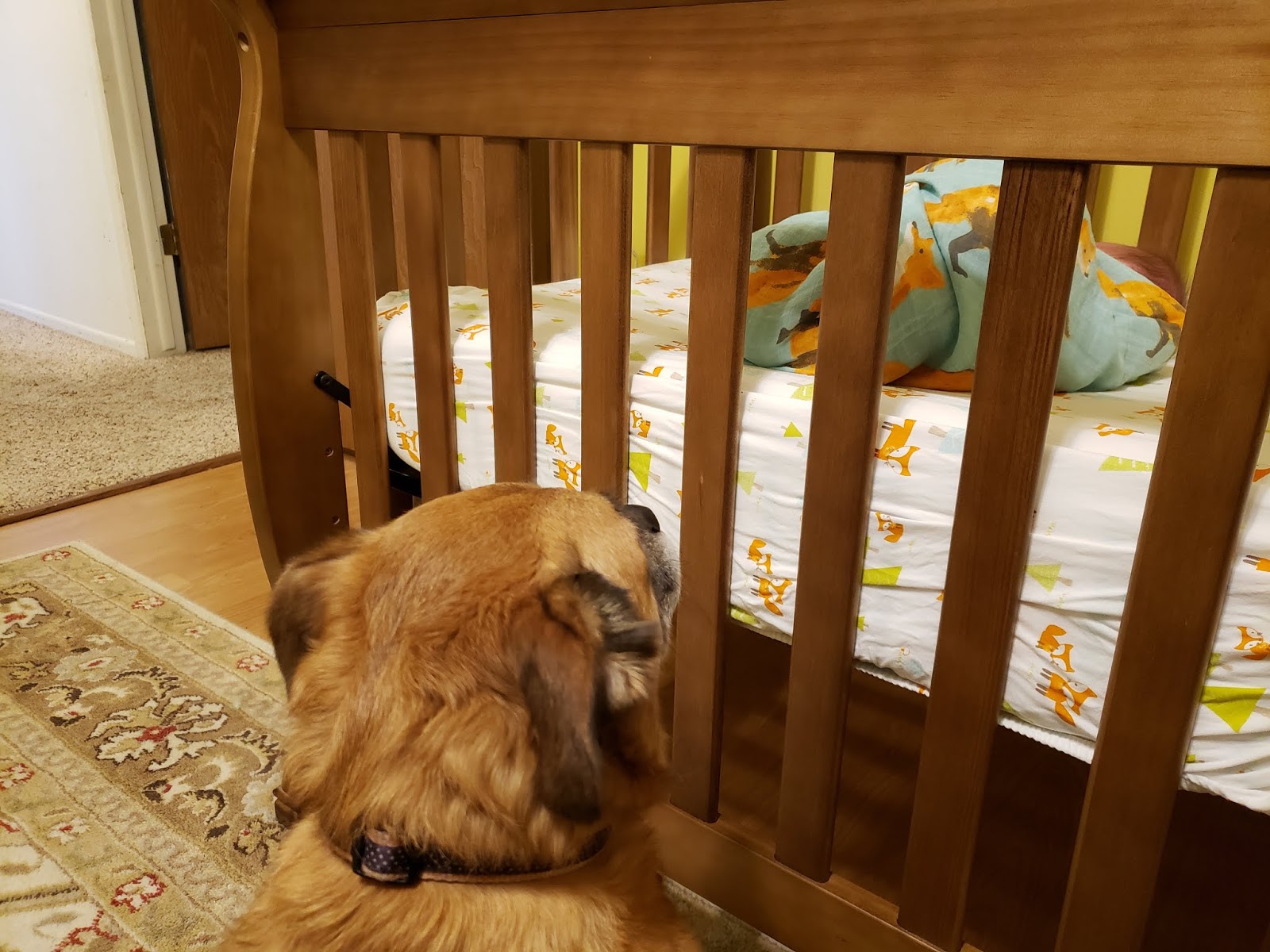
When we brought our new baby home in January, Ginny was mostly excited. She wanted to be where the baby was, and followed us from room to room, often watching the baby in her crib, bassinet, etc., wherever she happened to be. She still does this a bit - but some of the excitement has since worn off. When the baby starts to cry, Ginny gives us a look like "Why aren't you taking care of that noise?" and often leaves the room (though I can't say that I blame her!). She also seems to be jealous of the attention the baby gets. When we put the baby on a blanket on the floor for some exercise or tummy time, Ginny often gets right down on the floor with us - in between us and the baby, blocking us from interacting with the baby or taking pictures of her, until we acknowledge Ginny first. She also sometimes whines at me when I'm sitting on the couch nursing, complaining that I'm not able to play with her or pet her at the same time.


Ginny turns 5 years old today. Here's to another year of exciting changes as our baby grows (and Ginny learns how to adapt)! :) I think she'll appreciate the baby a bit more once she's older and starts sitting up and interacting with Ginny (someone else to pay attention to her!), and especially once she starts eating solid foods (someone else to drop food on the floor for Ginny to eat!).

Tuesday, March 10, 2020

Diabetes & Pregnancy: The 3rd Trimester

NOTE:
This post is a continuation of a series about managing my diabetes while trying to get pregnant and being pregnant. For more, you can check out these previous posts:

Diabetes Type 1.5/LADA
Diabetes & Miscarriage
Diabetes & Pregnancy: The 1st Trimester
Diabetes & Pregnancy: The 2nd Trimester

As always, these posts are not meant to be taken as medical advice, and merely discuss my personal experience with my specific diabetes. Everybody's experiences are different, and I am only speaking about mine.

***

My baby girl was born on 1/1/2020 (a New Year's baby!), weighing 8 lbs 10 oz and measuring 20.5 inches long. Being pregnant and giving birth as a diabetic is not easy - I knew that going into this pregnancy, and I know it even more acutely now that I've experienced it personally - but of course, all that insanity was worth it in the end, when I got the chance to hold my baby girl... And yet, this is a blog post about that insanity, not about the end result, so bear with me as I talk at length about all the hard work I put into managing my diabetes at the end of my pregnancy. :)

During the 10 weeks that I was in my 3rd trimester (from 28 weeks until I was induced at 38 weeks), I had 18 appointments. I had my annual physical at 28 weeks, as well as a growth ultrasound and doctor's appointment with MFM (maternal fetal medicine). At 29 weeks, I had an appointment with my regular OB and received the Tdap vaccine; at 30 weeks, I had a doctor's appointment with MFM without an ultrasound. I got a short week-long reprieve at 31 weeks... and then, starting at 32 weeks, I had appointments scheduled twice a week - an NST (non-stress test) and appointment with my OB on either Monday or Tuesday every week, followed by a BPP (bio-physical profile) ultrasound with either my OB office or MFM in the second half of the week, which (if it happened at MFM), also included appointments with MFM doctors and nutritionists, and perhaps another growth ultrasound as well. All told, by the end of my pregnancy I'd had 15 ultrasounds.

The non-stress tests were simple. I'd go to the doctor's office, where they would take my weight and blood pressure and have me pee in a cup. I would talk to a doctor, often (but not always) getting my fundal height measured and the baby's heartbeat found on doppler. And then I would be ushered into another room with a reclining chair, given a glass of ice water to sip, and told to stay put for 20 minutes with two monitors wrapped around my belly - one to measure my baby's heartbeat, and the other to measure any contractions I might be having. As I'd already experienced this at the hospital when I was 27 weeks pregnant and had some mildly concerning symptoms which my OB wanted to check out, I already knew the drill. They were looking for proof that my baby's heartbeat was doing well - but they were also looking for signs of "reactivity," which apparently means at least two momentary accelerations in heartbeat over the course of 20 minutes. They also didn't want to see any decelerations in heartbeat - or they would worry that my baby was in distress. Over the course of 7 NSTs, I only ever saw decelerations once. Usually everything was fine, and me and my baby "passed" with flying colors, being sent home once our 20 minutes of relaxation were up.

The one time I had an issue was at 35 weeks pregnant. I wanted to know what my A1C was (since it hadn't been tested in ten weeks, and I was curious), and my doctors needed to get another CBC (complete blood count) before I went into labor anyway, so before I sat in the NST reclining chair I was given a blood draw. I felt fine at the time (and I've never had issues with blood draws in the past), but ten minutes later, when I was sitting in the chair, I suddenly started feeling very faint. I worried it was my blood sugar dipping low, but my continuous glucose monitor (CGM) said I was fine. Before I had a chance to prick my finger to double check with my glucometer, my OB returned to the room and assured me that it likely wasn't my blood sugar at all, but a drop in blood pressure, caused by my blood draw and then sitting in a reclining chair. They moved me so I wasn't reclined as far, and they gave me a cold compress for my forehead, and after a few minutes I started feeling like myself again. I came close to passing out, but never actually fainted. In the minutes that followed that episode however, my baby showed heartrate decelerations twice. My OB guessed it was just because I'd almost fainted, and that probably my baby was fine, and not actually in distress anymore, now that I was feeling better. But just to be safe, it was recommended that I go to the hospital so they could monitor my baby's heartbeat for another hour.

The hospital was just around the corner, and I drove myself there. I checked in and went up to triage - just as I would a few weeks later, when it was time to be induced. They hooked me up to the same two monitors my OB office had just used, and for more than an hour I sat there, listening to my baby's heartbeat. By then, I felt fine - and so did my baby; I was more concerned with what the extra time I hadn't planned on spending away from home was going to do to my eating schedule. I was told three times that the doctor would "be right in" to see me - to assess what was clearly a normally reactive fetal heartrate and officially discharge me - before she finally came in. By that point, it was about an hour past when I'd wanted to eat lunch, and my CGM said I was at 70. The hospital staff offered to bring me a sandwich, but I didn't have my insulin with me; I didn't want to eat lunch at the hospital and have to use their insulin (which I figured would require more monitoring, and mean even longer before I would be discharged), and I didn't want to eat a sandwich without taking any insulin at all, so instead I accepted their offer of graham crackers, so that I wouldn't go low driving home - and then I ate my lunch once I was back in my own kitchen, with my insulin. (I suspect if my CGM had said 68 or something instead of 70, they might have been less keen to let me go - but as long I was at 70, I wasn't technically going low yet, and they had no reason to keep me.)

The bio-physical profiles were even more routine; during 6 BPPs not once did anything get flagged as a potential problem. Each BPP was an ultrasound where the sonographer looked for my baby's heartbeat, evidence that my baby was "practicing breathing" (moving her chest to exercise her lungs, even though babies can't really "breathe" while surrounded by amniotic fluid), and movement (both subtler movements and larger movements that showed proof of muscle tone, like an arm or leg flinging out). These ultrasounds are scored out of 8, and my baby passed with 8/8 every time, usually not needing anywhere near the allotted 30 minutes to demonstrate her abilities. During these BPPs, they also measured my amniotic fluid, to make sure it was within normal ranges. 

I also had three growth ultrasounds during the 3rd trimester - one at 28 weeks, one at 32 1/2 weeks, and one at 36 1/2 weeks. At 28 weeks, my baby had an estimated weight of 3 lbs 5 oz, putting her in the 95th percentile. I talked a lot about this in my previous post about my 2nd trimester, so I won't get into it much again now, but I was genuinely worried that I was going to have a "big baby" due to my diabetes, and that any health complications she might experience because of that (or any problems I might experience during labor because of that) would be "my fault" for not keeping my blood sugars lower - even though it felt like I was doing everything I could to try to do just that. Because of this worry, I started limiting my carbs a bit whenever I could (so basically - whenever I wasn't struggling with hypoglycemia that required me to eat more to keep my blood sugar in normal ranges). I tried to aim for eating about 45-50 g. of carbs per meal (instead of the 60 g. I had been doing earlier in my pregnancy); I also tried to keep my caloric intake around 2000-2200 a day whenever possible (though it wasn't unusual to hit 2400-2600 calories on days when I was battling low blood sugar). If I'd had my way, I would've been eating only 2000-2200 calories a day all along - on days when I ate more, I felt like I ate so frequently and so much, and was often very full, especially as I got farther into the 3rd trimester and my baby and uterus took up more and more real estate. I ate because my insulin dictated that I needed to, to avoid going low - not because I was hungry, or even felt like I had any room in my crowded stomach.

Thankfully, my growth ultrasound at 32 1/2 weeks started seeing my baby's average percentile go down a little - she was estimated to weigh 5 lbs 5 oz (89th percentile) that day. By my 36 1/2 weeks ultrasound, she was estimated to weigh 7 lbs (76th percentile) - at which point I stopped worrying so much. This was also about when my doctors talked to me about scheduling an induction - because I was battling lots of low blood sugars (more on that a bit further down in this post), and any (slight) high blood sugars I was seeing could not easily be fixed without simply causing even more lows, MFM decided it would be best to induce me around 38 weeks. Initially, they'd warned me they might want to induce as early as 37 weeks, but because my blood sugars were mostly on target (at least on average), there was no need to push for an earlier induction and risk complications due to prematurity. So knowing that I would be induced at 38 weeks, two weeks before my official due date, also helped my worries about my baby's size. Babies tend to gain about 1/2 lb. a week on average during the 3rd trimester; it was estimated that being born at 38 weeks gestation would put my baby at around 8 lbs. at birth - a number I was more comfortable with.

Of course, I still worried a little. Even though my baby's weight estimates were going down, her abdominal circumference stayed in a similar percentile through all three of those growth ultrasounds, ranging from the 94th-96th percentile - and since I'd been told that the belly size was a particular indication of diabetes-related larger babies, I was naturally concerned about those numbers. But MFM didn't make a big deal about it, and continued to congratulate me on how well I was maintaining my blood sugars. In fact, the A1C I had done at 35 weeks (which caused me to nearly faint, and resulted in my one abnormal NST result, as detailed above) came back at 5.1% - slightly higher than the 4.8% I saw during the 2nd trimester, but still well within non-diabetic ranges.

Besides all of these doctor's appointments, I also called in my blood sugars to the MFM nurses twice a week. Each time, they relayed my reports to the doctors and called me back with new recommendations for my insulin. As my placenta became more insulin-resistant (as all 3rd trimester placentas do), I needed ever-increasing doses of insulin to keep my blood sugars within my pregnancy ranges. When my 3rd trimester started, I was taking 27 total units of insulin - 9 units of Levemir in the morning and 5 u. at night, plus 6 u. of Novolog with breakfast, 3 u. with lunch, and 4 u. with dinner. 7 weeks later, by 36 weeks pregnant, I was taking 39 total units - 10 u. of Levemir in the morning and 6 u. at night, plus 12 u. of Novolog with breakfast, 5 u. with lunch, and 6 u. with dinner. At that point, my insulin needs finally leveled out, and I was able to stay under 40 total units for the last 2 weeks of my pregnancy, until I was induced at 38 weeks.

In general, I understood why I needed to keep increasing my insulin, and was usually on board with my doctor's recommendations - with one major exception: the recommendation MFM made around 34 weeks, when I called in my blood sugars just after the Thanksgiving holidays. Based on the readings I gave them, which admittedly included some higher-than-usual numbers, they decided to increase both my breakfast and dinner Novolog doses by 2 units - breakfast from 8 u. to 10 u. (a 25% increase), and dinner from 5 u. to 7 u. (a 40% increase). I was always going to hate that recommendation - because I hated it every time they tried to increase me by 2 u. instead of 1 u. at a time. When they did this, it made me feel like they weren't listening to me, not taking my individual diabetes into account, and refusing to consider that maybe my latent, gradual, adult-onset diabetes required different treatment than they were used to. I was not a gestational diabetic or Type 2 with severe insulin resistance and no danger of experiencing hypoglycemia; nor was I a Type 1 who'd had diabetes for most of their life, had been on insulin for a decade or two, and had let their A1C slowly creep up over the years to the point where it was problematic. I'd been on basal insulin for less than 3 years, and mealtime insulin only since becoming pregnant, I took my diabetes management very seriously, and I was very sensitive to insulin, having hypoglycemia easily with just small adjustments. Yes, being in the third trimester made me less sensitive to insulin than I had been in the past - but that didn't mean I could suddenly handle a 40% increase in insulin for a single meal. I knew that one or both of those 2 u. increases would be a major problem (and I knew that I would be the one dealing with the hypoglycemic consequences, not my doctors) and the fact that MFM didn't seem to realize this (or did realize it, but didn't care) pissed me off. 

But besides this negative gut reaction I always had when MFM tried to sell me on a 2 u. increase, I also hated that they were making any recommendation at all, when I knew my numbers "looked bad" not because my needs had drastically changed over a few days, but because they were my blood sugar logs over the Thanksgiving holidays. Besides the Thanksgiving meal itself, I'd eaten at restaurants more that weekend than I usually do. There had been several meals where I hadn't known exactly how many carbs I was eating, or what ingredients were used in recipes. I was also often eating at a different schedule than I normally ate at, with the result that sometimes I didn't take routine insulin (because I wasn't sure if what I was eating was a snack, or if it would end up being my lunch after all). It hadn't been a typical week, and I hoped that my numbers would go back to what they had been the week before, once I was back on a more regular schedule and diet - but MFM didn't seem to want to give me the chance to see if my blood sugars would even out, and that frustrated me.

I could've pushed back more from the beginning - and maybe I should've. But I haven't yet been diabetic long enough that I was completely confident in my gut reactions, and I often talked myself into giving my doctors the benefit of the doubt. I told myself, "I'll try it their way for a couple days, just to get the data to prove to them that this is too much insulin, and then they'll have to listen to me, because I'll have the data to back it up." Throughout my pregnancy, I took this approach a lot. It's probably why I ended up with so many low blood sugar readings - because I foresaw them but let them happen anyway, just to prove (to myself and to my doctors) what I had suspected all along about my insulin dosing. 

The first night I took 7 u. of Novolog with dinner, I was at 48 by three hours after eating - so low I actually felt hypoglycemia symptoms again (I usually didn't, since I had hypoglycemia so often my body had more or less gotten used to it). The second night, I was at 60 by three hours after dinner - another hypoglycemia episode, albeit not as severe as the previous one. By the third day (when I had also been doing 10 u. with breakfast for the last two days), I was at 69 before eating lunch, and 63 before even eating dinner - so I didn't take my 7 u. of Novolog with dinner, choosing to take only 6 u. instead. I saw MFM for an appointment the next day, showed them what had happened, and told them I wanted to take only 6 u. with dinner instead of 7 u. And they listened to me, and agreed that 6 u. with dinner made more sense.

My breakfast Novolog was also a struggle, but I felt like I had "less data" to back up my opinions there (or to even form my opinions at all). For whatever reason, my two-hours-after-eating-breakfast blood sugar reading often came back above 120 - and not infrequently as high as 150+. I'm not sure why breakfast affected me so much more than lunch or dinner did, when I tried to eat balanced meals for all three. Then, by 2.5 or 3 hours after breakfast, my blood sugar would be crashing, and I'd be scrambling to eat a snack to avoid a serious low - but that was a time of day when I was "supposed" to be eating a snack anyway, followed by lunch not too long after; it seemed less serious to deal with hypoglycemia during the mid-morning hours than it did after dinner, when I was prepared to eat only one more (small) snack at bedtime, and then go to bed. I did bring up my concerns about my mid-morning lows, and I talked to MFM about what I should be eating for breakfast, and for that mid-morning snack, to try to head hypoglycemia off before it hit, but in the end I was much less clear about what I wanted to do regarding my breakfast insulin. I could never get myself to say, "I don't want to take 10 u." (or 12 u., when they raised my breakfast by 2 more units just 1.5 weeks later) - because I didn't like seeing those high 150+ numbers either. I was worried about my baby's exposure to high blood sugar in the womb, and what that was doing to her abdominal circumference, or what it might due to her pancreas's ability to manage her blood sugars when she was born. I didn't want to be responsible for any problems she might have. 

So when they recommended more insulin with breakfast, I listened. For the last few weeks of pregnancy, I was taking 12 u. of Novolog every morning. I was working from home by this point, which made it easier to treat hypoglycemia when I had to (and I often had to), but it was also exhausting and frustrating to deal with it almost every day. I would eat 400-500 calories with breakfast, including protein (usually eggs), fiber, and enough carbs to get me to at least 45 g. Two hours after eating, I'd be anywhere from 70 to 180 - with no rhyme or reason I could tell for why some days were significantly worse or better than others, since most mornings I ate the exact same thing for breakfast several days in a row. My post-meal goal was to be under 120. If I was within that goal (and especially if I was under 100), I started eating my snack right away, knowing that number would only go lower; but if I was above 140 or so, I didn't want to start eating that snack yet - not until my blood sugar was back within target ranges first. I quickly learned this was a mistake, and that I had to start eating my mid-morning snack 2 hours after breakfast regardless of whether I was already closer to 70 or 180; by 3 hours after breakfast my blood sugar was pretty much guaranteed to be low if I hadn't eaten a snack (and sometimes even if I had). For example, on Monday, December 16, my blood sugar went from 81 (fasting/before breakfast), to 138 (2 hours after breakfast), at which point I ate a snack with 15 g. carbs. Despite this snack, an hour and a half later I was at 67, and needed to eat a second snack before lunch. The next day, on Tuesday, December 17, my blood sugar went from 73 (fasting/before breakfast) to 170 (2 hours after breakfast). Because it was already so high, I tried to postpone my snack; but an hour later, I was at 56 and had to drink some juice/eat some candy in addition to my planned healthy snack. 

It was a little ridiculous. I felt like every morning was either a race to have a snack before my numbers dipped low, or a scramble to bring my blood sugar back up if it already had bottomed out. There were a few days when I was so low, I actually felt symptoms. But even if I didn't feel symptoms, I took the readings I saw seriously. I sat at the kitchen table, sometimes for an hour or two, eating more and more candy if needed, waiting for my blood sugars to rise enough to take my dog on a walk or go up a flight of stairs to my computer so I could work from home. When I had doctor's appointments (which were twice a week at that point, and often around mid-morning), I made sure to bring extra snacks with me. I ate candy in the car. Once my husband was done with his graduate school semester, I asked him to come to appointments with me, so he could drive.

MFM stopped making adjustments to my insulin during those last two weeks of my pregnancy. I was still having some highs, and a lot of lows, but it wasn't clear what could be done. Try to account for the lows, and I'd end up having more highs; try to fix the highs, and I'd have even more lows. I already had an induction scheduled for the evening of Monday, December 30 - so those last two weeks were just a waiting game. We did the best we could in the meantime, but really we were just counting down the days. 

I also stopped taking baby aspirin at 36 1/2 weeks. I'd read online that it wasn't a good idea to take aspirin too soon to going into labor, since aspirin is a blood thinner and could cause excessive bleeding during labor and delivery if I was still taking it - so I asked both my regular OB and my MFM doctors about it. My OB said I should continue taking it until delivery; when I saw MFM a couple days later, they said I could stop. The reason they put me on baby aspirin in the first place was to avoid early preeclampsia, which is more common in pregnant diabetics than in the general pregnant population. By 36 weeks, we were already past premature labor, so the risk of early preeclampsia had also already passed - though it was still possible I could get preeclampsia in these last two weeks, my risk was more similar to the general pregnant population, and wouldn't be because of my diabetes. On the other hand, MFM also said that it probably wouldn't hurt to keep taking the aspirin until delivery, if I wanted to. The risk of aspirin-related hemorrhaging during labor/delivery was more of a "theoretical" risk than something actually proven and backed up with studies, and many women do take aspirin right up until they deliver without any problems. But I'd never had any problems with high blood pressure (pregnant or not), didn't see myself as particularly susceptible to preeclampsia, and didn't want to keep taking the baby aspirin if I no longer needed to - so with MFM's blessing, I stopped taking it. At my next appointment at 37 weeks, my blood pressure was slightly higher than my usual (136/74), but I still had no other symptoms of preeclampsia - no changes in vision, no headaches, no swelling - so my OB said, "alright, you're just 37 weeks pregnant - I'll allow it."

All things considered, I think I had a pretty easy pregnancy, and am really grateful that I never experienced any morning sickness, heartburn, or swollen ankles, let alone true complications like preeclampsia. Though myself and my doctors spent a lot of time trying to monitor and prevent potential complications, I didn't really have any actual complications (just false alarms). My A1C was never at dangerous - or even "diabetic" - levels (unlike many patients MFM sees), and while part of that was due to how carefully I was managing my diet and insulin, and how dutifully I was recording all my blood sugars, I also started out at an easier place than many Type 1 diabetics do - as a person with LADA (latent autoimmune diabetes in adults), not juvenile-onset diabetes. 

Still, by 38 weeks, I was ready to be done with my pregnancy. I was large and uncomfortable, moving was difficult, and I was tired of all the doctor's appointments and meticulous diabetes care. I was eager to decrease my insulin closer to my pre-pregnancy levels (which would undoubtedly mean fewer hypoglycemia episodes), and to be "allowed" more generous blood sugar targets. MFM told me that in the weeks after giving birth, while we figured out what insulin doses I should be doing, my goal should be simply to keep my blood sugar below 150. No more fasting below 90, or after-meal targets of below 120; I could relax a little. I was also, of course, eager to meet my baby - but if I'm being perfectly honest, "no longer being pregnant" was the fantasy I thought more about in those last few days leading up to induction. I had gained nearly 35 pounds, and was looking forward to losing at least 10 pounds of that over the course of just a few minutes, as I birthed my baby and placenta. I wanted to breathe and move easier, and start feeling like my body was my body again. I knew my body wouldn't bounce back immediately and that postpartum healing could be difficult, but anything seemed better than continuing to be pregnant. (I don't know how women do it all the way to 40 weeks - or past that. 38 weeks was plenty for me!) I was worried about induction - that my body wouldn't be ready to go into labor, and so the process would either be very painful or take a really long time (or both) as my body was medically forced into something it wasn't prepared to tackle yet - but mostly, I was just excited to have a deadline, a day I could count down to, when my pregnancy would end and my new life as a mother could begin...

I will have another blog post soon with an account of managing my diabetes during the week I ended up staying in the hospital (two days of induction, labor, and delivery, and the my first five postpartum days) so check back for that post within the next couple of weeks!