Showing posts with label lychnis. Show all posts

Wednesday, July 26, 2017

"Religion Bouquet (Stronger Together)" - In Progress 5

To read about religious discrimination and why tolerance of people of all religions (and non-religions) is so important, visit this blog post.

To read about the religious symbolism of the 24 flowers used in this drawing, go back to this blog post.

-

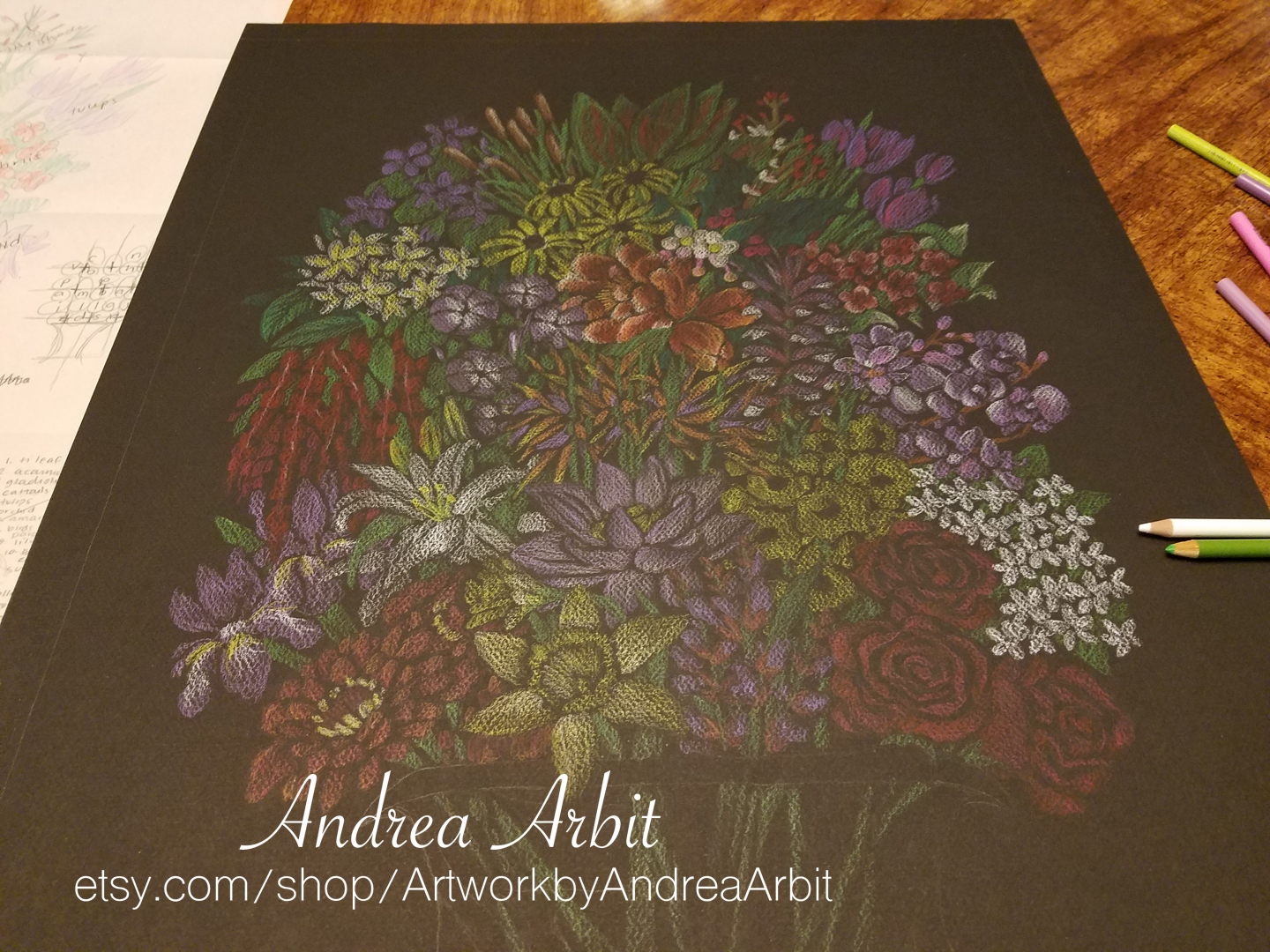
For the next six flowers in this bouquet, I used the same basic process that I used for the first six - building up layers with different colored pencils to add dimensionality and detail to the flowers, and to help increase the contrast between the bright, vibrant colors and the dark paper.

I worked on the holly plant next, nestled between the black-eyed susans and enchanter's nightshade. For the holly, I used two pink, white, black, two red colored pencils, and three green pencils:


Over the right side of the bouquet, I used white, three purple pencils, three magenta/pink pencils, and three green pencils to complete this bunch of purple tulips:


For the lychnis flowers, I used three shades of green, two shades of red, and pink, black, and white:


Back on the left side of the bouquet, I worked on these purple morning glories. I used white, yellow, blue-violet, purple, and magenta pencils, as well as three shades of green for the leaves and stems:


This large pomegranate flower and its duo of budding fruits was drawn in with green, white, yellow, orange, and three different shades of red:


Then, I worked on the acanthus, the twelfth flower in this bouquet - and therefore the halfway point. I used red, red-violet, pink, white, two different light purple pencils, and one green colored pencil for the stem:


Here is how the entire bouquet looks, with half of the flowers complete:


Next, I'll continue to add color to the bottom half of the bouquet - and the vase at the bottom.

Tuesday, July 18, 2017

"Religious Bouquet (Stronger Together)" - In Progress 3

To read about religious discrimination and why tolerance of people of all religions (and non-religions) is so important, visit this blog post.

To read about the religious symbolism of the 24 flowers used in this drawing, go back to this blog post.

-

My last blog post looked at the first twelve flowers - and this one will look at the last twelve. Once all 24 are lightly drawn in like this, the next step is to go back through and add more layers, building up colors and details.

I started this second half of the sketch with the holly plant:


At the very top of the bouquet is a cluster of green and red ti leaves:


On either side of the ti leaves, filling out the top, are brown cattails and the whiteish-red enchanter's nightshade herb:


Going back down along the right and left sides, I added purple colored violet flowers and purple tulips:


Below the violets, I drew a bunch of yellow-white plumeria:


And underneath the tulips, a bunch of red lychnis:


Continuing down the left side is the red amaranthus (aka love lies bleeding) plant, and a pair of purple irises:


On the right side, I filled in the rest of the drawing with several purple orchids and white jasmine flowers:


Here is the layout for the entire drawing:


As you can see, all of the flowers are in place - but from a distance especially they are too lightly drawn to stand out much from the black paper. Next I will go back through one-by-one and add more color to each flower.

Below is the quick sketch on newsprint (the plan I worked from), and the start of the black paper drawing (the final piece):


Friday, July 14, 2017

"Religion Bouquet (Stronger Together)" - In Progress 1

As I've mentioned before, I have plans for six 19"x25" colored pencil drawings in this "Stronger Together" series. The first three are already complete (Race, Gender, & Sexuality), which leaves only three more to do (Religion, Class, & Ability). If you've read my last couple blog posts, which talk about religious discrimination and the separation of church and state in the U.S.A., I bet you can guess which drawing is coming next.

The first three drawings used a lot of color symbolism to convey my meaning - a wide variety of flesh-toned flowers for "Race," a pink-purple-blue spectrum for "Gender," and a rainbow/color wheel for "Sexuality" - because there are colors already commonly associated with each of these categories. For these final three drawings, however, that is not the case; instead of focusing on color then, these next three drawings will look more at the symbolic meaning of the plants themselves, or (in the case of "Ability" especially) other aspects of appearance besides color.

For my next drawing - "Religion Bouquet (Stronger Together)" - I looked especially at how different religions throughout the world have used flower symbolism throughout history and in the present day. Because many religions tend to use the same popular flowers - especially the rose, which is a common symbol in several different religions - the flowers in my drawing don't represent one-to-one symbols with specific religions. There was just too much overlap to conceive the drawing this way. Furthermore, I didn't want people who don't subscribe to any religion to be left out of my "Religion Bouquet" - so there are also a few flowers that have not been adopted by religions, flowers that symbolize a more general spirituality, morality, or humanism, and flowers which are associated with logic, reasoning, critical thinking, education, and science (all other things that humans can choose to prioritize, put faith in, and devote their lives to in the place of, or in addition to religious pursuits).

Here are the flowers I picked for this drawing (in no particular order), along with the symbolism of the flower, and any pertinent religious history:
  • tulip - faithfulness, devotion, passionate love, abundance, prosperity, royalty, and indulgence. In Victorian England, it also stood for charity and supporting the less fortunate, while in Turkey (and Islam more generally), it refers to paradise on earth or a reminder of heaven and eternal life.
  • purple lotus - divine beauty, purity, faithfulness, rebirth, resurrection, death, the womb of the world, fertility, eternity, and prosperity. In Buddhism, it symbolizes spiritual awakening. In Hinduism, it is associated with the gods Vishu and Brahma (among others). Because the lotus sits on mud without sinking it, it also stands for living without attachment to one's surroundings.
  • pomegranate - fertility (for its many seeds), abundance, marriage, royalty, and mature elegance. The fruit of the pomegranate plant has especially been used by many religions throughout history: Judaism sees the fruits as symbolic of the fertility of the promised land, and uses pomegranates to welcome in the new year (Rosh Hashanah). In Christianity, pomegranates that are split open refer to Jesus's suffering and resurrection; in Catholicism specifically, pomegranates represent the resurrection of the Church; and in Eastern Orthodox Christianity, they symbolize the sweetness of the heavenly kingdom. In Hinduism and Buddhism, pomegranates also represent prosperity, abundant fertility, and fruitfulness. In Ancient Egypt, they stood for prosperity and ambition. And in Ancient Greece mythology, they feature heavily in the story of Persephone, who was taken to the underworld by Hades and ate six seeds there - which is why we have six months of winter every year.
  • amaranthus (aka "love lies bleeding") - hopelessness, hopeless love, compassion, and sacrifice. In Christianity, it symbolizes the self-sacrifice of Jesus.
  • white jasmine - sweet love, beauty, sensuality, purity, good luck, love and respect, calm, and relaxation. It is also a Hindu bridal flower symbolizing attachment, modesty, deep and everlasting love, grace, and elegance.
  • white lily - virginity, purity, divinity, love, and self-sacrifice. In Christianity, these are known as Easter lilies, and also symbolize the Virgin Mary specifically.
  • orchid - industry, enthusiasm, boldness, pride, luxury, wealth, perfection, abundance, and prosperity. In many Asian cultures, it also stands for scholarly pursuit, integrity, and friendship.
  • enchanter nightshade - witchcraft, sorcery, and skepticism. It was used as an ancient herbal medicine and its Latin name refers to the Greek goddess Circe. In Wicca, it symbolizes drawing energy into one's life, balancing light/dark or male/female, and finding connectedness to all things.
  • holly - hope, protection from evil spirits, defense, and domestic happiness. It is tied to Christianity, due to the cross-shape of its flowers, and its red berries are associated with the Christmas holiday.
  • zinnia - wisdom, life, intelligence, sacredness, beating hearts, vitality, endurance through trials, and familial ties. It was named after a German botanist.
  • violet - love, affection, modesty, faith, nobility, intuition, dignity, devotion, and healing. In Roman mythology, the goddess Venus was said to have given it its blue color.
  • plumeria - beauty, charm, grace, positivity, and perfection. Buddhism, Hinduism, and Mayan cultures all use plumeria as a symbol for immortality, creation and recreation, life and rebirth, and generalized divinity. Hindus also associate the plant with dedication and devotion, while the Mayans believed that the plumeria flower gave birth to the gods.
  • gladiolus - strength of character, remembrance, honor, faithfulness, conviction, passion, infatuation, gladitorial combat/swordsmanship, cheerfulness, and compassion.
  • acanthus - art, endurance, immortality, regeneration, and mourning death. In Christianity, it is a symbol for pain, sin, and/or punishment (due to its thorns). In Ancient Greek mythology, it represented the healing abilities of Apollo, and it is said to be the inspiration for the Corinthian style column design.
  • morning glory - affection, gentle strength, tenacity, and unrequited love. Mexican cultures associate the flower with dreams and communication with the gods. In Christianity, morning glories symbolize mortality of life, or finality of life on Earth. And there is a Chinese legend associated with this flower of two lovers who neglected their spiritual duties to be with each other, which led the gods to decree that they could only meet one day every year; the flower therefore symbolizes the sweetness of earthly relationships. 
  • ti leaf - strength, high rank, divine power, protection against evil spirits, healing, and fertility. In Hawaii, this plant is sacred to the gods Lono and Laka, and the hula dance.
  • lychnis - religious enthusiasm, sunshine, eyes, and open air. It is also a medieval Christian symbol for the Virgin Mary.
  • sage - wisdom, immortality, long life, experience, connectedness to the world around us, and protection. In certain Native American tribes, it was considered a purifying herb and believed to ward off evil spirits and bad luck.
  • black eyed susans - justice and encouragement. Its botanical name (Rudbeckia) was given in honor of a Swedish scientist known for his accomplishments in medicine (anatomy), linguistics, music, and botany.
  • iris - wisdom, compliments, eloquence, good news, royalty, faith, and hope. It is also seen as a bridge between heaven and earth, and in Greek mythology was associated with the goddess Iris, who personified rainbows.
  • birds of paradise - freedom and the ability to travel, flight, optimism about the future, magnificence, excellence, success, royalty, paradise on earth, and romantic faithfulness
  • cattails - victory in mind, body and spirit, peace, prosperity, lust, balance, and stability. In Pueblo tribes, it symbolizes earth energy, water, and rain; the Navajo use cattails as a protective charm against lightning.
  • red rose - love, romance, sacrifice, and passion. In Hinduism and Buddhism, roses symbolize spiritual joy and wisdom. In Judaism, red roses stand for blood, life, and judgment. In Christianity, the red color represents Jesus's crucifixion wounds and sacrificial blood, while roses in general evoke the paradise of the Garden of Eden. The scent of roses and roses without thorns are said to symbolize the Virgin Mary - which one can see especially in the Catholic rosary. In Islam, roses symbolize beauty, divine love, and the human soul. In Christianity and Islam both, roses are associated with the scent of angelic messengers. Red roses are also symbolic of the English monarchy.
  • daffodils (aka narcissus and/or jonquil) - rebirth, spring, new beginnings, uncertainty, returned affection, luck, reward, creativity, inspiration, renewal and vitality, awareness, inner reflection, and memory. In Greek mythology, narcissus flowers represented self-involvement. In some Asian cultures, daffodils symbolize hidden talents and career-driven hard work. In Christianity, they are symbols of forgiveness and eternal life.
    In cases where the flower had natural varieties in more than one color, and the color of the flower did not alter its symbolism, I chose red, purple, yellow, or white - because I noticed that many of these flowers already fell into those four colors, and I wanted to play up that limited color scheme.

    Once I had all my flowers selected, I made a quick sketch on newsprint to decide the composition of the bouquet. I wanted to sprinkle those four different colors throughout the arrangement, mixing them up so that only rarely would two flowers of the same color be next to each other.


    Check back soon for "in progress" photos of starting the drawing on black paper!