Showing posts with label baby. Show all posts

Sunday, February 21, 2021

Recreating the Nursery

In October 2018, in between my two pregnancies (the first which ended in a miscarriage and the second which led to the birth of our daughter in January 2020), I spent a few days painting yellow ombre stripes on the walls of the room that would become our nursery. I wrote about the process in this blog post, but the "tl;dr" of it was that 1) it gave me something to do to transform my grief after miscarriage into hope that we would get pregnant again and use that room as a nursery some day after all, and 2) it involved a lot of painter's tape. Like, a LOT a lot. And then a lot of touching up once the tape was removed and we saw all the oopsies we managed to make despite the painstaking measuring and taping. But I loved the end result, and I loved it even more when we had furniture in the room too, and we started using it for our daughter.


(See more pictures of the finished nursery in this blog post.)

So when we decided to move... of course I had to recreate stripes again in her new bedroom. It was one of the things I was saddest about leaving behind in our old house, and something that I knew would make our new house feel like ours. I also hoped that it might ease our 1-year-old's transition - I reasoned that if her new room looked similar to her old room, it'd be easier to get used to living in a totally new house. On the other hand, we have a pretty easy-going child, and I think her general go-with-the-flow attitude about moving had more to do with her personality and her age (being just young enough still that she doesn't quite yet *expect* things to stay the same from day-to-day) than about me painting stripes. Saying it was "for her" would be a lie. She doesn't say any words yet (other than "mama mama mama" all day long) and I have no idea what her favorite color is, or what her feelings are about stripes. In all honesty, painting stripes on her walls for me, and for me alone. ;)

What I didn't anticipate about painting stripes the second time around was how much longer it would take, thanks to 1) the aforementioned 1-year-old, and 2) the fact that we weren't yet living in the house when I painted them. We wanted the room painted before moving our daughter's furniture (and ourselves) in, which meant I could only paint during the few short hours we would drive down to our new house on weekends. My husband did all the measuring and marking with a pencil, and helped with some of the taping. Those processes took at least a weekend in total (it was so long ago I don't remember at this point). Then once we were ready to go, I painted two stripes one day, another two the next, and then didn't get to paint the fifth and final stripe until the following weekend. And then the touch-ups... First the room was pink when we bought the house - light pink on 3 walls and dark pink on the 4th wall - and some of the lighter yellows I chose did not cover the dark pink wall very well, and required two coats. I also had to do white touch-ups on the ceiling, trim, and door frame. And of course the touch-ups along each "seam" where the paint changed color. All in all I was painting for 1.5 months - an hour here, an hour there, when we were in the new house for a short time between our daughter's naps (which we tried to time with the drives back and forth between our houses, since it was an hour-long drive each way, and it was convenient for her to be able to nap in the car). It was SO MUCH work. But again... I loved the end result! And I loved it even more when we moved in, added her furniture (and books and toys) and it really became *her* space.

There is one big change I made from the first room - instead of doing 5 shades of a slightly greenish yellow, I did 5 stripes of warmer (slightly orangeish) yellows, and orange. In her old room, there was a brown hardwood floor, and we had a light green area rug that I had to coordinate the colors with; going too orange with that yellow was not an option - it just didn't look nice with the rug. But her new room has white carpet, which means the area rug didn't come with us (we had no use for it elsewhere in the house either), and I wasn't restrained in color choice trying to coordinate with it. Instead, I focused on choosing colors that would go with the artwork I created for her, and something that would pick up the browns in her wood furniture. I decided to branch out from just doing one color family (yellow) and used both yellow and orange instead. So the first stripe was a pale yellow ("String Cheese"), the second stripe was a slightly yellower/darker ("Vanilla Ice Cream"), the third stripe was a really saturated yellow ("Yellow Jubilee"), and then I transitioned to more orange with two shades of yellowish-orange, one lighter ("Solar Storm") and one darker ("Splendor Gold").


I won't write up the whole process again, since it was the same as the first time I did it - measure, draw pencil lines, tape alternate stripes, paint, take the tape off, put new tape up, paint more, etc. - but here are some of the in-progress pics so you can get a sense of the steps I took:


Doesn't the room just look so much brighter and happier with yellow and orange than it did with those pink walls? I have nothing against pink in general (though I do find it far too cliche for a baby girl's nursery)... but the pinks the previous owners selected were really "cool" pinks (meaning pinks that leaned more purple/blue than red) and it made the room look dark and a bit depressing for a toddler's room. I just LOVE how happy and sunny the yellows and oranges look! They fit our daughter's personality so much better.

Finally, here are some photos of the finished nursery, once we moved in:


Lots of work? YES. Worth it? Also yes.

Sunday, November 22, 2020

Thanksgiving

It's Thanksgiving week! Since I have no new art to show you (see my previous post about moving), I thought I'd take some time to list all the things I have to be thankful for this year instead. I know for many 2020 has been a really rough year, in many ways - and I feel very fortunate to have so have so much to be thankful for in such a bleak time.

The year started with the birth of my daughter on January 1st. What a way to start the year! It has been amazing these last ten and a half months watching her grow. From nursing to pureed foods and sippy cups, and now to eating the food off our plates; from barely being able to lift up her head to learning how to roll and sit and crawl and stand; from sleeping constantly to never wanting to sleep at all (why sleep when there's so many things to learn, so many rooms to explore, so many ways to play!) - she has been a constant source of wonder and joy throughout 2020.

On a similar note, I am also so thankful for my husband, who is the best dad to our daughter. The pandemic meant all of his classes for his master's program went fully online in the spring; once he found a job and started working full-time again, that was also remote. I love having him home so much, especially while our daughter is so young; even if he's working, he's still close enough that he can join us for walks around the neighborhood or a bit of playtime during his lunch break. He has gotten to watch her grow just as intimately as I have, and they have a wonderful bond. It's also been amazing for me, to have someone around to help get her down for naps and bedtimes when she just refuses to sleep, and to share in some of the daily stresses of parenting a baby.

I am thankful to have spent the majority of this year in Rochester Hills, which has so many great outdoor spaces. Over the summer, when we were bored staying inside our house but didn't feel comfortable taking our daughter to all of the places I'd once imagined taking her during her first year (to the library, and to stores, and to the zoo, and to anywhere else fun I could think of), we still had plenty of opportunities of places to go. We visited several nearby parks and took her on walks (in her stroller or in a baby carrier) along the Clinton River Trail, which was a lot of fun for her and our dog, and great fresh air and exercise for all of us.

I'm grateful that my husband was able to find a job he's really excited about, working for a non-profit he's really excited about, and that his new employers value his health and are taking this pandemic seriously. I'm also grateful that we were able to find a house we love in a neighborhood we love in Ann Arbor, and that we have the time to move there more gradually than we otherwise probably would if my husband wasn't working remotely and was already in the Ann Arbor office.

I'm thankful for our families - those who have been able to visit (once the stay-home order was lifted), entertain the baby, and help us move; and those who live farther away but still made time for countless Skype and Zoom calls to visit with our daughter safely (and virtually). They say it takes a village to raise a child, and this pandemic has isolated many from their villages; I'm so appreciative of the efforts made to make sure that wasn't our fate.

Monday, June 1, 2020

5 Months of Motherhood

When I planned making a blog post after a few months of motherhood, I didn't expect it to be quite like this one. I envisioned a quick check-in where I would reflect back on how things have been going, and how much (or how little) art and writing I've been able to do compared to what I thought I'd be able to squeeze in, now that baby duty is taking up so much of my time. I counted on sleepless nights and long days, crying jags and learning curves, as I learned what my daughter needed from me - and when. But I didn't anticipate a global pandemic casting a shadow over these first several months, and how that might factor into my art and writing plans.

Michigan was under stay-at-home orders from mid-March until the end of May - 2.5 months altogether. Or, to put another way, half of my daughter's life to date (she turns 5 months old today). In many ways, our lives were not upended by this nearly as much as other people's lives were. We were already basically social distancing while our baby was young - limiting visitors to those who had received flu shots, and avoiding taking her out into any crowded public spaces. Furthermore, I was already planning to be home with her full time (ramping up to working from home part-time around the 3 month mark), and my husband was finishing the last bit of his master's degree by driving the one-hour commute to campus twice a week for classes. We had already restructured our lives to being home with the baby as much as possible - so when the pandemic altered our work and schooling, it was only "in our favor," letting us be available to our baby even more. My working from home was pushed back (with no events happening, there's little to design flyers and emails for, so I haven't been needed); and instead of going to Ann Arbor, my husband's classes moved online, letting him be home with us all 7 days a week. It's never a good time for tens of thousands of deaths - but from our standpoint, being granted even more time at home with our baby has actually been really nice.

Still, if you thought both of us being home all the time meant I had even more time to do all that art and writing I'd planned on doing, you'd be wrong. I did manage to complete two 8"x10" colored pencil drawings since our daughter was born - but these were both done in January/February, before the pandemic hit our state, and before the stay-at-home orders began. I've done very little art (and no writing) since.

It's not that I don't have time for it - after all, I managed to squeeze in some time in January/February. It's just that it hasn't been a priority for me lately. For one thing, as our daughter got a little older, and staying awake longer, it's been so fun and rewarding to spend that awake time with her every day, playing and taking pictures and videos of her. Even when my husband is available to watch her and I could take a break, I often choose not to, just because I don't want to leave her side. I'd probably feel this way regardless, but I'm guessing that the pandemic has exacerbated this feeling. When we can't leave the house, and no one but my husband and I can see her every day, it seems more important to witness and document all of those moments, and to share daily photos and videos with the grandparents, who haven't been able to visit during all this.

Another aspect is that I feel obligated to make the most of our time at home with her, since she's "missing out" on other experiences outside the home. It's true we wouldn't have been doing much with her yet anyway, but I had wanted to start taking her to storytimes at the library, or just to different stores to let her look around and experience new things. Now, if I want her to see something new, I have to try to find a corner of the house we haven't spent much time in yet. Expanding her horizons is not as "easy" as packing up the diaper bag and heading out somewhere (though that is never easy either, I'm sure!). We're lucky that she's still so small, and that so many things are new to her. I feel so bad for parents stuck at home with toddlers or kids, whose worlds had already opened up a little past their own houses, only to have this situation shrink their worlds smaller again. Our daughter doesn't yet know what she's missing out on.

Still, she isn't playing or feeding ALL the time - she's a baby, and she also naps. And that was when I'd planned to do any art or writing I wanted to do - while the baby was sleeping. But she isn't the best at napping during the day, and I suspect that's because she hasn't had to be. Instead of trying to make her conform to our schedules, we didn't really have a schedule anymore - and so were able to let her dictate her own routine however she wanted. Plus, we're both always home to hold her or pick her up if she cries, or rock her to sleep so she doesn't have to self-soothe. For a long time, she wouldn't nap in her crib at all - only in our arms (though she's starting to finally get a little better at that). Part of me wonders also if she'd be a better napper if her world was more "exciting" during the day. If we could pack her up and take her out somewhere, to show her a totally new place she hasn't seen before, would that extra bit of stimulation tire her out more, and help her sleep better?

She still often naps for only 30-45 minutes at a time, which means she ends up taking 4 short naps like that throughout the day. In the last month or so, I've been trying to rectify that - trying to encourage her to sleep longer, so she can also go longer between naps, so that we're only down to 3 naps a day. It's hard to get anything done when I only have a 30-minute window. It's not impossible, but it's harder. And when I don't have the motivation to prioritize squeezing in 30 minutes of work on a colored pencil drawing... it doesn't get done. I was able to do it early on, in January/February. But now it's harder. For the first part of the stay-at-home order, I was on my phone a LOT, reading news articles and keeping track of how many new cases and deaths there were - in the world, in the U.S., in Michigan, in our area. It burned me out a little - it left little time to work on any of my creative pursuits, and with little motivation to do so. I've also been doing more planning - planning dinners several days in advance, looking up new recipes to try to be creative with what ingredients we already have on hand in the pantry (and yes - hopping on the quarantine baking train), and those things also take up time I might otherwise spend on art or writing.

All of this is to say... I am very "behind" on the plans I'd made for creating art this year. All of the posts you've seen these past few months, and many of the ones I have scheduled for later in the year, are all things I made in 2019 (though the next two posts will be of the colored pencil drawings I did in January/February). I kind of figured I was overestimating how much time I'd have, and that I'd fall behind on my plans for 2020 artwork - but I didn't think it would be because of a pandemic. I hope to start making more art again in June, and getting back to my plans. Once our baby starts napping a little better (more consistently, for longer time spans, and actually IN her crib), that will help; so too will the grandparents being able to visit again, and the weather (finally!) getting nice enough to go out to parks, etc. I think that the more time we're able to spend with other people, or out of the house, the less pressure I'll feel to be present with her for ALL of the time spent at home with just us and her - I'll allow myself to sneak away and steal 30 minutes here or there for some art projects, knowing that I already did a lot to stimulate her at other times of day.

Or, you know, I'm just kidding myself again, and when I reevaluate in another few months, I'll find that I'm still super behind on all my artwork plans. :)

Sunday, April 26, 2020

Custom Name Painting (Omeed)

I recently completed a watercolor painting for a friend who'd just given birth to a baby boy named Omeed.

First, I traced the name onto watercolor paper, and selected the tubes of watercolor paint I would use. Then, I taped the paper down - to keep it flat while the paper was wet.


Because I have to do these types of paintings quickly, while the paint is still wet, I'm unable to stop and take "in progress" photos. But here is the painting once I was finished, but while the paint hadn't yet fully dried. You can see the shiny areas where the paint is still wet.


Once everything was dry, I untaped the paper and framed it.


These simple paintings make great minimalistic gifts for newly married couples and parents of new babies! You can order your own custom painting like this in my Etsy store.

Monday, April 20, 2020

Diabetes & Pregnancy: The 4th Trimester

NOTE:
This post is a continuation of a series about managing my diabetes while trying to get pregnant and being pregnant. For more, you can check out these previous posts:

Diabetes Type 1.5/LADA
Diabetes & Miscarriage
Diabetes & Pregnancy: The 1st Trimester
Diabetes & Pregnancy: The 2nd Trimester
Diabetes & Pregnancy: The 3rd Trimester
Diabetes & Pregnancy: Childbirth

As always, these posts are not meant to be taken as medical advice, and merely discuss my personal experience with my specific diabetes. Everybody's experiences are different, and I am only speaking about mine.

***

My last post about my diabetes talked only a little about how my blood sugars and insulin needs changed after giving birth on New Year's day, January 1st, 2020. The focus of that post was more about managing my diabetes during labor and delivery, with just a few passing comments about changes that happened in those first few days after, while I was still in the hospital. This post will pick up where that one left off, continuing through the first three months postpartum - a time period some refer to as the "4th trimester," when a person's body readjusts to a state of no longer being pregnant.

Before becoming pregnant, I had only been on Levemir (basal insulin); I had no prescription for Novolog (mealtime insulin) until I first saw MFM at 8 weeks gestation. (MFM = maternal fetal medicine, the doctors and nurses who helped me manage my diabetes while pregnant.) My pre-pregnancy Levemir doses were 5 u. in the morning and 7 u. at night, for a total of 12 u. Over the course of 9 months of pregnancy, my total Levemir increased to 16 u., though we shifted when the bulk of it was taken, to 10 u. in the morning and 6 u. at night. I also started taking insulin with meals; by the end of my pregnancy, I was taking 12 u. Novolog with breakfast, 5 u. with lunch, and 6 u. with dinner. This increase in insulin requirements happens because the placenta causes insulin resistance - meaning that my body needs more insulin to process the same amount of blood sugar. (Though to be fair, I also wasn't eating the same amount of carbs during pregnancy as I had been before... Once I had access to mealtime insulin, I didn't need to be on a lower-carb diet anymore - and was actually told NOT to be, since growing a baby requires quite a bit of energy from carbohydrates. So I also was giving my body more blood sugar to process, as well.)

It was expected that after giving birth, my insulin needs would go back down to approximately what they'd been before getting pregnant. But I wanted to continue taking mealtime insulin after giving birth so I had a bit more flexibility with the amount of carbs I was "permitted" to eat - especially since I was planning on breastfeeding for the first several months of my baby's life, and would need similar dietary needs for breastfeeding as I had while pregnant. And that meant I couldn't just revert back to exactly what I had been taking pre-pregnancy, when I was taking enough basal insulin to cover post-meal glucose spikes as well. Still, those pre-pregnancy doses gave us a baseline to start at, with the expectation that it might take a bit of time to figure out exactly what insulin doses I should be taking for my basal insulin and at meals.

Taking all that into consideration, MFM recommended that I try 4 u. Levemir in the morning and 8 u. Levemir at night, for a total of 12 u. of basal insulin (same as I'd been taking pre-pregnancy). They also suggested that I try NOT taking any mealtime insulin at first, doing only 1-2 u. corrective doses if my blood sugar was high two hours after eating, until I better understood how much insulin it might be prudent to take with each meal. I wasn't super into that idea (it seemed like the first step toward ending up back where I was pre-pregnancy - only taking basal insulin and not having access to mealtime insulin), but they were the recommendations I brought with me to the hospital nonetheless, and what I planned to implement in the first few days after delivery.

That plan lasted one meal.

Other than a 2 am snack a few hours after giving birth, my first real meal postpartum was breakfast on January 2nd. Following MFM's plan, I took 4 u. Levemir and no fast-acting mealtime insulin. Three hours later, my blood sugar was at 197, and I took a corrective dose of 1 u. - which did the trick and brought me back down to normal ranges. Still, I was over that nonsense. Managing my diabetes at the hospital required jumping through a ridiculous series of hoops multiple times a day: reminding the nursing staff when to check my blood sugar (per their own protocols - I had my own ways of checking my blood sugar on my own any time I wanted), asking the nursing staff for access to insulin, having a doctor sign off on the dose, and waiting for the insulin to be brought into the room - all while my hospital cafeteria food grew cold as I waited. Taking a "wait and see" approach with every meal just meant even more of a hassle - a hassle I didn't need on top of everything else. We were dealing with my baby daughter's low blood sugar, treating her with glucose gel and formula, and trying to establish breastfeeding; I didn't want to be subjected to extra blood sugar checks in the middle of all that, making decisions to correct highs after the fact. It seemed easier to just take preemptive insulin and avoid the highs in the first place.

Of course, I was also still very much in the mindset of keeping a very tight control over my blood sugars - a mindset that it was hard to get out of. For the past year and a half, I'd tried to keep my blood sugars below 120 at all times - during my first pregnancy (which lasted 8 weeks and ended in miscarriage), during my second pregnancy (which was full-term), and during the months in between, when I started using my CGM and we were trying to get pregnant again. When you start thinking of anything above 120 as bad, 197 seems downright criminal. (Compare that to the typical recommendation for (non-pregnant) diabetics: keeping blood sugars below 180. If that's the goal, 197 doesn't seem nearly as off-target.)

There was also this: I expected to experience lows postpartum. I'd read that some diabetics struggle with low blood sugars when breastfeeding, and so had taken precautions to strategically leave snacks around my house in the places I planned to do a lot of nursing, just in case that became an issue for me. I also brought a lot of snacks with me to the hospital, for this same reason. So I felt more prepared (both mentally and literally) to deal with the possibility of lows than highs.

All of this meant I started requesting 1-2 u. of mealtime insulin with breakfast, lunch, and dinner (depending on what my blood sugars were before eating, and what exactly I was planning to eat). I suspected this might require a change to my basal insulin, since now my total insulin levels were likely higher than they needed to be - but I figured it'd be easier to take too much insulin and then treat with more snacks if I needed to, than to not be taking enough insulin, and need to add more - especially since I often had to wait at least a half hour (and sometimes as much as an hour or more) between my request for insulin and when the hospital staff would bring it to me.

Still, even with that extra mealtime insulin I started taking, I didn't experience a postpartum low until 6 am on January 4th. I was getting so little sleep (up all hours of the night trying to breastfeed or pump, and visiting my baby girl, who had been taken to the NICU for a couple days to monitor her nasal congestion, breathing, and jaundice levels) that I was often hungry and ate frequent snacks - my body's way of compensating for lack of sleep, I guess. I decided to run an experiment; the night of January 3rd-4th, I didn't eat any snacks after 10 pm. Finally, I saw the low blood sugar I was expecting. When the nurses came to check my fasting blood sugar, I was at 61; my CGM said 62. During my pregnancy, I only very rarely felt hypoglycemia symptoms; for my first postpartum low I again didn't feel any symptoms. The nurses brought me graham crackers, and I ate those before breakfast.

I was discharged later that day, even though my baby was still in the NICU. We were allowed to board in another hospital room closer to the NICU for a couple days. My insulin pens were returned to me, and I was once again able to manage my own diabetes, but we were still on the hospital premises until our baby was also discharged on January 6th. I knew from the "experiment" I'd done that I had to eat a snack at least once overnight - one of the times I was up anyway, nursing or pumping - or risk going too low. Alternatively, now that I had access to my own insulin again, I also had the option of adjusting my insulin however I saw fit, without having to run it by the hospital staff. I could choose to not take insulin with a snack or meal, and then more easily correct it after the fact, if I saw myself going too high. Or I could decrease my basal insulin, to compensate for the fact that I was taking more mealtime insulin than MFM had originally suggested.

At first, I continued to follow the insulin plan I had been doing (4 u. Levemir in the morning, 8 u. Levemir at night, and 2 u. Novolog with breakfast, lunch, and dinner), making sure to eat snacks in between meals when needed, and at least once overnight. I made it through the night of January 4th-5th this way with no problems. But the next night, my CGM urgent low alert went off before I ate my middle-of-the-night snack, and I found myself needing juice and a snack during one of the few chunks of time I'd been able to set aside for sleeping. A few hours later, when I woke up to eat breakfast, I was back down to 74 again - not low, but getting close.

I was beginning to understand that I was trying to keep unnecessarily tight control over my blood sugars. I didn't need to subject myself to occasional hypoglycemia in an attempt to keep my highs from getting too high; I wasn't pregnant anymore, and didn't need to stay below 120. Now, it was more important for me to avoid lows, rather than to avoid highs - especially if my body was still unaware of my hypoglycemia, showing no symptoms. What might happen if I was unknowingly low while holding and carrying around my newborn? I had to ease up on my blood sugar control to take better care of myself - so I could also take better care of her.

My daughter was discharged later that day, and we finally got to take her home. At home, I ran an even greater risk of hypoglycemia for two reasons: 1) I had access to a wider variety of food, including options with fewer carbs, meaning I ate fewer total carbs throughout the day than I had at the hospital, and 2) now that she was no longer in the NICU, she was under my and my husband's care 24/7, without help from the NICU nurses. It was harder to find time to eat several snacks throughout the day just to keep my blood sugars up, when I was responsible for every feed (no more supplementing with formula!). That night, my blood sugar was at 77 at 10 pm. I decided it was time to start decreasing my insulin; I took 6 u. Levemir instead of 8.

This was the right choice - my blood sugars stayed pretty steady within a good range of 70-140 over the next couple of days. I hadn't had another overnight low. Still, when I called MFM to discuss the change I'd made to my nighttime insulin, they recommended that I decrease it even further, going down to 4 u. Levemir at night. They also suggested I cut my lunchtime dose to 1 u. instead of 2 u. (Though, I admit - going through the whole process of using an insulin pen needle to take only 1 u. seems a bit silly to me... I usually choose to either not take any insulin, or to take 2 u., depending on what my blood sugar is before eating and what I plan to eat.) 

A few weeks later, I switched my care back to my regular endocrinologist, and he agreed with my decision to continue taking those doses (or near those doses, per my discretion) - so that's precisely what I've been doing since January 8th:
- 4 u. Levemir in the morning
- 2 u. Novolog with breakfast
- 0-2 u. Novolog with lunch
- 2 u. Novolog with dinner
- 4 u. Levemir at bedtime

This seems to be a good amount of insulin for me. There are times when I see slightly higher numbers than I grew used to seeing over the last 1.5 years - but those "highs" aren't too high, just higher than what I was aiming for when I was pregnant. There are also times when I have occasional low blood sugars. But both scenarios seem less frequent than I was experiencing when pregnant - my blood sugar in general stays steadier, with fewer peaks or valleys. Everything acts a little more predictably, and easier to control.

In fact, everything has gotten so much "easier" that I've stopped counting calories and carbs of the things I eat. I still try to eyeball portion sizes and guess how many carbs I'm eating, but I don't add everything together when I make a recipe. Maybe I've just gotten better at guessing what 40-50 g. carbs looks like, after meticulously counting everything for several months; or maybe it really is that my blood sugars are steadier even if my estimate is "off" and I'm closer to 30 or 60 g. It probably also helps that I continue to use my CGM (continuous glucose monitor) - I can see at a glance what my blood sugar is doing and if it's trending up or down, which in turn influences what I decide to eat for a given meal or snack.

When I started making this change, I thought I'd only do it for a couple months. Recording every gram of carbohydrates I ate was just too much to keep track of on top of recording nursing sessions and diaper changes. (The first I'm still keeping track of, so I know how often (and how long) my baby eats; the second we kept track of for only the first 3 weeks or so, to make sure she was having enough wet/dirty diapers). But as time went on, and my blood sugars still stayed within a good range, I decided to continue being "more lax" about what I was eating. 

Constantly counting carbs can start to feel like an eating disorder after awhile - even if it's done for a healthy reason, like knowing how much insulin to take. I find that it can really start to negatively impact how I feel about certain foods, leading to me thinking of foods as "good" or "bad" - and myself as "good" or "bad" depending on what I choose to eat. I want to model for my daughter how to have a healthy relationship with my body and food. I don't want her growing up thinking that some foods are "bad", nor do I want her seeing me obsessing over numbers and constantly adding up nutrition facts in my head to determine whether or not I can allow myself to eat something in that moment. I don't want to pass on disordered eating to her.

If/when I am pregnant again in the future, I will probably have to revert back to my hyper-vigilance, making note of everything I eat. Not only is it important to have tight blood sugar control during pregnancy - it's also a lot harder. Part of that is because the targets are stricter - but it's also just hard to keep up with the changes a pregnant person's body is going through. Eating 30 g. of carbs vs. 60 g. of carbs makes a much bigger difference, and everything seems to follow a much less predictable pattern, which makes simply "eyeballing" foods a lot more difficult. 

In fact, I may even have to revert back to recording what I'm eating once I stop breastfeeding, and my body once again readjusts to a new normal. My endocrinologist told me that I will likely continue to need only about 12-14 total units of insulin a day as long as I'm exclusively breastfeeding. Not only does nursing burn calories - it also creates another avenue for excess glucose to exit my body, in addition to the traditional avenue of urine. (For those who don"t know, the full scientific name diabetes mellitus actually comes from the Greek words for "sweet urine".) Of course, I don't want to give my baby excess glucose through my breastmilk - but the fact remains, in those rare times when my blood sugars are a little too high, I probably do... to the benefit of my own blood sugar, at the expense of hers. (Thankfully, my baby's pancreas is better equipped to handle that excess.) Once we start introducing solid foods in a few months and she starts breastfeeding less and less frequently, my insulin needs are likely to increase a little again. But for now, I seem to be doing okay without recording everything I eat, and I intend to continue doing it this way until my blood sugars show that that approach is no longer working. I'm hoping that, moving forward, keeping such careful track of my carbs will be a the exception rather than the rule - something I only do temporarily, when pregnant or going through a similar hormonal shift (e.g. menopause), or when I'm making a lifestyle change (e.g. weaning off breastfeeding, or if I suddenly decided to start training for a marathon or something - HA!).

Another thing I've had to readjust since giving birth is how I wear my CGM sensor. During pregnancy, I had so many problems with my CGM giving me false low alerts, or going entirely offline and being unable to register my blood sugar, that I started wearing it on the back of my upper arms instead of on my abdomen. (My growing baby bump made it hard to have enough available belly fat for the CGM, which is inserted into subcutaneous fat tissue.) For the first few weeks after giving birth, I continued to wear it on my arm - until my arm started giving me the same sorts of problems. My postpartum body now had plenty of belly fat to work with - and my arms did not, as my baby continued to grow and I spent much of my days carrying her and holding her. So I switched back to putting my CGM sensor on my abdomen instead.

There is one final aspect I want to talk about - the guilt and worry that comes with being a diabetic mother. Every time my baby has a health problem, I wonder if my diabetes caused it. When my baby had some trouble with nasal congestion and breathing in those first few days after birth, was it because of all the IV fluids I was given during induction - something that wouldn't have had to happen if I hadn't been diabetic? When she had jaundice - both in those initial days and over the course of the next several weeks, in what was ultimately determined to be "breast milk" jaundice - was it because I, a diabetic, was breastfeeding her? When her blood work came back indicating high liver enzymes for several weeks in a row, even after her jaundice had finally disappeared, was it because nine months in a diabetic womb, or months of being breastfed by a diabetic, or just an unfortunate combination of my "autoimmune disorder" genes, had somehow damaged her liver or some other liver-adjacent organ (such as the insulin-producing pancreas)? 

We all have predispositions we might pass along to our children, and things that we've experienced that we want to see our children spared from - but from my perspective, being diabetic seems to amplify those worries. I'm not just worried about passing along some bad genes or less desirable habits - I also worry what the physical environment I'm exposing my daughter to. Hopefully as she gets older - once she has spent more time outside my body than inside of it, and as I wean her off my breastmilk someday - her body will feel less connected to my own, and those worries, at least, will start to fade. Then my diabetes and the choices I make for how best to manage it will only affect my body, my health - and not also hers.

Tuesday, March 31, 2020

Diabetes & Pregnancy: Childbirth

NOTE:
This post is a continuation of a series about managing my diabetes while trying to get pregnant and being pregnant. For more, you can check out these previous posts:

Diabetes Type 1.5/LADA
Diabetes & Miscarriage
Diabetes & Pregnancy: The 1st Trimester
Diabetes & Pregnancy: The 2nd Trimester
Diabetes & Pregnancy: The 3rd Trimester

As always, these posts are not meant to be taken as medical advice, and merely discuss my personal experience with my specific diabetes. Everybody's experiences are different, and I am only speaking about mine.

***

As I wrote in a previous post, my baby girl was born on New Year's day, January 1st, 2020, weighing 8 lbs 10 oz and measuring 20.5 inches long. That post delved into how I managed my diabetes during the last trimester of my pregnancy; this one will discuss a much shorter scope of time: the single week from Monday, December 30, 2019 - Monday January 6, 2020.

I was told to take half as much basal insulin (Levemir) as I usually did the morning of Monday, December 30 - the day I was scheduled to come in for induction - but to continue taking my full doses of mealtime insulin (Novolog), and to eat normally throughout the day until I came to the hospital birthing center at 3 pm to start the induction process. I had prepared a birthing plan ahead of time, and left space on the paper to write down my most recent insulin doses over the previous 24 hours, so the hospital staff would know how much insulin was in my system upon my arrival. I also made a note at the top of my plan of my usual end-of-pregnancy insulin doses (16 u. of Levemir - 10 u. in the morning + 6 u. at night; 12 u. of Novolog with breakfast, 5 u. with lunch, and 6 u. with dinner) and my pre-pregnancy daily insulin doses (12 u. Levemir - 5 u. in the morning + 7 u. at night; no mealtime insulin). And at the top of my birthing plan, I included a patient history, which listed my diabetes diagnosis, pregnancy A1C ranges (4.8-5.6%), the location of my Dexcom continuous glucose monitor (on my left arm), my daily medications (Levemir, Novolog, prenatal vitamins, calcium supplements, and baby aspirin, the last of which was discontinued at 36.5 weeks of pregnancy), allergies (amoxicilian and sulfatrim), and previous surgeries (the D&C I had after my miscarriage in September 2018, and an appendectomy in February 2001).

The plan itself included the following points:
- I would like to be consulted before any adjustments are made to my insulin or glucose IV, and any time treatments are suggested for high or low blood sugar. Please keep in mind that I tend to be very sensitive to insulin and can have frequent lows. If at any time during labor my blood sugar is consistently less than 70, my insulin drip should be decreased or temporarily turned off.
- I would like to be in charge of managing my own blood sugars after delivery, including the use of my own insulin pens and needles.
- I would prefer to walk around during labor. If fetal monitoring is necessary, I would prefer a wireless/mobile fetal monitor.
- I would like to labor without pain medication. I will ask if I would like something for pain; please do not ask me.
- I do not want an episiotomy, or for vacuum extractor or forceps to be used, unless there is a medical necessity.
- I would like to delay cord-clamping for 2 minutes or until the cord stops pulsing. After clamping, please use the provided kit to donate the cord and placenta to a public bank.
- I would like skin-to-skin contact as soon as possible and to breastfeed within an hour of delivery.
- I would prefer that any non-urgent procedures or assessments of my baby be done in the room with me, including any treatment of low blood sugar, if possible.
- If my baby has to be separated from me for any reason, my husband will go with the baby and my doula will stay with me.
- After the placenta is delivered, I would like my insulin drip to be switched to my lower pre-pregnancy basal insulin dose, or shut off completely.

The plan was to take misoprostol pills overnight from December 30 into December 31st, and then start pitocin in the morning, as part of a gradual induction process. Until the pitocin started, I was able to eat normally; an insulin drip was not required. (But while the pitocin was in use, I was to be on a "clear liquid" diet only - water, ice chips, popsicles, broth, and juice.) I had been told that I would be able to use my own insulin pens and needles during those times when I wasn't restricted to that clear liquids diet - including early labor and after delivery. So I brought my pens with me to the hospital, and once I was out of triage and was assigned to an antepartum room, I gave my pens to the nurses to have them taken to the hospital pharmacy for verification. Once in the antepartum room, I was also given my first dose of misoprostol with dinner, and the nurses inserted a saline lock into my right hand, so they would be ready to quickly start the insulin drip (or IV fluid) whenever necessary. 

I was hooked up to a non-mobile fetal and contraction monitor an hour before, during, and for one hour after each misoprostol dose. This was just like the NST (non-stress tests) I'd been doing once a week for the last several weeks of my pregnancy, with two small monitors that were strapped to my belly. Because this monitoring was happening overnight, I didn't request a mobile/wireless monitor - I would be lying in bed most of the time anyway. But it did mean I had to call the nurse anytime I needed to pee, so they could remove the monitors and hook me back up once I returned to bed. At arrival, I was 0 cm dilated, but having contractions (non-painful, barely-noticeable ones like most people have at the end of their pregnancy, as their body starts getting ready). The misoprostol regulated these contractions into a noticeable pattern, which I could watch on the monitor. Unfortunately, they were too close together (happening every 2 minutes when they wanted them closer to every 3 minutes) for where my body was in the process, and there was concern that my uterus would start tiring out too soon doing so many "unproductive" contractions. I was told to drink more water, and was also given some IV fluid, to try to space them out before they gave me the next dose of misoprostol. I was finally given the 2nd dose at 10:30 pm, and the 3rd dose at 3:15 am. 

At 7 am on Tuesday, December 31, I got another cervical check, and they determined I was 2-3 cm dilated. I was given the chance to eat breakfast and take my usual mealtime insulin, and then was moved from my antepartum room into a labor/delivery room after I was finished eating. There, they placed another IV, this time in my left hand. The first attempt didn't work (my wrist was swelling up around the vein, where fluid was leaking in), and the second attempt was a particularly bloody affair that was gruesome to watch - but after ten minutes, I was set up with my second IV. My right hand was for IV fluid and insulin, and my left hand was for the pitocin for my induction, a glucose drip, and antibiotics (since I had tested positive for group B strep). This meant that at any given time, I had up to five bags to carry around with me on two different IV poles. Walking around the room and up and down the hallway, trying to go to the bathroom, and getting in and out of bed all required intricate choreography to keep the lines from tangling. Still, I wanted to walk around to try to get my labor going, so I requested the mobile fetal/contraction monitoring. It was another thing to keep track of, on top of so many other things - a heavy box that I could either wear around my neck or shoulder, or hang on one of my IV poles, and every hour or so I would have to end up back near my bed to recharge something (my IV monitors, or the fetal monitor), but at least it meant I could move around a bit and wasn't fully restricted to the bed.

The nurses started my pitocin, antibiotics, and IV fluid at 9 am. They wanted to start the glucose and insulin drips at the same time, but I reminded them that I had just eaten breakfast and taken 10 units of Novolog an hour ago - and that it would make more sense to wait at least another hour, for my the fast acting insulin I'd taken with my meal to start working through my system. If they started me on an insulin drip on top of the insulin I'd just taken, I feared I'd go low. I also didn't see why I needed to be on glucose yet - I was contracting regularly, but they were not strong contractions; I was still in early labor. I had also JUST eaten breakfast. I was not in need of glucose for energy - nothing was happening yet! So they called in a doctor for consultation, and the doctor agreed that we could wait and see what my blood sugar was two hours eating first - if it was above 120 at that point, we'd start the insulin and glucose. Somehow this wasn't communicated fully to the nurses though - because though they didn't start me on the insulin yet, they did start me on glucose. I didn't realize this had happened until nearly an hour later, when I noticed my CGM saying I was at 145, and I took a closer look at what IVs were actually being pumped into my system. Two hours after eating, the hospital blood sugar check had me at 157 - because of course my sugar was high now that they'd given me glucose on top of my breakfast! I don't want to be cynical, but in that moment, I definitely was. They seemed very eager to switch me over to hospital insulin, so they could more closely manage how much insulin I was taking, and it made me wonder - had they started my glucose early just to ensure I would be above 120, prompting the insulin protocol into effect?

I'm sure they're used to diabetic patients that require a lot more insulin, making it more important to start the insulin drip sooner rather than later. In fact, it probably would've mattered more for me too - if I had actually transitioned into active labor and given birth that day. But that wasn't in the cards, and once they started me on the insulin drip it quickly became apparent that I really didn't need much of it at all. Following their own protocols based on what my blood sugar readings were every hour, I was on insulin for only three hours before they stopped it. They started me at a rate of 2 u./hour at 10:30 am. At 11:30, my blood sugar was measured at 109. At 12:30 it was down to 68, at which point they reduced my insulin drip to 0.5 u./hr. And an hour later, my blood sugar was at 65, prompting them to shut off the insulin drip altogether. They continued to check my blood sugars every hour, but as they stayed below 100 for the rest of the day, the insulin was not restarted. At 2:30 pm, I was at 89; at 3:30 pm, 90; at 4:30 pm, 96.

Meanwhile, they gradually increased my pitocin throughout the day, from 1 mu/min up to 8 mu/min by 3 pm, but nothing much was happening. (My husband and I watched a lot of Netflix and Disney+ on his laptop to pass the time.) A cervical check at 4:30 pm confirmed that there had been no progress since that morning - I was still only 2-3 cm dilated. It was decided that my baby wasn't ready to be born in 2019 after all. The pitocin, glucose, and antibiotic IVs were suspended. The plan was to repeat the cycle we'd already done - another night of taking misoprostol, and then restarting the pitocin in the morning. This meant my "clear liquid" diet restriction was lifted, and I was able to eat dinner and breakfast again. 

This seems like a good time to point out how my meals and insulin pens worked in the hospital... I expected that once my insulin pens were verified, I would get them back and be able to use them - but I guess that was a naive assumption. In actuality, they were kept at the nursing station for the duration of my hospital stay, and anytime I wanted to use them I had to ask a nurse to get them for me, and wait for the dose to be verified by a doctor, before I was able to administer the medication. On the one hand, I understand why they do this (liability reasons), but on the other hand, it was beyond annoying. The doctors and nurses in the maternity ward were (obviously) often busy with more pressing matters than deciding how much insulin I was allowed to take. I would tell the nurses when I ordered a meal, and tell them again when my meal arrived, but still my meal would end up sitting in the room for an hour or so, getting cold, before I would finally be brought my insulin to take with my food. (Couldn't they have just had me sign a form promising I wouldn't sue them for any insulin mismanagement that happened on their premise, and then let me manage my own insulin instead? Seems like that would be less aggravating for everyone involved...)

After doing this for dinner on December 30 and breakfast on December 31, I was rather fed up with the whole procedure. I assumed (again, perhaps naively) that the problem was that I had insisted on bringing and using my own insulin pens, instead of the hospital insulin. So for dinner on December 31, I acquiesced and told the nurses that I would take the hospital insulin instead of requiring them to find my Novolog pen at the nurses station and get it re-approved. Unfortunately, using their Humalog syringes didn't go any faster; I still had to wait until a nurse was available to check my blood sugar, put it into the system to see what insulin dose was recommended for me, get a doctor (and myself) to sign off on that assessment, go get the Humalog, and wait for another nurse to be available to administer it - all while I sat there staring at a plate of food I wasn't able to eat until all those steps had been completed. The first two times, it was annoying; this time - after a day of not being allowed to eat anything solid - it was even more so.

That second night, December 31st, I had my first misoprostol dose at 8 pm. My next dose was at midnight, to the sounds of nurses shouting "Happy New Year!" to each other in the hall. My husband and I did nothing to acknowledge the new year (the new decade!); our room was dark, and we were both trying to rest up for what would be a long, tiring day to follow (assuming my labor finally started progressing). That first night in the antepartum room we'd both been too excited at the thought of meeting our baby soon that we hadn't gotten much sleep, but after a rather boring day of waiting for things to happen, we were both able to get more sleep the second night. (No small feat, as I was woken up frequently for blood sugar and blood pressure checks, fetal and contraction monitoring to assess whether my body was ready for the next misoprostol pill, and being woken up to take said pills.)

My last dose of misoprostol was at 4:30 am on January 1st. I was given hospital Humalog with my breakfast at 8 am, given another cervical check (still 2-3 cm dilated, with no further progress overnight), and the pitocin and my antibiotics were resumed at 9:30 am. This time, they didn't begin the glucose or insulin right away - as a result, my glucose two hours after eating was only 87, and it wasn't until around noon, when my blood sugar was at 113, that my glucose and insulin drips were restarted - the insulin at a rate of 1 u./hr.

The pitocin was increased more quickly on January 1st than it had been on December 31st, and I was up to 6 mu/min by about 1:30 pm. By 3 or 4 pm, I started getting consistently painful contractions for the first time. A cervical check put me at 4 cm dilated - finally some progress! We called our childbirth doula to join us at the hospital, and she recommended positions and breathing exercises that helped me manage my pain without requiring medication. (I already had so many IVs pumping medication through me - I really didn't want any more!) As my contractions grew more painful, my blood sugars also started to climb. I wasn't eating anything - at one point some chicken broth was ordered from the cafeteria for me, but I wasn't able to concentrate on drinking much of it - and as far as I know my glucose IV was kept at a similar level throughout the day (though honestly I never really looked at it, so I have no idea); the increase in my blood sugars then, was mostly (if not completely) due just to stress and the exertion of the labor process. 

By 6:30 pm, my blood sugar was at 115 and the insulin drip was increased to 1.5 u./hr, by 7:30 my blood sugar was 131 and it was increased again to 2 u./hr, and at 8:30 my blood sugar was at 144, and the insulin drip was dialed up to 3 u./hr. At this point, I was given another cervical check; I was at 8 cm dilated. My blood sugars briefly evened out a bit (at 9:30 pm, they were back down to 131), but around 10 pm I started pushing, and this again raised my blood sugars. At 10:30, the glucometer tested me at 156, and my insulin drip was increased to 4 u./hr... And at 11:09 pm, our daughter was born!

You may wonder how I remember what my blood sugars were doing during all of this, or what my insulin was adjusted to. But the answer is - I don't remember. Before going to the hospital, when I thought about the labor/delivery process, it was SO important to me that I be aware of what was going on and how my diabetes was being managed by hospital staff - but when it was all happening, it was often the last thing on my mind. The nurses would tell me they were increasing my insulin, and I would just nod; I no longer cared what they did. I was too busy concentrating on getting through the next contraction. But my husband and our doula helped me keep track of what was happening, and they wrote down notes for me so that I'm able to refer back to them now and piece together what happened, which I'm so grateful for.

Within an hour of our daughter's birth, it was no longer January 1st. At midnight at the beginning of January 2nd, my blood sugar was 142, and my insulin and glucose drips were both cut in half. Again, I didn't really care what they did to my IVs at this point; I was barely paying attention. I was holding my new baby and trying to breastfeed for the first time, while my ob/gyn worked on some repairs. At 1:30 am, my insulin drip was cut in half again, and my husband and I were presented with a tray of food in case we wanted a snack before the cafeteria opened up again for breakfast at 6 am. I assume it was the same sort of tray they gave every family - there was nothing diabetic-specific about it, and all of the options (sandwiches, chips, juice) were full of carbs. I ended up eating half of a turkey sandwich, and a protein bar that I'd brought from home. I wasn't really hungry, but felt like I should probably eat something. At 2:30 am, they were finally ready to move us from our labor and delivery room into a postpartum room; my blood sugar was down to 115 at this point, and the insulin drip was shut off.

I got maybe two hours of sleep that night, in little chunks, once we were in the postpartum room. I was also, understandably, a bit distracted with my new baby still. So I wasn't really paying attention when, at 6:30 am, a nurse came to check my blood sugar for a "fasting" number. (I put "fasting" in quotation marks because usually to be considered fasting, it has to be at least 7-8 hours since last eating - but I'd eaten that half a turkey sandwich and protein bar sometime around 2 am, only 4.5 hours earlier.) My blood sugar was high - 193. The nurse put this into their system and got back the recommendation to give me a corrective dose of 2 u. of Humalog - a fast acting insulin I usually only take with meals. She administered the insulin; distracted and half asleep, I wrongly assumed she was giving me my morning Levemir dose, which I usually took when I checked my fasting blood sugar. This caused a lot of confusion at 8:30 am when my breakfast arrived and we started going through the process of checking my blood sugar and figuring out how much mealtime insulin I needed to take with my breakfast. The nurse was trying to tell me I needed to take my morning Levemir, which I thought I'd already been given; and I was trying to tell her that I didn't need to take any insulin with breakfast, since my blood sugar was at 101 and I'd been told weeks ago by MFM not to worry about taking mealtime insulin right away after delivery. (MFM had recommended that after delivery I go down to 4 u. Levemir in the morning + 6 u. Levemir at night, for a total of 10 u. - close to the 12 u. I'd been at pre-pregnancy. They also suggested that I not take mealtime Novolog (or the hospital's Humalog equivalent) with my meal, waiting instead to see how the meal affected my blood sugar, and then giving myself a corrective 1-2 u. dose if needed. It wasn't as important to keep my blood sugars down now that I was no longer pregnant - in fact, they told me it was better to be slightly high than to be too low.)... Eventually, we sorted it out and I took my 4 u. Levemir with breakfast, with no additional mealtime insulin. Three hours later, my blood sugar was at 197; at which point I took a corrective dose of 1 u. Humalog.

The nurses were also repeatedly checking our daughter's blood sugars throughout the day. One of the potential problems caused by diabetic pregnancies is low blood sugar (hypoglycemia) in the baby. Because the baby spent the last 9 months in a sugary womb, their pancreas got used to producing more insulin to manage that extra sugar - and now that they're on their own and no longer exposed to as much sugar anymore, their pancreas is producing too much insulin, which can cause hypoglycemia - until their pancreas readjusts to the new levels of insulin they now need. Our daughter's initial blood sugar soon after delivery had been within normal ranges, but by 12:30 pm - about 13 hours after her birth - they were too low, and we had to give her glucose gel, which the nurses rubbed into her gums. Perhaps her blood sugars would have been low anyway, just because of my diabetes and how high my blood sugars were at the moment of her delivery - but it definitely didn't help that she was congested and having trouble breastfeeding, and couldn't get her blood sugars raised from my breastmilk either. An hour later, her blood sugar was still a bit low, despite the glucose gel, so she was also given a bit of formula in an oral syringe. Her blood sugars did not dip so low again that she required more glucose gel - but she was given formula a few more times over the next several days, mainly because she was having trouble breastfeeding.

It is not uncommon for babies to have some congestion after birth, given all the fluid they're exposed to both in the uterus and during the birthing process - but our daughter's excess fluid was sticking around longer than usual. Given that it was interfering with her ability to successfully breastfeed, and given that I had tested positive for group B strep during pregnancy and had been on antibiotics during labor, there was some concern that it wasn't just "normal" fluid build-up after all, but a sign of infection. My antibiotics were supposed to be administered every 12 hours during labor, but my last dose hadn't been given, as I'd been in the middle of pushing when it was due. As a result, 12.5 hours had lapsed between my last dose and when our daughter was born, which was considered "inadequate." To top it off, my group B strep had been resistant to the most effective antibiotic, and I had an allergy to the second choice (amoxicilian), meaning that I'd been given their third choice antibiotic, which was considered not as effective. All of this led to our baby being taken to the NICU for three days to monitor her breathing and administer antibiotics (just in case), while we awaited the test results to see if she actually had an infection. During that time, her congestion got a lot better, and we slowly were able to see some success breastfeeding. She was also treated for jaundice while she was there. Eventually, her results came back infection-free, and she was finally discharged on Monday, January 6, 2020 - exactly one week after my husband and I had arrived at the hospital to start my induction.

Later, talking to (of all people) my lactation consultant, it was brought up that maybe our baby had so much excess fluid in her nasal passages and lungs because of all the IVs I had for the 14 hours immediately leading up to her birth, and for 7 hours the previous day. All that extra fluid could've also accounted for her size at birth - 8 lbs 10 oz, about 10 oz more than I was expecting her to be, given my growth ultrasounds at the end of my pregnancy. At the hospital, doctors and nurses at shift changes kept asking me what kind of labor/delivery experience I'd had, and whether there was anything abnormal about it. I never really knew how to answer that question, and ended up saying, "I mean, I was induced? So it took awhile to get started, but once it did, I think it progressed pretty normally?" I assumed they wanted to know if she'd gotten stuck at all on the way out, if my labor had momentarily stalled, if the doctor had needed to use tools to help her get out, if her heartrate or my blood pressure had ever been too low or too high, etc. - all things that hadn't happened. But maybe I should've brought up all the different fluids I had pumped through my veins during labor and delivery - the IV fluid, the glucose, the insulin drip, the pitocin, and the antibiotics. Of course, those things should have been listed in my chart; I shouldn't have HAD to tell them - but clearly not everyone looks carefully at the notes the previous doctors and nurses have written from a day or two earlier. Maybe they would've been less concerned about my daughter's congestion and difficulty breathing if they'd considered that aspect of her delivery; maybe it would've been more obvious that it was "normal" fluid that she just needed a bit more time than the average baby to work out of her system, and not an infection.

In any case, it was actually kind of nice having her in the NICU for a few days - the worries about her health notwithstanding. It meant we got to spend a few extra days in the hospital, which meant more opportunities to talk to lactation consultants and nurses. The nurses in the NICU were especially helpful with tips on how to help our daughter latch and suck and figure out how to breastfeed, working around her congestion and showing me how to pump to help my milk supply come in faster. I was discharged earlier than our baby was - on Saturday, January 4. Thankfully, the hospital let us continue boarding there, in another room (our 4th different hospital room since our arrival) closer to the NICU, while our daughter was there. Even better - once I was discharged, I no longer had to wait for nurses to bring me my insulin anytime I wanted to eat. My insulin pens were returned to me, and I was able to fully go back to managing my blood sugars on my own.

I have more to say about what my blood sugars looked like in those first few days, weeks, and months after giving birth, as I readjusted back to non-pregnancy target ranges and much lower doses of insulin - but as this one is already quite long, I'll save all that for another entry, which I'll write and post here soon!

Wednesday, March 25, 2020

Ginny turns 5!

Our poor dog Ginny had quite a year since she turned 4 on March 25, 2019. Over the summer, she had a blockage in her anal duct that required manual compression at the vet (and a couple weeks in a cone so she wouldn't lick the area while it healed). Then in the fall, she started vomiting (more than usual), including little bits of blood, which had us concerned that she'd eaten something she shouldn't have, and led to us taking her to the emergency vet for x-rays. The x-rays didn't find anything, and after a couple weeks of a modified diet and some anti-nausea medication, she was back to normal.


I was also pregnant for much of Ginny's fifth year, which Ginny didn't always know how to handle... At the beginning of my pregnancy, we found her hiding in the strangest places around the house - behind my nightstand in my bedroom, under beds, behind couches, etc. Eventually, she seemed to get used to the idea that something was "different" about me, and she even took to snuggling against my pregnant belly sometimes. She enjoyed all the people who came over for our baby shower in October - but not the baby items that started slowly taking up all of "her" space in the house.


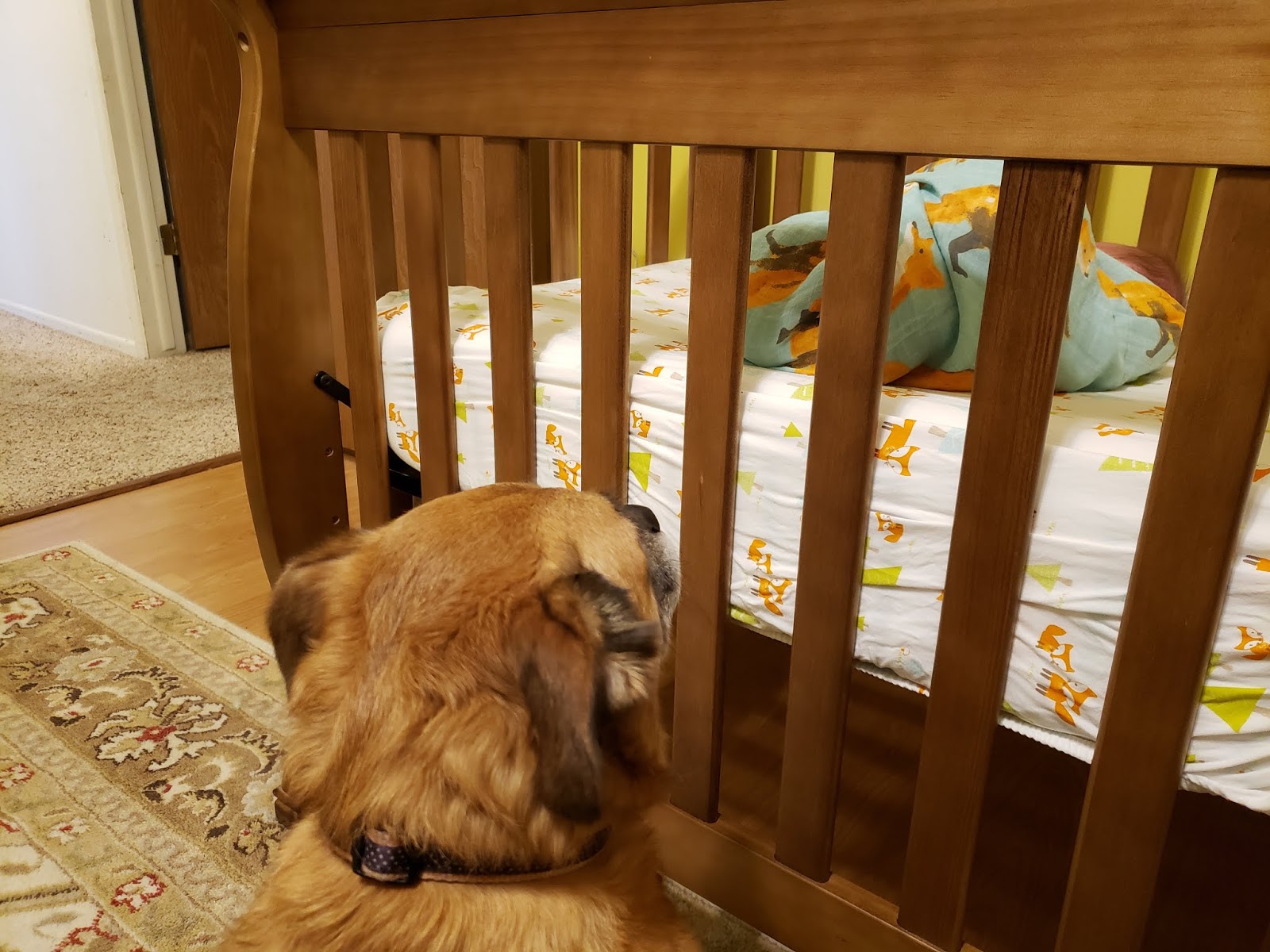
When we brought our new baby home in January, Ginny was mostly excited. She wanted to be where the baby was, and followed us from room to room, often watching the baby in her crib, bassinet, etc., wherever she happened to be. She still does this a bit - but some of the excitement has since worn off. When the baby starts to cry, Ginny gives us a look like "Why aren't you taking care of that noise?" and often leaves the room (though I can't say that I blame her!). She also seems to be jealous of the attention the baby gets. When we put the baby on a blanket on the floor for some exercise or tummy time, Ginny often gets right down on the floor with us - in between us and the baby, blocking us from interacting with the baby or taking pictures of her, until we acknowledge Ginny first. She also sometimes whines at me when I'm sitting on the couch nursing, complaining that I'm not able to play with her or pet her at the same time.


Ginny turns 5 years old today. Here's to another year of exciting changes as our baby grows (and Ginny learns how to adapt)! :) I think she'll appreciate the baby a bit more once she's older and starts sitting up and interacting with Ginny (someone else to pay attention to her!), and especially once she starts eating solid foods (someone else to drop food on the floor for Ginny to eat!).