Showing posts with label racism. Show all posts

Monday, November 6, 2017

"Stronger Together" Notecard Sets

My Etsy shop finally has listings for all my recent large format colored pencil drawings. I have a set of six detail shots from my "30 Days" drawing, two different sets of six detail shots from my "28 Years" drawing, and six sets of four detail shots from each of the six drawings in my "Stronger Together" series. I also have a boxed set of six notecards, each featuring the entirety of one of the "Stronger Together" bouquet drawings (as opposed to detail shots). You can find all of these notecards for sale in my Etsy shop.

Today I'd like to showcase the seven different sets of notecards I've created from my "Stronger Together" colored pencil series.

**

The Bouquet Set - Featuring full images of all six "Stronger Together" Bouquets (Race Bouquet, Gender Bouquet, Sexuality Bouquet, Religion Bouquet, Class Bouquet, and Ability Bouquet)


You can buy this set of notecards here. :)

**

The Race Bouquet Detail Set - featuring four close-up detail images from my drawing, "Race Bouquet (Stronger Together)"


You can buy this set of notecards here.

**

The Gender Bouquet Detail Set - featuring four close-up detail images from my drawing, "Gender Bouquet (Stronger Together)"


You can buy this set of notecards here.

**

The Sexuality Bouquet Detail Set - featuring four close-up detail images from my drawing, "Sexuality Bouquet (Stronger Together)"


You can buy this set of notecards here.

**

The Religion Bouquet Detail Set - featuring four close-up detail images from my drawing, "Religion Bouquet (Stronger Together)"


You can buy this set of notecards here.

**

The Class Bouquet Detail Set - featuring four close-up detail images from my drawing, "Class Bouquet (Stronger Together)"


You can buy this set of notecards here.

**

The Ability Bouquet Detail Set - featuring four close-up detail images from my drawing, "Ability Bouquet (Stronger Together)"


You can buy this set of notecards here.

**

Like all of my four-packs of notecards, each of the detail sets sell for $7. The six-pack set which includes images of all six bouquet drawings sells for $10.50.

They're oriented vertically (4 1/4" width x 5 1/2" height), are blank inside, and come with six matching white A2 envelopes. The original artwork was scanned at 600 dpi, the color was adjusted in Photoshop, and the prints are inkjet printed on smooth, matte cardstock. The backs of the cards list the title, size, medium, and date of the original artwork, a digital artist signature, and website/social media information.

Tuesday, October 10, 2017

Letting Marginalized Groups Speak for Themselves

I have a lot of privilege. I recognize this about myself.

I am white - very white, actually, with blonde hair and blue eyes. In high school, other people sometimes described me as Aryan. (I assumed they meant to imply that if I had lived in Nazi Germany, I would have so perfectly fit the description Hitler wanted for his new master race that not only would I have been spared, but possibly celebrated and married off to some prominent Nazi official in need of a respectable looking wife or something. The way they said it made it seem like a compliment, but it was a very strange compliment, and made me a little uncomfortable.) My point is - I could never pass for anything but white. I am so white that even among white people my whiteness is "fascinating" (or possibly intimidating). I have no way to fathom what it actually feels like to be a person of color in this country, because so much of my life experience has been that of white privilege. I can try to empathize, but there is no way I will actually ever understand.

I am female. And while this means I lack male privilege, I do still have cisgender privilege. My body and gender identity match. I also conform to many female appearance stereotypes - my hair is long, my fingernails are long and sometimes painted, and I often wear dresses and skirts, earrings and necklaces. I've never been misgendered. I can't truly understand how it would feel to have a disconnect between who I wanted to be and who I looked like on the outside.

I am straight. I am married to a white man. I never had to come out to my family or friends, or felt ostracized from my religion because of my sexual preferences, or had a stranger make incorrect assumptions about my sexual orientation, or felt that my relationship with my husband was somehow unacceptable or morally wrong. I'll never really know what it's like to be gay, bi/pansexual, or asexual.

I was raised Christian in a Christian-majority nation. My religion's holidays matched the school calendar. I was exposed to the traditions and cultural practices that remain entrenched in American society - and it was never required of me to learn any others. Though I chose to step away from Christian beliefs as I grew up, I still have that outward Christian privilege to fall back on if I chose to - unless I specifically admit that I don't believe in God and would rather identify as atheist, no one would know or assume that about me. I don't really know what it's like to belong to a different religion, a religion without privilege (though I've seen some glimpses, working as a graphic designer at a large Reform Jewish synagogue).

I grew up in a middle class family. I have never known real poverty. Even when my dad was unemployed for 15 months during the recession, I never really wanted for material things. Throughout my life, educational resources were readily available to me if I wanted them. I went to a local state school, was lucky enough to get scholarships and have a lot of my expenses paid for by family members and my (very) part-time jobs, and graduated with virtually no student loans. I'm 28 years old and my husband and I became homeowners five years ago. I don't know what it's like to lack class privilege. Even when it felt like maybe I didn't have it growing up, I really did. I've always had it, and still do.

I'm also healthy (relatively so). I look healthy from the outside. I have poor eyesight, so I wear corrective glasses - but there is no real stigma attached to wearing glasses, so that's irrelevant. And no one could guess any other chronic ailments I might have - unless I told them - because they are not noticeable, nor significant enough to impact my day to day life. I do a lot of preventive behaviors to keep the threat of LADA at bay (latent autoimmune diabetes in adults), because my glucose is slightly elevated. But it's never really been bad enough to be even officially labeled "diabetes," let alone impact my life much. And any mental health/emotional issues I'm working through also don't outwardly influence my daily functionality. I have ability privilege, and have no idea what it's really like to be discriminated against based on my ability (or appearance of my ability).

My point is that I'm not exactly an ideal candidate to talk about a lot of these issues - race, gender, sexuality, religion, class and ability - which I just spent several months addressing with colored pencil drawings and blog posts. I want to use my privilege to draw attention to these topics that warrant discussion, if I can. But I also want to be careful not to speak for these oppressed groups. I don't want my voice to drown out theirs, and I don't want to presume to know their experiences or what the best steps would be to help them moving forward.

This is perhaps the most difficult thing privileged people like myself face in trying to help the unprivileged. We want to help - but often don't quite know how to help. We spend so much time patting ourselves on the back for taking on liberal causes or doing good in the world that we neglect to recognize that we've painted ourselves as "savior" figures. Marginalized groups don't need us to "save" them - they just need us to shut up and listen. It shouldn't be up to us to give them more rights; it is instead our job to support them and help draw attention to their cause from the sidelines while they take the rights they deserve. We are meant to be allies, not leaders.

Marginalized means they have been relegated to the margins. It's our turn to stand in the margins instead, and allow oppressed groups an opportunity to assert their own voice.

I feel a bit like a fraud when I start talking about politics or social issues too much. I'm not an expert. I barely even follow details of what is going on in the world. (To be honest, there's just been too much bad news lately that it's been overwhelming. And I'm lucky enough that I have the privilege to tune all that shit out when it overwhelms me. But that is another discussion for another time.)

It is precisely this reason that my message in this "Stronger Together" series is so vague. My drawings celebrate the differences found in humanity and show a symbolic floral arrangement in which all flowers (all people) have equal weight in filling out a bouquet - regardless of race, gender, sexuality, religion, social class, or ability. It is a hopeful idea that could have just as easily been drawn a hundred years ago or a hundred years in the future as drawn today. It doesn't reference specific topical events, and it doesn't try to speak for marginalized groups. It just showcases a utopia in which all people have their own equal voices with which to speak.

It tells people where I stand - on the side of tolerance and love and acceptance, on the side of allies, on the side of hope for a better tomorrow - without presuming that I have any real answers, without taking a clear leadership role, and without even referencing many specifics. Maybe this isn't enough; maybe as an ally I could have done more. But this is where I'm at in my journey right now. I am erring on the side of Not Doing Enough out of concern for overstepping. This is the extent that I feel capable of.

I do feel more qualified to talk about gender and religion, because these are areas that I feel I have more personal experience in. I don't have male privilege and never have, and I gave up Christianity to label myself an Atheist (an Atheist who married into a Jewish family, an Atheist who works at a Reform Jewish synagogue), so I don't have as much religious privilege anymore either. I can more comfortably talk about these issues and state where the problems lie - because I've witnessed them myself and because I am one of the marginalized who deserve to have their voices heard.

But even here, I often want to step aside to let those with intersectional oppression speak. I can only speak to my experience as a white, cisgendered, straight woman; women who are black or gay or transgendered (or all of the above) face much greater oppression than anything I've lived through.

All humans suffer sometimes. But not all suffering is created equally.

I hope that my "Stronger Together" drawings are adequate at straddling that line - the line between speaking up but not shouting over those less privileged than me; the line between wanting to do something, or say something, but not knowing exactly what to do or say. I hope that their vagueness allow more people to find resonance in them. Often, the more we get into specifics, the more we start to disagree. I am hoping that despite where we are on the political spectrum, or what life experiences we've had, or what privilege we've been granted or oppression we've endured, we can all agree in this very basic premise:

Humans - ALL humans - deserve respect, love, acceptance, acknowledgement, tolerance, and to have their voices heard.

Especially those who have traditionally been denied such things, who have a lack that needs to be filled.

Sunday, October 8, 2017

Finished "Stronger Together" Series

My "Stronger Together" series consists of six 19"x25" colored pencil drawings, each created with Prismacolor pencils on black Canson Mi-Teintes paper.

The general concept behind the drawings is this: We humans can be labeled, divided, segregated, and categorized in a myriad of different ways, including (but not limited to) race, gender, sexuality, religion, class, and ability. Often, with these six categories in particular, certain subgroups have been historically/traditionally thought of as "lesser," while other subgroups are thought of as inherently better, stronger, or smarter - and are therefore given more opportunities, more privilege, and more power. This is, to use a profound phrase, absolute bullshit. People don't have more or less inherent worth than others just because of the families they were born into, their genetic code, their preferences, their life experiences, or the choices they make. We are ALL human, and we ALL matter and deserve respect. In fact, we matter not despite our differences, but because of them.

Floral arrangements are not melting pots. They do not blend all varieties together into a muddy brown soup. They are made greater by the sum of their parts, while still showcasing each beautiful part that makes up the whole. And so I chose to use drawings of floral bouquets, each made up of two dozen different flowers, to demonstrate the rich variety of the human experience, as it relates to those six categories.

**

RACE BOUQUET (STRONGER TOGETHER)

I worked on this drawing way back in April, utilizing 31 different colored pencils. The bouquet consists of a wide range of flowers available in "skin tone shades" to demonstrate different races of people living and working side by side, in harmony, to create a beautiful, multicultural community.


  • Click here for the list of flowers used in this bouquet.
  • Click here for more images of the final drawing (and links to pictures of the step-by-step process and detail shots).


**

GENDER BOUQUET (STRONGER TOGETHER)

This tri-tonal drawing was created in May using 30 different colored pencils. Here, I used "traditional" color stereotypes (pink for girls, blue for boys) and color theory (which recognizes that purple is the color created by mixing pink and blue together) to represent the spectrum of all genders in a symbolic floral bouquet.


  • Click here for the list of flowers used in this bouquet.
  • Click here for more images of the final drawing (and links to pictures of the step-by-step process and detail shots).

**

SEXUALITY BOUQUET (STRONGER TOGETHER)

In the month of June (Pride Month), I finished this colorful drawing, which required a total of 39 different colored pencils. This "color wheel" bouquet includes all the colors of the rainbow (red, orange, yellow, green, blue, and purple) to symbolize the beautiful arrangement made when all people identifying as/experiencing different aspects of human sexuality are included equally. This includes people with little or no sexual desire, as well as those who crave it all the time; people who yearn for only physical intimacy and those who find fulfillment in emotional intimacy and long-term relationships, people experienced and not experienced in a wide variety of sexual behaviors, and of course people at all places of the LGBTQIA spectrum.


  • Click here for the list of flowers used in this bouquet.
  • Click here for more images of the final drawing (and links to pictures of the step-by-step process and detail shots).

**

RELIGION BOUQUET (STRONGER TOGETHER)

This completed piece, drawn with 28 different colored pencils in July, combines flowers that are symbolically associated with modern or ancient religions (including Christianity, Islam, Judaism, Buddhism, Hinduism, Wicca, various Native American religions, and/or Greek/Roman mythology), with flowers that symbolize Atheism, Humanism, or Science, to present a utopian arrangement of religious tolerance and togetherness.


  • Click here for the list of flowers used in this bouquet.
  • Click here for more images of the final drawing (and links to pictures of the step-by-step process and detail shots).

**

CLASS BOUQUET (STRONGER TOGETHER)

In August, I employed 26 different colored pencils to complete this drawing, which symbolizes different social classes through art of two dozen flowers. America is made up of very poor people, very rich people, and everyone in between. It is important that we acknowledge and give equal respect to all of these people, helping those who need assistance and remembering that we're all human.


  • Click here for the list of flowers used in this bouquet.
  • Click here for more images of the final drawing (and links to pictures of the step-by-step process and detail shots).

**

ABILITY BOUQUET (STRONGER TOGETHER)

The sixth and final drawing in this series used 29 colored pencils and was completed in September/October. Employing flower symbolism and visual cues (such as browning, aging, wilting, discoloration, or minor imperfections), I compiled two dozen flowers that would symbolize differences in physical, emotional, and mental ability. We all have different limitations, skills, and talents (not all of which are immediately or outwardly apparent) and we should work to respect and accommodate everyone so that we can better work and live together.


  • Click here for the list of flowers used in this bouquet.
  • Click here for more images of the final drawing (and links to pictures of the step-by-step process and detail shots).

Monday, August 21, 2017

Intersectionality of Class

Intersectionality refers to the fact that there are often overlapping cross-sections of people with multiple disadvantages. This is especially true when considering social class. 

Consider the following statistics:

  • 14.8% of females live in poverty, compared to 12.2% of males.
  • Gender differences are more pronounced for the elderly, with 10.3% of elderly women and 7% of elderly men living under the poverty threshold.
  • 26.6% of Native Americans, 24.1% of African-Americans, 21.4% of Hispanic-Americans, and 11.4% of Asian-Americans live in poverty, compared to 9.1% of whites not of Hispanic origin.
  • 28.5% of people with a disability live below the poverty line.
  • Somewhere between 20-40% of homeless youth identify as LGBT, compared to approximately 10% of the population at large.
  • Children raised by same-sex couples have poverty rates twice those of children in heterosexual married couple households.
  • Transgender individuals are four times as likely to have a household income under $10,000 and twice as likely to be unemployed as a cisgendered person. Furthermore, almost one in five report being homeless at some point in their lives.
  • 24% of lesbians and bisexual women are poor, compared to 19% of heterosexual women.
  • African-American same-sex couples are roughly three times more likely to live in poverty than white same-sex couples
(Statistics sources came from here and here.)

[Side Note on Religion: Religion is one category that does not necessarily fit this pattern in the U.S.; in fact, according to a 2014 study by the Pew Research Center, Jewish people ranked as the most financially successful religious group in the U.S., with 44% of Jewish people living in households with incomes of at least $100,000 - followed by Hindu (36%), Episcopalians (35%) and Presbyterians (32%). There is a similar correlation between education and income, which probably accounts for this anomaly - about 77% of American Hindus have at least an undergraduate degree, followed by Jews (59%), Anglican (59%), Episcopalians (56%) and Presbyterians (47%). (Source 

Rates on Muslim-Americans with regards to wealth are less clear - in part because U.S. Muslims as a group tend to have a high level of education (which might indicate increased wealth), and because Muslims in the U.S. are a very diverse group, many subcategories of which fall into other minority groups (which might indicate greater instances of poverty). It is estimated that more than 60% of U.S. Muslims are immigrants (largely from South Asia, but also from Arab nations), and of those, up to about 30% are not U.S. citizens. Of native-born U.S. Muslims, about 60% are African-Americans. Though there are clear differences between the style of worship used by immigrants and by African-Americans, the truth is that both groups may face discrimination for their ethnicity/race; it is therefore hard to determine how much of the rate of Muslims in poverty might be impacted by their religion, and not from other factors. The only concrete statistics I could find only compares Muslims in the U.S. to Muslims in Western Europe, where many have seen significant issues with poverty and integration. A 2007 Pew poll found that just 2% of U.S. Muslims are in the lowest income bracket, while Muslims in Britain, France, and Germany made up around 20% of those countries' low-income populations. (Source)]


In general (religion not withstanding - see note above), the more disadvantages someone has in other areas (race, gender, sexuality, ability, etc.), the more likely they are to also struggle with their financial situation. If our goal is to lessen the economic inequality in this nation, looking at how class intersects other categories can therefore lead us to some profound conclusions, and lead us into some helpful solutions. 

Once we realize how many women live in poverty, for instance, it's easier to see how so-called "women's issues" (like better sex and reproductive education, greater access to women's health care, more comprehensive maternity leave policies, and addressing the persistent gender wage gap) are actually economic issues that could help alleviate some of the wealth disparity in this nation and rise countless women out of dire financial hardship.

Better access to and higher quality health care would also help alleviate the financial burden of many disabled Americans. Anti-discrimination policies in the workplace, handicapped accessible public transit, work environments that allow for flexible scheduling, and the destigmatization of mental illness would also help the countless Americans who suffer with any myriad of chronic diseases.

Similarly, pushing for marriage and job equality for homosexual couples are important economic steps to ensure that their families have the same legal protections as heterosexual couples, and that no one will face job discrimination for their sexual preferences. Better laws regarding public restroom usage would create more safe spaces for transgender individuals, and reform regarding workplace discrimination would create more job opportunities.

Affirmative action policies at universities are implemented for comparable reasons - to allow more African-Americans or Native Americans access to higher education (and, in turn, higher economic status). 

There is no specific amount of poor people the United States is required to have; it is not the case that lifting African-Americans or Native Americans or LGBT individuals or disabled Americans or women out of poverty will create a sinkhole that will suck other groups into lower social classes in their stead. Helping these subsections of poor people decreases the general rate of poverty in this country, and can only be a good thing for the economy of our nation. 

Before I conclude this blog post, I would remise if I didn't make one final point - I am married to a statistician/actuary, after all - and that point is this:

The above statistics show a correlation between certain subgroups and lower income brackets. Do not confuse correlation with causation. It is not a simple cause-and-effect situation; in fact, they each tend to exacerbate the other.

When someone lacks institutionalized privilege in these other categories (all of which are completely outside of someone's control), it can be harder to earn a steady income, be accepted into higher education programs, secure housing in good neighborhoods, have access to community amenities, feel safe working irregular job hours or taking public transportation, make networking connections, have access to quality health care services, see their families and unions protected by legal and economic safeguards, or have self-confidence in their abilities. All of those things, in turn, can contribute to poverty. 

Conversely, when certain groups of people are continually associated with lower class status, it can reinforce negative stereotypes and discrimination towards those groups. These include stereotypes that people of color are lazy (because many of them live in poverty, and must, therefore, have been unwilling to put in the effort necessary to pull themselves out of it) or violent (because many of them live in poor, crowded, urban areas, where there is also a higher instance of crime).

Such gross generalizations, while rooted in a very real truth that intersectionality is a serious problem, also do the disservice of discussing large groups of people as if they were homogenous. Thinking in such absolutes is not only incorrect but deeply concerning, because it encourages segregation and "othering" - viewing or treating certain groups of people as intrinsically different from and alien to oneself. Though many people living in poverty are people of color, not all people of color are poor or live in poor neighborhoods, and many people who are poor or live in poor neighborhoods are actually white. To believe or talk as if "people of color" and "people living in poverty" are synonymous is to perpetuate dangerous misrepresentation. 

Indeed, many people in power who want to uphold the current systems of inequality to ensure they maintain their own privileged standing purposefully make these generalizations as a fear-mongering tactic. Such liars don't even require facts to lay a tenuous foundation for their claims, insisting for instance that "all Muslims are terrorists" or "all homosexuals/transgendered persons are pedophiles/rapists" even when the data proves that it is more likely for a non-Muslim to be a terrorist in this country, and for a pedophile or rapist to identify and present as heterosexual and cisgendered.

It is important, therefore, to balance careful consideration of harmful stereotyping against one's desire to recognize the intersectionality of class and take concrete steps towards addressing the unique problems faced by people who lack privilege in more than one area of their lives. We need to keep the above statistics in mind - but also not fall into the trap of misinterpreting them, misrepresenting them, or assuming that correlation implies a direct cause-and-effect relationship.

Sunday, April 30, 2017

"Race Bouquet (Stronger Together)" - Finished

My latest 19"x25" colored pencil drawing is now complete! Titled, "Race Bouquet (Stronger Together)," it is part of a series of six planned drawings of bouquets that showcase the richness and beauty that can come from a variety of plants, representing humans of different subgroups under a broad category. "Race Bouquet" uses a wide range of flowers available in "skin tone shades" to demonstrate different races of people living and working side by side, in harmony, to create a beautiful, multicultural community.

Here is the completed drawing, along with the 31 colored pencils I used:


Here are some detail pics of the bouquet:


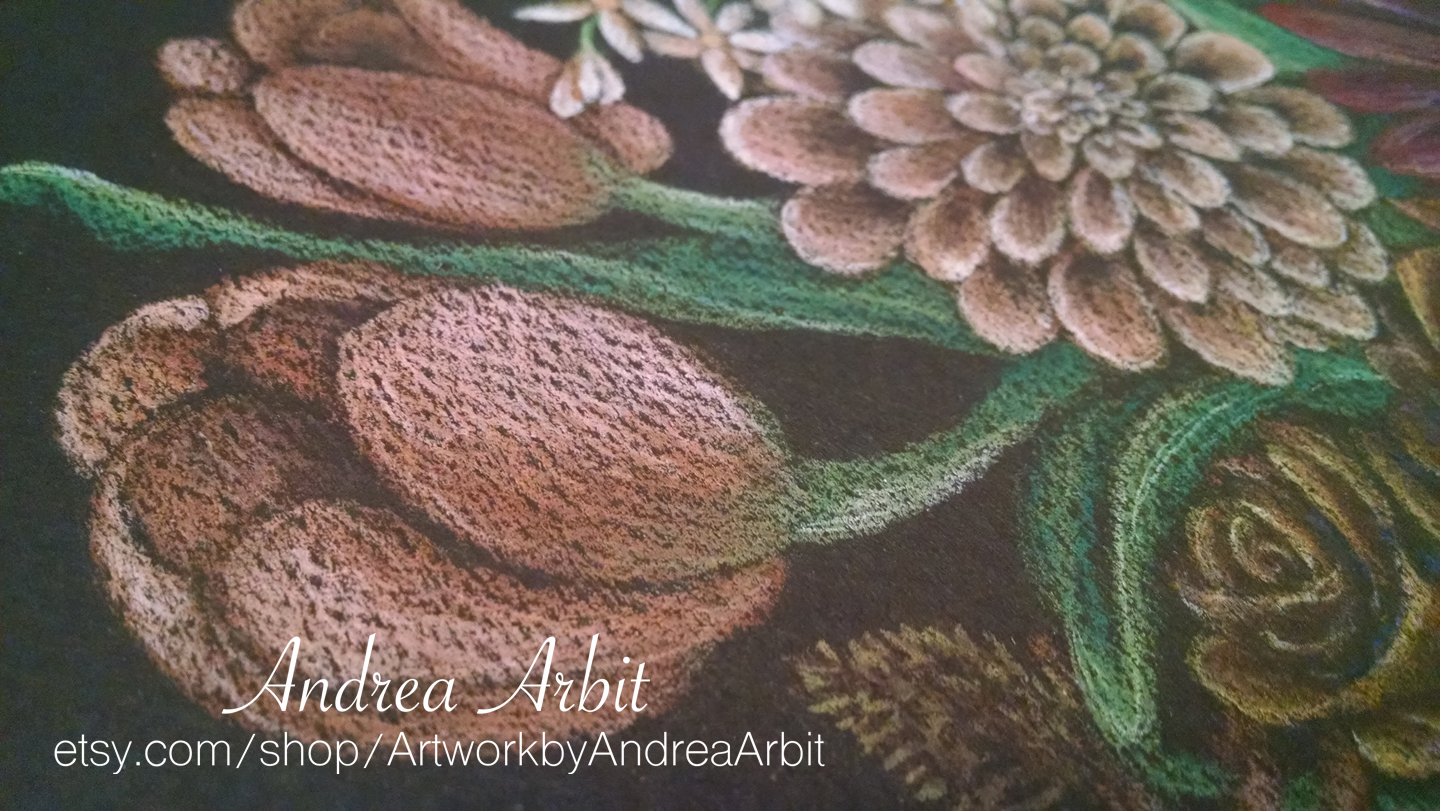
And some extreme close-up shots, showing the texture of the paper through the colored pencil:


This is not yet available for sale, but I will probably list it (and the others to-come in this series) in my Etsy shop at the end of the year.

-

To read more about the meaning behind this drawing or the specific symbolism of each flower, visit this blog post.

To see "the making of" photos of this drawing, visit these other blog posts:

  • Preliminary sketches ("In Progress 1")
  • Drawing and lightly coloring in the first 12 flowers ("In Progress 2")
  • Drawing and lightly coloring in the last 12 flowers ("In Progress 3")
  • Adding detail and dimension to the astilbe, cattail, gladiolus, protea, freesia, and amaranthus plants ("In Progress 4")
  • Adding detail and dimension to the gerbera daisy, jasmine, ti leaf, carnations, peony, and chrysanthemums ("In Progress 5")
  • Adding detail and dimension to the tulips, dahlia, orchids, roses, chocolate sunflower, and succulent ("In Progress 6")
  • Adding detail and dimension to the peruvian lilies, coneflowers, asters, hibiscus, lotus, and cherry blossoms ("In Progress 7")